 Netwrck
Surrealism.
The Door for Borrowed Courage
In the Museum of Doors, each corridor exhaled a different kind of courage. The seventh gallery opened onto apologies delivered to stone. The twelfth smelled of burnt orange and opened upon a yellow field where every lost traveler was permitted to ask for directions. Lichen climbed the labels, softening their brass letters.
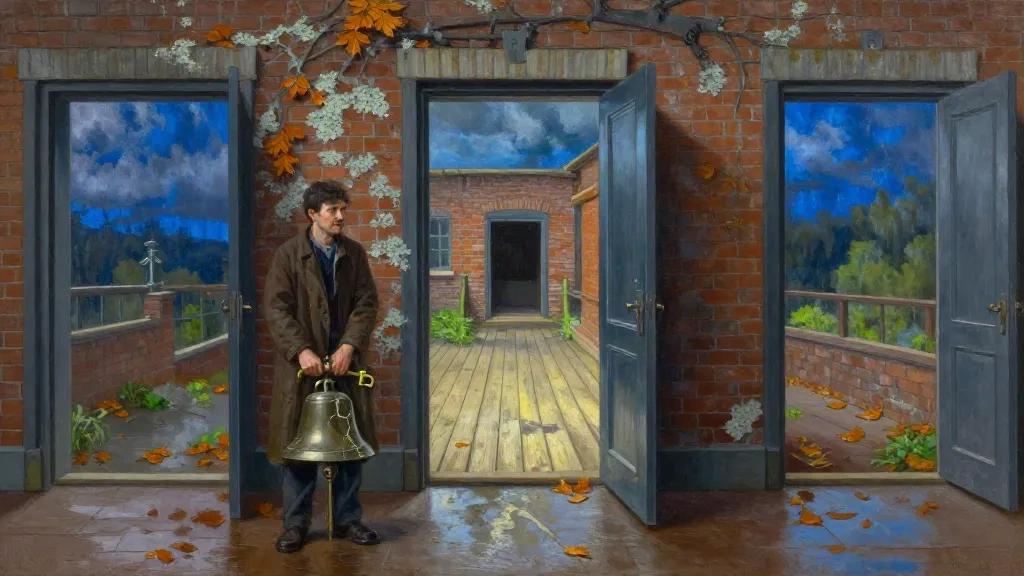
Mara Venn, municipal gardener, visited only the abandoned courtyards behind the museum. That morning she carried pruning shears, a cracked bell inherited from her mother, and the brass key that had opened her family’s kitchen before the backs of its doors were burned black.
Her family had one story for hard weather: during the flood year, Mara’s grandmother sheltered six strangers beneath a false floor. The city records showed only a collapsed wall. The family records showed nothing, but every winter someone left a dry apple on the kitchen threshold.
Mara’s task was simple. Her division maintained six neglected courtyards. She intended to turn one into a shelter and speak the family story aloud so the strangers who came after her would know what the house had once done.
A Machine Against Belief
The museum’s conservator, Bell Aster, met her beside an iron machine shaped like a chapel without a roof. Its crank was connected to a wall of numbered doors.
“This turns descriptions into places,” Bell said. “The courtyard, the flood, the false floor. Give it sufficient disbelief and it will construct them.”
Mara looked at the brass levers. “Sufficient disbelief?”
“Belief locks the mechanism. Every conviction adds a counterweight.”
To test her, Mara rang the cracked bell. Its note entered the metal ribs and came back carrying the smell of rain on hot pavement. Blue storm-light flickered between the numbered doors.
She took the brass key from her pocket. “My grandmother opened the cellar for six people she had never met.”
The machine shuddered. A courtyard appeared in the blank wall: narrow, wet, crowded with bicycles. Faces looked through its leaves. Mara’s certainty warmed the gears, and a red indicator brightened beside the word REFUSED.
She ended the story before the figures could approach.
What the Flood Remembered
For three days Mara returned with altered versions. She said the grandmother was kind because charity was admirable. She said the strangers were victims because pity demanded shelter. Each time, belief tightened the machine’s joints. The courtyard doors appeared painted shut.
On the fourth day, two children found her among the ivy. They asked whether the bell could summon a hungry dog.
“Not hungry dogs,” Mara said. Then she remembered the kitchen ceiling, the rainwater trapped above it, and six sleeping strangers breathing in perfect silence.
She rang the bell and told them the beginning: a wall gone dark, water under the floorboards, grandmother knocking twice with the brass key. She never said why the key worked. She never claimed the strangers thanked her.
The children listened with shining eyes.
“Our work,” Bell called from the gallery, “requires no audience at all.”
Mara handed them the bell. “Then don’t listen to me.”
She showed them the machine’s red counterweight and spoke plainly. “A door made for people who may never arrive is still a door. I want it built, but I don’t know that it will be. I don’t know your story is true. I only know strangers once mattered here.”
She turned the brass key before he could believe the gesture would help.
The Courtyard for Strangers
The bell struck once inside the machine.
Nothing happened.
Mara felt belief return—the first apple on the doorstep, the kitchen rebuilt in her memory, every winter redrawing that single act of courage. The crank would not move.
Then the children carried the bell away. Its cracked note faded down the corridor. One child laughed. The other asked a question neither could answer. Their certainty traveled with them, leaving the machine unsupervised.
Mara released the key.
Every belief she had brought—the story as property, the shelter as reward, the strangers as proof—fell from the machine and struck the floor without sound. The numbered doors swung open at once.
Beyond them stood the neglected courtyard, blue with storm-light. Its walls were built from cracked bricks, orange leaves, and pale green lichen. Inside, strangers sheltered beneath a wooden floor raised above the rain. Among them a child held the cracked bell. An old woman held a key that opened nothing she owned.
Mara entered. The dry floorboards gave beneath her boots.
“This is my family’s story,” she began.
Then she sat down and let the nearest stranger finish it.
By nightfall, seven versions occupied the courtyard. They disagreed about names, weather, and which hand turned the lock. No one needed the story to be true. They needed only a roof, a voice, and room for the next arrival.
Mara planted the brass key in the courtyard’s last empty bed. By spring, it had become a slender tree, its branches chiming faintly whenever blue storm-light shook the leaves.





