 Netwrck
Surrealism.
The Tide Brought a Key
Bracken Quay kept its secrets in the salt line. At low tide, the beach withdrew and revealed a hundred small betrayals: bottle glass, children's teeth, the ribs of boats that had never carried anyone. At high water, the town counted what it had lost.
Mara Venn was the municipal gardener. She wore orange gloves and carried a narrow spade. Her work was to plant stories in neglected courtyards, where brick walls held the weather and weeds grew through the mortar with impeccable civic patience. She would ask a family for a memory, loosen the soil around it, and sow the memory in a place that had forgotten how to hold one.
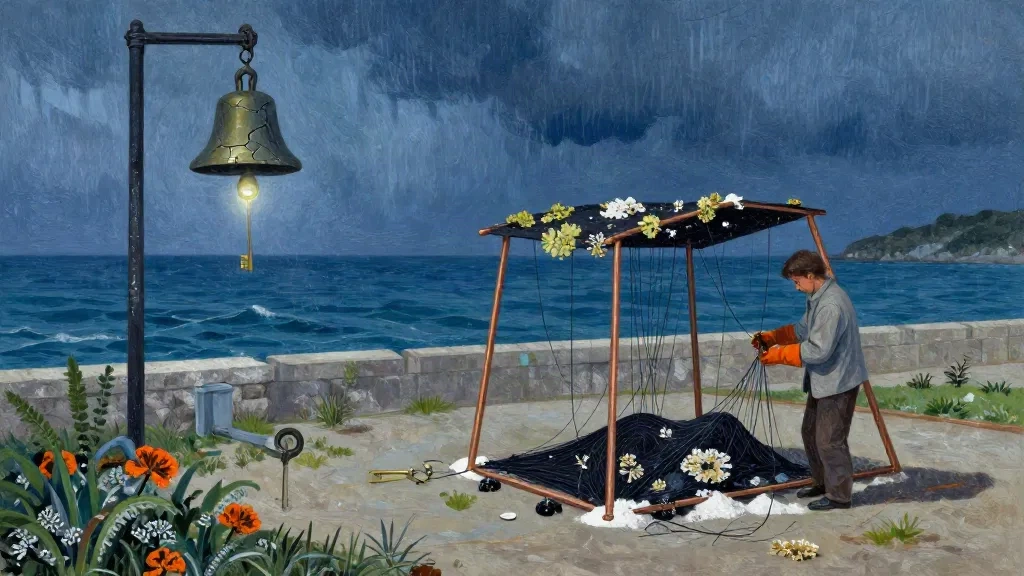
The first returned object was a brass key. It came ashore beneath the seawall, bright as a small sun, while the sky turned the color of a bruise before rain. Mara buried it beside a cracked courtyard fountain.
By midnight, a bell began ringing from beneath the paving stones. It was not a temple bell. It was the cracked bell from the old ferry office, the one whose clapper had been sold, stolen, and finally lost. The bell gave one exhausted note, and Mara's grandmother came running from the house next door.
The Story Without a Roof
“That sound is in my mother's account,” her grandmother said. “She kept the ferry keys after the last boat stopped running. She said one would open a room where nobody had to pay for shelter.”
Mara knew the story. It was thin: a key, a locked room, a promise made in bad weather. She planted it anyway. In the courtyard, the fountain produced a single orange flower. The bell split cleanly down its old crack.
A municipal inspector arrived with a permit form and a skeptical stare. Behind him stood a machine.
It had no visible motor. Six iron legs carried a copper drum, a brass pressure valve, and a spool of black thread. A small window in its chest displayed nothing but reflected sky. The machine had been installed overnight, though the courtyard had been locked for years. Its painted label read: THE SHELTER MACHINE, FOR UNCLAIMED STORIES.
Mara's grandmother tried the key. It did not fit any lock.
“Of course,” said the inspector. “It can't work.”
Every person in the courtyard agreed. The machine was a machine. The story was a story. The key was only a key, the bell only a broken bell, and a courtyard was only a courtyard. Immediately afterward, the machine unfolded its legs.
The Work of Disbelief
It pulled thread from beneath the paving stones. The thread was black, blue, and the color of lichen. It stitched the courtyard wall to the underside of the bell. It stitched the old ferry office to the cracked fountain. It stitched Mara's grandmother's house to the sky.
The inspector recited measurements. The neighbors explained that nothing could be repaired without permits. The children insisted they had seen a roof where there was only air. The machine gained a door, three windows, and a crooked chimney. Each denial made it more complete.
When Mara tried to praise it, the walls collapsed back into rubble. When she called it beautiful, the roof vanished. The machine worked only in the space between certainty and doubt, where a thing could be present without being agreed upon.
Families brought memories from the tide. A drowned wedding ring. A red mitten. A railway ticket softened to gauze. Mara planted them in the courtyard. The machine built rooms around each one: a kitchen for the smell of burnt onions, a hall for a lullaby, a narrow room where strangers could leave their shoes and sit beneath blue storm-light.
By dawn, the shelter stood without walls. Its floor was a mosaic of salt, brass, and lichen. Inside, every stranger found a bed, a bowl of soup, and one object that had returned with the tide.
What the Door Remembered
The brass key remained in Mara's palm. She had planted the family story, but the key had not taken root. At the final high tide, she carried it to the shore.
The machine followed her, ticking softly despite having no motor. The cracked bell swung above it, silent. Mara placed the key at the waterline. The foam drew back.
For one moment, the sea offered her a room. Inside it, her grandmother sat with her mother and a dozen strangers she had never met. They were waiting for the bell to ring.
Mara understood then that a story was not a shelter because it was remembered. It became a shelter when strangers entered without knowing who had left the key.
She stepped into the water. The brass key vanished beneath the blue storm-light. At dawn, the tide brought it back, warm and rusted shut.
In the courtyard, the door remained open. Nobody could explain why. Everyone agreed they had forgotten the lock.





