 Netwrck
Surrealism.
The Whale Behind the Lighthouse
Mara arrived on a bus that had lost its route. The destination board over the driver’s shoulder read 14, and the 14 had been written over so many times the numerals had gone soft as chalk. When the vehicle stopped on a road narrower than the bus, the driver handed her a paper ticket printed with a garden plan: a rectangle, a path, a north arrow pointing down.
“Kilstad,” he said. “Sea version.”
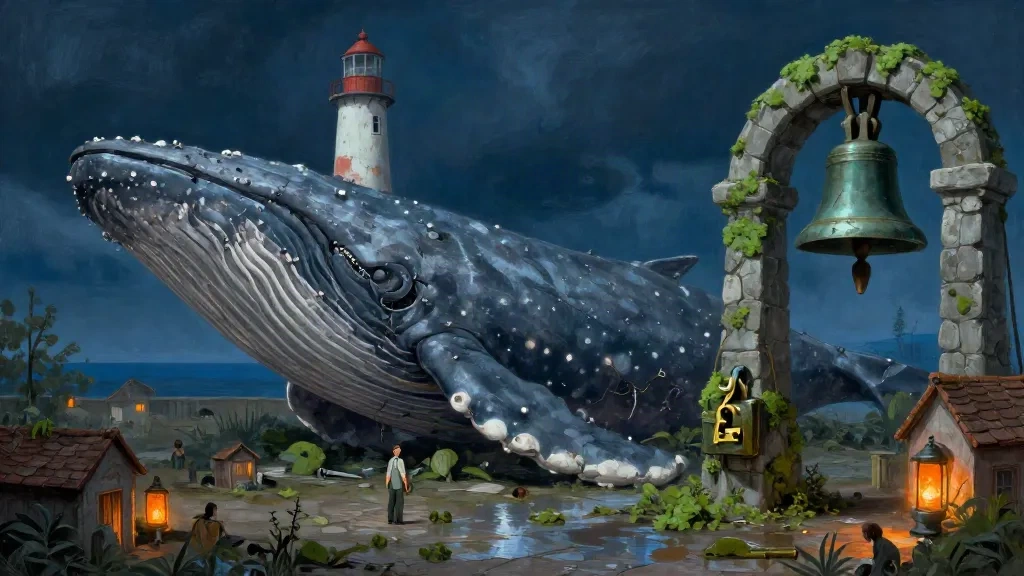
Above the road the sky stood at the color of blued steel, close enough to touch. The sea had folded itself into a hill, and on the hill lay the lighthouse, white and salt-scored, fastened to the back of a sleeping mechanical whale. Its ribs rose and fell under the windows. Every breath made the lantern room lean, though no wind moved in the lichen on the stones.
Mara was a municipal gardener. Her office was two rooms above a hardware store on Torvgatan, between the municipality’s seed depot and a shuttered kiosk. She was employed to plant stories in neglected courtyards. A quarrel preserved in a cracked fountain. A staircase that a house had swallowed after the demolition of its stairwell. A grandmother who had left written instructions for becoming a bird and had not, as far as the records showed, completed the process. Mara carried a trowel, a brass key, and a notebook stained blue with rain.
Her rule, which she had written on the inside cover and underlined twice, was this: a story is a plant. It needs a place, a season, and a person who does not water it.
That morning she had come to prune the courtyard behind the lighthouse. It held broken tiles and the dry husks of last year’s flowers, and at its center a bell without a tower, its surface split by a long crack from lip to waist. A man from the electricity board had climbed it once to photograph the crack and had come down unable to remember his own name. He had told the depot this. The depot had told Mara. Mara had come to see whether the bell was a story that had gone wrong.
The whale opened one brass eye.
A Shelter With No One Inside
“You have brought the wrong season,” it said.
Mara dropped her trowel. “I brought seeds.”
“Seeds are small arguments with the future.” The voice came up through the whale’s ribs and into the courtyard stones, so that Mara felt it in her ankles. “My keeper left a story here. It needs a roof.”
“Where is your keeper?”
The eye turned a few degrees, taking in the tiles, the bell, the wall with no gate. “How many of them are still speaking?”
Mara knew what it meant. Three sisters in a housing estate in Norrsund, in the year the municipality was still demolishing rather than planting. Nour, Sefa, and Ines, who had not spoken to one another for nine weeks after their mother died, and who had stopped speaking to everyone shortly after. Mara had been sent to grow something in the estate’s one surviving courtyard and had planted instead the first sentence of a story about a boy named Ansel, who built a shelter in his family’s abandoned rooms and who gave it doors whenever a stranger came and windows whenever someone tried to leave.
She had written the title on the notebook’s first page and had not written since. The sentences would not come. Every time she reached the part where the boy decides to stay, her hand went elsewhere, and she wrote instead about municipal boundaries, or seed viability, or the correct depth for autumn bulbs, and then she was surprised to be an expert in those things.
“A family’s,” the whale said, when she asked the story’s name. “Everyone leaves the same way. Into a room with the family in it.”
“And if the shelter is not finished? If it has no roof?”
The whale considered this in the way of a building considering weather. “Then it is a courtyard with weather in it. And the weather comes in, and the family comes apart, and the courtyard keeps the shape of a family for a while so that people can stand inside the shape and be looked at.”
“That is the worst architecture I have ever heard.”
“You are a municipal gardener,” the whale said. “You have seen what happens to unpaved ground.”
Behind the bell, half in the tiles, Mara found a machine shaped like a small iron house. It had one lever, one keyhole, and a brass key already turning in the lock, turning with the slow patience of a thing that had been left mid-sentence for a long time. A label was fixed to its side with four rivets and no glue.
THIS MACHINE CONSTRUCTS ONLY IN THE ABSENCE OF BELIEF
“That is a poor arrangement,” Mara said.
“Belief is heavy. It presses roofs downward. Doubt makes space.” The whale’s ribs locked, and the lighthouse steadied. “That is the whole of my instruction. I have repeated it to everyone who came. None of them believed me when I said it, which is the correct response, and none of them survived being right about it either.”
The Machine of Unbelief
Mara believed in the machine. The key stopped turning, sulking. She believed in the whale, and the whale’s eye brightened with something she chose to read as gratitude. She believed in the shelter, and the courtyard filled with a roof so low she had to crawl. The tiles pressed up against her back as she went under it. The roof smelled of wet slate and of the inside of a mouth.
So she began to doubt, and she discovered that doubt, once started, is not a faucet but a floor.
She doubted the machine. She doubted the lighthouse, and the lantern came on in her hand as a warm brass cylinder, which is not a lantern. She doubted the municipal maps, and every map she had ever trusted went soft at the coast. She doubted the diagnosis letter on the third floor of the care home where her father had spent four years being helped into a shape that would hold him, a shape with a roof, and she saw the letter, and it was true, and it was also a story, and she did not know which of those things she could survive. She doubted the whale’s ancestry, which was a long way back through iron and salt. She doubted the stars, which was easy, and the ones that mattered, which was not.
The harder she searched for certainty, the more space appeared around her.
At midnight she put the brass key into the lock and turned it. The machine coughed, twice, like an old man clearing his throat before saying something difficult. A wall grew out of the courtyard’s worst tiles, unspooling with a sound like a rug being beaten. A second wall came from the bell’s cracked edge, and the crack sealed itself as the wall took its material. A third came up out of a door that no one in the courtyard remembered installing, and the door was still in it, still opening and closing politely on nothing.
The family story poured through the gaps. The mother’s kitchen, with its particular smell of burnt milk. The sisters’ quarrels, one of which had been about a window and was therefore fatal. Ansel’s borrowed shelter, room by room, the doors arriving first, then the windows, then the boy standing in the middle of it all with his hands open, refusing to stay in any of the rooms he had built out of his family’s leaving.
Strangers came down the narrow road. They came all night, drawn the way water is drawn. They brought wet coats, paper bags, names that did not fit them. Mara guided them in, and the machine built a room for each one, and then — because doubt is a room and every room wants company — it built a second room for every doubt, and a third for the doubt of the second room.
The Rooms the Doubt Built
By two in the morning the courtyard held more floor than it had at noon. Mara had stopped being able to keep the accounts. Each new person cost her something, and the cost was never the same currency: a childhood address, the name of her first cat, the taste of her mother’s coffee, the reason she had taken the municipal job instead of the boat. She began to lose the professional part of herself first. She could no longer remember the depot’s telephone number. She could no longer remember which ward of the city she lived in, and when a man in a municipal coat asked her, at half past three, which ward she lived in, she gave him a street that ran into the sea on the old maps.
“Mara Reisner,” he said. “Culvert and Retention. I am here about the roof.”
“There is no roof.”
“There is a roof,” Osvald said. He had a clipboard and a flashlight and the terrible gentleness of a man who has spent a career in condemned buildings. “I am required to stand under it and record what falls down. Nobody falls down. That is the problem. I have written four reports and I cannot use one of them.”
“Why not?”
“Because you have withdrawn your address.” He tapped the clipboard without looking at it. “You did it with your hands, in front of me, and then you forgot. The courtyard is not on any plan. I have put it in as a discrepancy. A discrepancy is not a building. I cannot condemn what I cannot find.”
He stood in the road for a while. Then he said, “Somebody is going to have to teach that machine to stop,” and went back up the hill, and Mara took this as the first kindness anyone had shown the place.
The machine was failing. Without belief it had no strength, and every stranger in the courtyard weakened her by one notch, the way a man in a current weakens the swimmer who is holding him up. Rooms built of doubt have doors on both sides and no handle. She saw it happen and understood it too late: a woman in a yellow coat named Viveka was given a room, and a room inside the room, and a corridor, and the corridor could not be locked, and the woman sat down in the corridor and said, without raising her voice, that she had not come this far to be permitted.
That was the argument the whale had been making. Permission is what a courtyard gives. Shelter is what a house gives. She had promised a stranger a shelter and had delivered a courtyard.
The Roof Became a Sky
The bell stood at the center of everything with its crack like a held breath.
Mara looked up at the whale, at the belly of it, at the blue storm-light collecting under it, and she asked the question she had been circling since the first minute on the narrow road.
“Ilse Rand,” she said. “Your keeper. The archive has her books. She is why I write the way I write. Where is she?”
The whale was quiet for long enough that the lantern room swayed twice.
“I have been the shelter for a long time,” it said.
Mara put her hand flat on the tiles. They were warm, and they had a grain in them, long grain, like wood.
“Then what have I been arguing with?”
“A house and a whale are the same word when they are hungry.” The voice was almost gentle. “I did not bring you here to build a home. There is no version of a home. There is a version of a place where people are allowed to be nobody’s responsibility, and that is a colder thing, and it does not have a roof.”
“You said it needed a roof.”
“My keeper needed a roof. I have repeated it for forty years because it is the only sentence I am certain of, and certainty is the opposite of what this place eats. I am sorry. You came with a trowel.”
Mara understood then that she had been offered the truth as an apology, which is a municipal courtesy as much as a monstrous one, and that she was going to accept it, and that the two facts would have to live on the same page.
She rang the cracked bell.
No sound came out. The machine stopped mid-turn, its walls half-grown, its lever pointing at nothing. Every machine in the place went quiet, and in the quiet Mara could hear the crowd she had made: forty people breathing in rooms that would not hold, a woman in a yellow coat refusing to be permitted, a boy of about nine eating an orange with the peel still on, an old man selling nothing, three sisters who had not spoken to each other since a courtyard in Norrsund.
“What do you want?” she asked the whale.
“I want strangers.”
“They are here. You could have said that an hour ago.”
“An hour ago you were still certain.”
She had been certain of so many useless things. The department was efficient. Grief was a private matter. A sentence must be finished to count. Her father had been helped into a shape and the shape had held him and she had called that love, and it had been, and it had not been, and the machine had eaten the difference and left her the room where the difference used to be.
So Mara struck the bell again, this time without expecting it to ring, the way you knock on a door you already know is open.
The note went out through the courtyard, through the tiles, up through the whale’s ribs, along the gallery, into the lantern. It did not carry far. It did not need to. Every machine in the place turned over at once.
The walls became doors. The doors became windows. The windows came open onto the blue storm, and the low roof Mara had made by believing in it lifted, folded, and went out like a held breath, and the rain that had been falling through the shelter without wetting anything stopped falling, because there was nothing left between the rooms and the sky. The shelter held. It held the way a hand holds: openly, with nothing closed, the whole of it available, the whole of it revocable.
What the Courtyard Kept
Viveka got up out of the corridor and went to look at the sea, and then she came back and sat down in a different doorway, and Mara understood that this was the whole of the difference between a house and a courtyard, and that it was not nothing, and that it was not enough, and that no available thing has ever been enough.
Two people left before morning. One of them was a man who had come from a town two hundred kilometers inland and had said so, at length, to anyone who stood still, and who now said it to no one, and went. The boy with the orange fell asleep in a doorway with his shoes off. The old man with nothing to sell was asked, by the three sisters, whether he had a story.
“No,” he said. “I have a place, though. That is the same thing with the roof taken off.”
Nour laughed first. It was the first sound any of the three had made in Norrsund that the depot would later record, carefully, as an event in the garden record.
Mara did not stay to see whether the courtyard survived. She went out through the gap where a wall had been in the morning and stood on the narrow road while the first bus of the day came up the coast, its destination board corrected now, the 14 restored to itself, the numerals hard again. The driver looked at her and then at the whale, and asked, not unkindly, whether she was coming.
She said no, and then she said yes, and got on, and the ticket came off the same roll, the same rectangle, the same path, the same north arrow pointing down.
On the coast the depot had filed her absence as a hardship. Her father's room at the care home was still empty of any story; she had a sheaf of paper on it, the depth for autumn bulbs, and the letter, and she had not decided what the room was for, which was the first honest thing about the room in four years. She wrote in the blue-stained notebook, on the last page, one line and no more: A house that borrows its shape must learn to hold still. And she left it there, unfinishing it, which is not the same as leaving it alone.
The whale dreamed that night of gardens on hills it had never been to, and the lighthouse kept watch over all of them, and over the one below, where the roof was gone and the bell had cracked and forty people were finding out, one doorway at a time, what it is to be warm in the open air.
Behind her, the cracked bell rang once for every person who stayed, and once, a little later and thinner, for everyone who left.





