 Netwrck
Surrealism.
The Monastery Without an Hour
At the edge of a country whose rivers changed their names before anyone could write them down stood the Monastery of Unkept Hours. Its monks repaired clocks without winding them, polished bells without hanging them, and measured rain by the number of puddles that vanished.
There was no reliable time there. Dawn might arrive twice. A visitor could leave before entering. The monastery kept its hours in a cellar, where they were stored in jars and occasionally mistaken for preserves.
Every morning, Mara Venn crossed the salt road with her municipal pruning shears and a sack of seeds. She was the gardener of neglected courtyards, planting stories wherever the stones had forgotten what they were for.
Her stories were not written down. She spoke them into the soil, pressed them beneath a brick, or left them humming inside a broken irrigation pipe. In return, the courtyards gave her shelter: a fig tree, a bench, a cool room where no one had to explain themselves.
That summer, Mara carried a different burden. Her sister had sent her the family story before the old house was sold.
Our grandmother opened the western door during an earthquake. The house did not fall. It opened onto a room where the lost things were waiting.Mara wanted to plant that story in the monastery’s most neglected courtyard. If it took root, the courtyard might become a shelter for strangers. Travelers who had nowhere to go could sleep there without names, debts, or correct answers.
The Machine in the Lichen
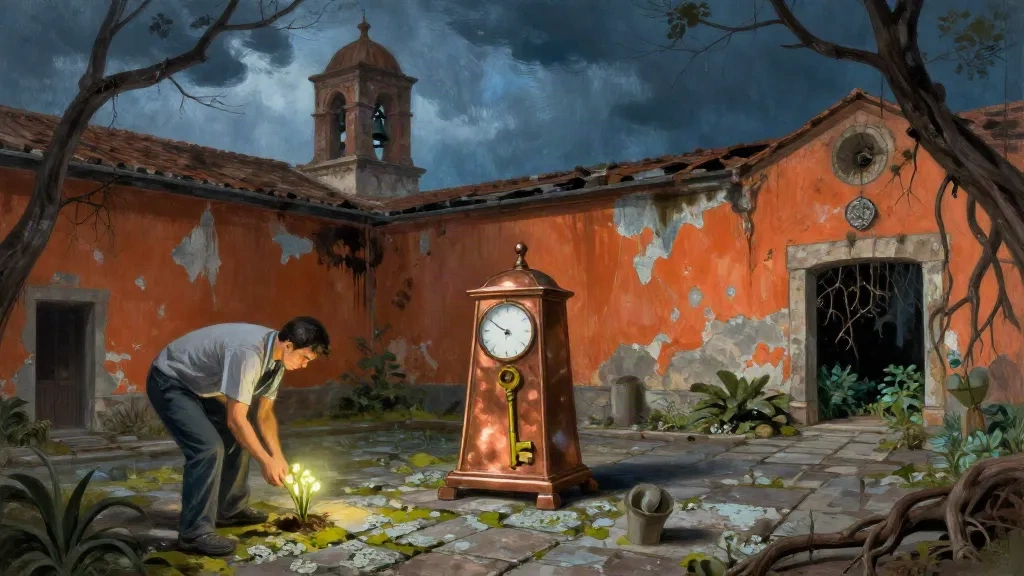
The courtyard lay behind the bell tower, where burnt orange paint peeled from the walls and lichen spread across the paving stones in green constellations. At its center stood a squat machine of copper and black wood, surrounded by a ring of white sand.
The monks called it the Unbeliever. It was said to repair a lost thing, but only while nobody believed it could. The moment someone trusted the machine, its needle stopped moving and its little brass key turned uselessly in the lock.
So Mara worked by doubt. She told the monks she had no faith in the machine. She mocked its useless gears. Twice she pretended to leave the courtyard.
On the third evening, the cracked bell in the tower rang by itself. The sound was not loud. It seemed to come from inside the walls, from the underground room where the monastery kept its stolen hours.
Mara followed the sound through a door she had not noticed. Inside lay a workshop filled with unfinished mechanisms. Clocks ticked behind locked doors. Brass keys floated in bowls of rainwater. A small clock on the wall showed a different date for every eye that looked at it.
On the workbench lay a machine shaped like an open door. Its face was blank except for a tiny painted house, burned orange by age.
A Door That Refused
The machine accepted the family story only in pieces. Mara fed it the earthquake, then the western door, then the room of lost things. Each time, the machine emitted a dry click. Each time, she felt a desire to leave.
She remembered her grandmother’s hands on the latch. She remembered the way the house had looked afterward: ordinary, sunlit, and empty. Family stories were often only doors people kept locked because the room beyond frightened them.
When Mara tried to plant the final piece—the promise that the room sheltered everyone—the machine stopped.
The monks arrived. Someone had seen the painted house. Someone else had heard the bell. Their certainty moved through the courtyard like wind over dry grass.
The Unbeliever’s needle sank to zero. Its brass key emerged from the lock, cold and slightly bent.
“Then it cannot shelter anyone,” said the prior.
“It can if they choose not to believe it,” Mara said.
So she asked the strangers sleeping beneath the arcade to repeat the family story in unison, each voice disagreeing with the others. The beggar said there had been no room. The merchant said the earthquake had been a door closing. The child said lost things were only things nobody had looked for properly.
The story cracked open. Mara took the brass key and fitted it to the machine’s blank face. She turned it while the courtyard filled with blue storm-light.
What Grew Without Certainty
The wall did not become a door. That was the first sign it had worked.
Instead, the paving stones loosened, revealing a narrow garden beneath the monastery. Roots crossed the underground chamber, carrying branches, leaves, small doors, and pieces of furniture from houses that no longer existed. The lost things were there, but they were not waiting. They were growing.
Travelers came from the country with no reliable time. They slept beneath branches heavy with names they had abandoned. In the morning, the storm-light had lifted, and every courtyard path led to a different shelter.
The cracked bell remained in the tower. Whenever it rang, nobody could agree on the hour. The monks stopped repairing that.
Mara kept the brass key in her pocket, though the machine no longer needed it. Once a year, when the lichen grew thick over the western wall, she planted one new sentence there.
Usually it was only this: You may remain.
By the next morning, there was always another place for a stranger to sit.





