 Netwrck
Magical Realism.
Below the First Floor
By midnight, the market had lowered itself into the city’s empty foundations. Lanterns floated above stalls selling bottled rain, second-hand constellations, and noodles woven from someone else’s childhood. Above, the city stopped at the first floor. Its offices ended in clean brick. Its houses ended in locked doors. Beneath them, narrow passages stitched the old foundations together, and the market went on in pearl-colored light.
Ilma Venn carried a silver trowel, a watering can, and the municipal gardener’s brass badge. Her work was neglected courtyards. When a courtyard had been forgotten by its owners, she planted something in it: a chestnut from a demolished avenue, a jar of seeds labeled forgiving lilies, or a story someone had carried too far.
Stories required more water than plants. They wilted under suspicion and thrived when spoken plainly.
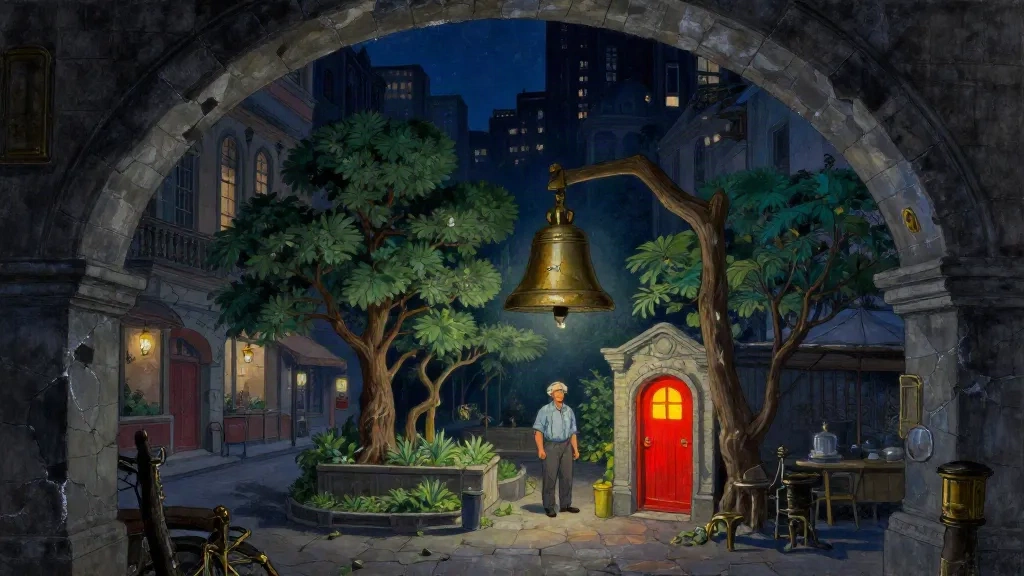
At the market’s western gate, she found the courtyard her grandmother had left her. A cracked bell hung above its empty well. A brass key rested on the sill, warm despite the night.
“Not a request,” said the market keeper from behind a curtain of blue scarves. “An inheritance.”
Ilma turned the key. It did not open a door. It opened her grandmother’s story.
The Machine for Unbelief
The story began with a red door.
Ilma’s grandmother had once sheltered a lost railway clerk in this courtyard. She had fed him, hidden him from the census takers, and given him the key to the cellar. At dawn he vanished, leaving only the bell cracked by the thunder that followed his arrival.
“A shelter for strangers,” Ilma said, placing the key on the cracked bell. “That’s what you meant.”
She planted the story in the courtyard’s cracked soil. By morning, bricks had lifted themselves from the wall, making a room behind the red door. Inside waited a cot, a kettle, and a machine shaped like a metal beetle.
The market keeper explained its purpose. It converted belief into shelter. A person need only say, “I believe this place can help me,” and the beetle would unfold a roof, summon bedding, and provide a key to every locked room in the city.
Ilma tried the machine. Nothing happened.
She adjusted its brass gears. The machine remained silent.
She spoke loudly about its purpose. Its legs folded inward.
“It works only when nobody believes in it,” the market keeper said.
Ilma stared at the beetle. “That is impossible.”
“Yes,” he said. “Now try again.”
What the Market Believed
Ilma began to test the machine. She told strangers it was broken. She told the vendors it was a vending machine for luck. She posted notices describing it as an experimental municipal ornament.
That night, the beetle clicked awake.
It walked beneath the cot and released a hidden seam in the floor. A second room appeared, then a third, then a stairway descending farther than any foundation should descend. The red door opened onto shelter for a hundred strangers.
But the machine needed more than disbelief. It needed a story large enough to house everyone who came.
People arrived carrying their own burdens: a child who could not sleep, a woman whose family had forgotten her name, a man who kept hearing the bell in abandoned buildings. Ilma planted each account beside the machine. The courtyard grew rooms for their grief, their courage, and the futures they had been denied.
Then the cracks spread.
The machine’s legs bent. Pearl light leaked from its joints. The red door began to close whenever a stranger looked directly at it.
“It is being disbelieved too strongly,” the market keeper warned.
Ilma understood. Hatred, doubt, and despair were also forms of doubt. The machine could not tell the difference.
The Key Under the Bell
At dawn, she climbed onto the well and rang the cracked bell. Its note was thin and imperfect. It sounded over the market, through the foundations, and into every courtyard where the city had refused to remember its people.
Ilma rang it again and again.
“I believe you,” she called, not to the machine but to the courtyard, the key, and every stranger gathered below. “I believe you are not here because you are useful. I believe you are here because someone must not be alone.”
The bell’s crack widened. A red thread of light escaped it and struck the brass key.
Ilma understood the final condition. The machine worked only when nobody believed in it, but the shelter could survive only when someone believed in the people inside it.
She turned the key.
Nothing appeared. Nothing moved.
Then, from beneath the floor, came the sound of a hundred locks opening at once.
The beetle unfolded. The red door swung wide. Shelves filled with warm bread, clean blankets, and handwritten maps of the city’s missing rooms.
By sunrise, the courtyard had vanished beneath a market of its own. The old machine sat at its center, rusting politely, while strangers carried stories between the trees.
Whenever someone asked who had made the shelter possible, Ilma pointed to the bell, the key, or the red door.
“Nobody,” she said. “Everybody helped.”





