 Netwrck
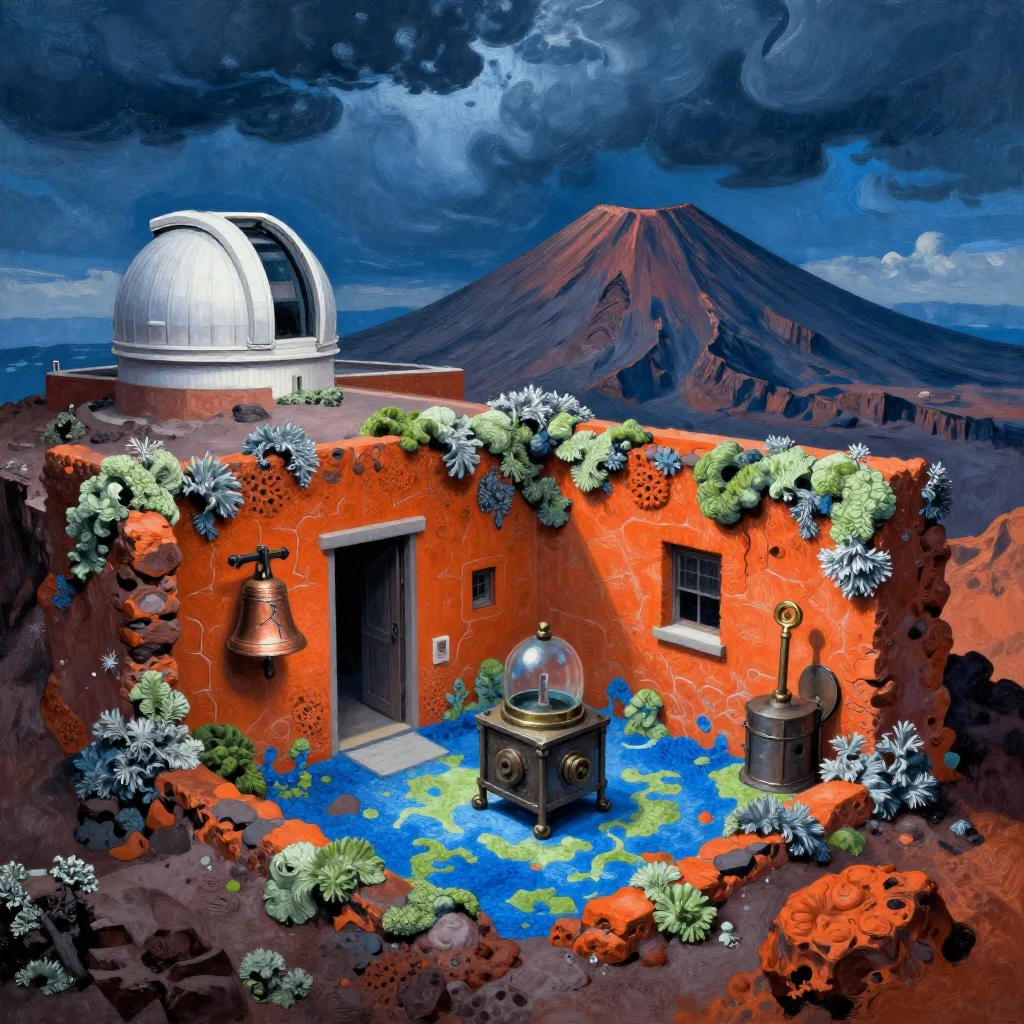
Surrealism.
Planting in the Ash
Mira had been appointed municipal gardener of Caldera Ridge for eleven years, though the title described a woman paid to prevent the mountain from swallowing its own history. She tended the old observatory’s heat gardens: stone beds of silver lichen, iron moss, and a blue sedge that leaned toward storms before they arrived. The summit slept beneath them, its crater filled with a red mineral haze that smelled of burnt oranges and struck matches.
The neglect was on the eastern side, where a courtyard had once served astronomers’ families. Black basalt steps climbed toward apartments sealed with tin shutters. Their owners had gone when the observatory shifted from stars to underground instruments. Their weeds remained.
Mira worked there every fourth afternoon, carrying stories in her pockets. A story was a seed with a difficult shell. You pressed it into a neglected place and waited for it to decide what kind of building it wanted to become.
Her own family story was a cracked copper bell, found in the basement of her childhood house. In Mira’s childhood, her mother had rung it whenever the sea was rough. No one agreed on what it announced. Her father said danger. Her grandmother said arrival. Mira said only that the house needed reminding.
She carried the bell to the courtyard in a box lined with blue storm-light-colored cloth. The bell did not ring. It had not rung for years.
At the center of the courtyard waited a machine.
The Unbelieving Engine
It was a squat iron instrument with a glass dome, three brass wheels, and a keyway shaped like a flame. No plaque identified it. A cloth label tied to its handle read: OPERATES AT THE MOMENT CONSENSUS IS ABSENT.
Mira had found the machine in the same abandoned apartments. She had expected it to build walls. Instead, it accepted a story through a narrow slot and returned a handful of dry soil.
“That is not a shelter,” she told it.
The machine clicked once.
She placed the soil in the courtyard’s largest bed. The next morning, a small tree stood there, each leaf carrying a line of handwriting. The first leaf said: My mother left a blue cup in the dishwasher. The second said: We heard her key before we saw her. The third said: The storm was speaking to us.
People came to read the tree. They photographed it. They said the story clearly belonged to a family, and the family’s story should have a proper place. A sign appeared: FAMILY ARCHIVE. PRIVATE PROPERTY. NO ADMISSION.
The tree folded shut.
Mira understood then. The machine had not failed. Their confidence had sealed it.
So she began to doubt aloud. She said the writing might be nonsense. She said the courtyard might be ugly. She said a shelter built from a stranger’s memory could easily become a trap. She insulted the soil. She insulted the bell. She called the machine a metal coat hanger.
Under cover of night, the courtyard filled with narrow doorways.
A Roof for the Uncertain
The doorways led nowhere and everywhere. Through one, Mira saw a woman wringing a sheet in blue light. Through another, a boy listening beneath a staircase. Through a third, her mother, older and standing in a kitchen she had never seen.
The brass key appeared in the machine’s keyway.
Mira did not touch it. If she believed it was the key, it would vanish. If she believed it was bait, it might also vanish. She sat with the machine and admitted that she was afraid.
“I want a place where people can leave what they cannot carry,” she said. “I want my family’s story to shelter them. But I cannot make strangers safe by pretending they owe us a story.”
At dawn, she used the cracked bell as a wedge against the key. The metal machine groaned. Its glass dome filled with a miniature storm, blue lightning moving beneath the glass. One turn of the wheel made a roof. Another made windows. A third made three empty beds.
The courtyard became a shelter, and the shelter remained absurd: a roof of storm-light balanced on coral walls, a floor covered in blue moss, and a door that opened only when no one had decided whether it should.
Strangers came.
They brought the memory of a key turning in a wall no one could find. The story of a bell rung under snow. A recipe written on the back of a train ticket. The shelter received them without deciding what they meant.
What the Mountain Kept
By winter, Caldera Ridge had stopped calling Mira’s work gardening. The observatory board wanted a plaque. The town wanted a story. Even the sleeping volcano had begun to leak a thin line of orange smoke whenever strangers spoke honestly.
Mira refused to let the machine finish.
She left the brass key inside it, unturned, and placed the cracked bell beside the door. Travelers rang the bell before entering. The sound was imperfect, carrying one note off pitch. It reminded the mountain that a shelter was not the same as a monument.
On the last evening, Mira climbed above the roof and watched blue storm-light gather over the crater. Her mother’s key lay warm in her palm. She did not know which door it opened. She no longer needed to.
Below her, the courtyard breathed in and out. One stranger arrived. Another departed. Between them, the machine worked without belief, shelter without ownership, and the cracked bell answered from underground.
Mira planted one more story in the ash: a traveler who had arrived with nothing, and a house that had chosen to expect them.





