 Netwrck
The Unfinished Weather
Every apartment in Morrow House remembered the future, though the residents called it remembering because the truth was harder to furnish. In the lifts, announcements arrived a half-second before anyone spoke them, so that people nodded along to sentences they had not yet earned. In the kitchens, alarms sounded at four in the morning for fires that would not happen until February. At night the windows showed blue weather from tomorrow — a slow procession of rain over rooftops that were not yet built — and the people inside slept beneath yesterday’s blankets, sweating.
Iona Vale was the municipal gardener. She carried a narrow trowel, a brass watering can with a dented spout, and a ledger of courtyards the city had abandoned: a list, forty-one entries, of lots where no one had planted anything for longer than the memory of the department that owned them. Her work was not planting flowers. It was planting stories. She knelt beside broken drains and turned over soil darkened by too many remembered futures, looking for the one that had not yet been spent, and she could tell the difference by smell — a used future smells of hot metal and old bread; an unspent one smells of wet stone and nothing at all.
The work cost. Everyone in the department knew the arithmetic and nobody said it aloud, the way people in kitchens will not say what is in the flour. A story needed a future to root into. A future was made of someone’s hours. Iona had learned to take them in small change: a birthday she would have had with her brother, a particular Thursday in a kitchen with a blue kettle. She paid. The courtyard grew. The ledger recorded only the lot number and the date, never the payment, because a record of payment is a receipt and the department was very careful about receipts.
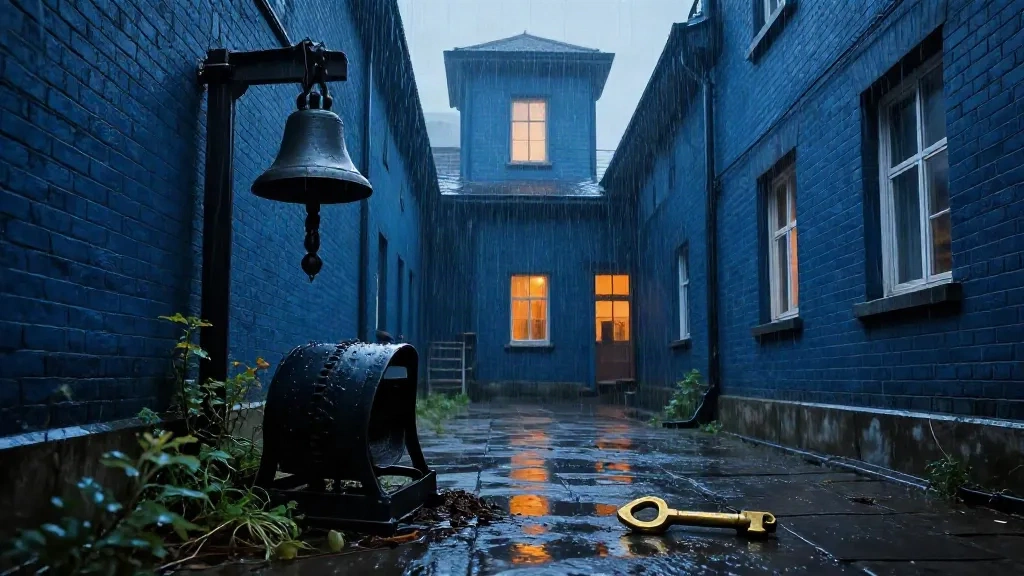
Lot 7 had been empty nineteen years. Its courtyard was walled in rain-silver brick, and the only warm color in a quarter of grey was an amber window in the tower above it, lit at all hours by a tenant who paid nothing and explained nothing. The registry said the courtyard belonged to the Fen family, who had lived there before the building began remembering forward, and who had left no furniture, no forwarding address, and no person willing to be traced.
At the gate she found a cracked bell suspended from a rusted arch. No hand had rung it in nineteen years. When she laid two fingers to the clapper it trembled, and in the metal she felt the future sound of rain on a roof she had not built yet. Inside, beneath a season of weeds, a child’s story waited to be dug up.
The Story No One Believed
It began with a girl who carried a brass key wherever she went. She never opened a door with it. She put it under her tongue, and she promised that every lost traveler could sleep in her family’s house, and that they would not be asked where they had come from, because a question is a door too.
Iona had the girl’s words in the building registry, copied in a clerk’s careful hand, and then struck through in three other hands by three different officials across two decades. Beneath the crossings, where rainwater had run, one sentence showed through like a bruise:
Belief is not required. Only arrival.
That was the whole of it. No refusal explained why the Fens had gone. No permit explained why the amber window burned. Iona had read the entry forty times and it never improved, and she understood — with the dull certainty of a woman who has read enough ledgers — that the three men who crossed the story out did not think it untrue. They thought it unadministrable. A story that shelters anyone is a story with no headcount, and a headcount is the only thing the city can count on.
She planted it anyway. She shaped the soil into a low mound, set the cracked bell into the earth beside it, and hung the amber light from a branch that had never grown but held the light as though it had always been there. Then she waited, because planting a story is ninety-nine parts waiting and one part panic.
A man appeared at the gate with a suitcase he did not know how he had packed. He said he was looking for his sister, though he had never met one; the sentence embarrassed him and he said it anyway, which Iona had learned to respect. A woman came in with a wet coat and no destination, still wringing it. A boy followed, holding a brass key that trembled in his closed fist like something alive and cold.
They stood around the mound and laughed. Not cruelly — worse, tiredly, the way people laugh when a thing is too earnest to survive.
“There is no house,” the man said.
“There is no family,” the woman said.
“There is no story,” the boy said, and he said it kindly, which is what made it fatal.
The courtyard collapsed inward. Walls folded along their seams into doors and then into nothing. The cracked bell fell silent and went still in the weeds. The amber window went out, and the three strangers were gone before reaching the gate, not vanishing so much as unmade. Iona caught the boy’s key as it dropped. It was a scrap of cold metal with a milled edge, brass-plated steel, the kind issued to a machine that has been out of service since before the building remembered anything at all.
Arrival Without Proof
She came back after midnight with a lantern she did not put out. The machine stood at the courtyard’s center, half-buried, and it had not been there in the daylight. It was an old municipal device for planting stories: a black iron seed drill with a glass chamber at its heart, no label, no municipal inventory number, a hand crank removed and its square socket left open. Cold came off it like cellar air. When she set the scrap of key into the socket it turned a quarter-turn and stopped, a door opening onto a locked room.
She put her hand on the cracked bell. The fracture in it shone with a thin line of silver, and from somewhere overhead came the sound of rain arriving on a roof three days from now. Still nothing. She tried the key again. Still nothing. She understood, then, what the three refusals had been for, and she felt the old anger rise — because the mechanism did not need faith, and every official who had crossed the story out had assumed it did, and had been wrong in a way that cost a family nineteen years.
The man came back first. He had remembered, in a dream he declined to describe, a bed waiting for him, and he could not say who had made it. The woman brought the wet coat back, folded carefully over one arm, and would not say why. The boy held out the key.
“I don’t believe in stories,” he said. It was an offer, a dare, a thing he wanted very much to be told he was wrong about.
“Good,” Iona said. “Do you believe in shelter?”
He looked at the empty courtyard for a long time. The man took the key from him and turned it. The woman touched the gate, once, with two fingers, the way you touch a wall to check whether it is real.
Nothing miraculous occurred. The machine simply turned once, the way a well crank turns.
Its glass chamber filled with a warm amber glow, and a narrow path surfaced under the weeds, and doors opened in the wall where there had been no doors, and the cracked bell gave one clear note that went out across the district and was heard, later, by people who had no explanation for it. Strangers came in, carrying the luggage of lives they had not yet lived. Iona did not stop them. She stood aside and let them in, and she was careful, afterward, never to describe it as magic.
The rule, once understood, was simple and terrible: the machine worked only while nobody believed in it. The instant the boy smiled at the shelter he had found — a real smile, wet at the corners, the first unguarded thing he had done in Iona’s presence — the gears stopped with a sound like a fist closing. Still, the doors remained. The path remained. Twelve beds, a communal table, a stove that somebody’s hands had already been warming by, and a narrow garden of silver leaves. The family’s story had become timber and roof without once becoming a miracle.
The Cost of Timber
The payment came due on the third night, and Iona did not notice until it had already been taken.
She went to the ledger to enter the date and found she could not remember the first entry — the earliest lot, the one she had learned on, a courtyard in the Halvers district with a fig tree growing sideways out of a wall. She knew the number and the street and nothing else: no fig tree, no wall, no summer. She sat on the step of her own flat with the ledger open on her knees and found she could not remember the blue kettle either. Not the shape of it. Not that it had belonged to anyone she loved. There was a gap in her life shaped like a kitchen, smooth as a pulled tooth, and on its edges the small bright pain of a word on the tip of her tongue.
She went back the next night and wrote it down anyway, because the alternative was to lie about a place that was still standing. Then she went to the Fens’ entry and found another change. The clerk’s hand was still there, the struck-through story was still there, but the three refusals had become two, and the sentence in the rainwater had thinned. Every shelter she grew cost the family its evidence. The Fens were being spent down into timber and roof the way she was being spent down into a life with smooth places in it, and the arithmetic was not fair, because the city got a shelter out of it and she got a kitchen she could no longer dream about.
The inspector arrived at dawn on the fourth day with a refusal form, and he was right, which Iona had not expected and would go on thinking about for years.
He stood inside the gate and read the form aloud in the flat voice of a man reciting the reasons the law exists. No traced family held the lease. No future had been authorized under section nine. The walls had no footings below the frost line; the well was story and would fail the moment a health officer asked to see its permit. There were twelve people sleeping in a building that legally did not exist, and if the amber window went out on a Tuesday, every one of them would be trespassing in a structure with no address to trespass at.
“I could sign this tomorrow,” he said, “if there were a name on it.” He looked at the ledger under her arm, then at the stove, where a woman who had arrived with a wet coat and no destination was stirring something for eleven people. “You are asking the department to insure a miracle. Departments are very bad at that.”
“I’m asking you not to,” Iona said. “I never filed.”
That was the crux, and she knew it, and she did not resolve it. She could have withdrawn. She had a supervisor and a pension and a form for voluntary decommissioning, and the boy would have been found and returned to whatever address had failed to produce him, and nobody would have been harmed except her, in the way she had already agreed to be harmed. Instead she said the true thing, which is rarely the useful thing:
“If it’s illegal, it isn’t safe, but it isn’t empty either. You want me to close a place because it has no address. That’s the reasoning that closes everything.”
He did not agree. He also did not write the number on the form. He wrote inspected, non-compliant, no action pending further, which is a bureaucratic sentence with a hinge in it, and he left before he had to decide what he was.
The Future Arrives
By the following dawn the courtyard held twelve beds, a long table scarred by other tables, and a garden of silver leaves that made no shade and no sound in wind. Iona set the cracked bell on the table where everyone could reach it. She laid the brass key beside it, flat, so that no one could be accused of taking it. Then she did the only administrative act left to her, which was to rename the thing in front of witnesses.
“Then let it be a public shelter,” she said. “Lot 7. Address it to the city. Put my name on the occupancy as caretaker and let them send the letter.”
The man with the suitcase wrote Halvers on the registry line, in a hand steadier than his voice, and the woman wrote wet because it was the only word she had for herself that morning, and the boy wrote nothing and did not need to; Iona entered his line as unaccompanied, no belief, admitted, and the phrase went into the city record where the three old refusals sat, and it was, she thought, the first sentence anyone had ever entered in that ledger that the ledger could not strike out, because it was not a story. It was an observation. It had been checked.
That evening the amber window lit above the gate, and in every room someone remembered arriving. The boy, who had not slept a whole night anywhere in a year, slept until noon the next day and left no name behind, which Iona recorded, correctly, as a fact about a person and not a fact about a miracle. The machine stood where it had always stood, buried to its chamber, waiting for the next person who did not believe in it to turn the key. She did not tell them that, and she did not stop them from finding it, and if you think she should have, go and sleep in a street for a month and come back and tell me about belief.
What the Courtyard Kept
Lot 7 stayed open. That is not a metaphor, and it is not a happy ending; it simply did not close, because the city could not prove a negative about a building it had no address for, and because the letters came, and Iona answered every one of them, and because a department that is bad at insuring miracles is very good at processing paperwork at length.
What she paid kept accruing. By the second winter she had lost the fig tree, the blue kettle, and a song her brother used to sing badly; the ledger was becoming a map of absences with a woman standing at the edge of each one, holding a trowel. The Fens were down to a single line of clerk’s hand and a sentence thin as breath. She mourned them properly, in the only way available: by keeping the courtyard warm and by writing their entry in her own hand for the first time, so that when the last trace was gone there would at least be a woman’s account of a girl with a brass key under her tongue who promised that no lost traveler would be asked where they had come from.
And once a month, late, after the last stranger was asleep, Iona walked out to the machine, put her hand on the cracked bell, and felt the rain coming in on a roof three days ahead. She never asked what the roof was for. She had spent a kitchen and a fig tree and a bad song on the answers to questions like that, and she had learned the only rule that mattered for a woman who spends other people’s futures: do not look too closely at what you have bought until the bill is settled.





