 Netwrck
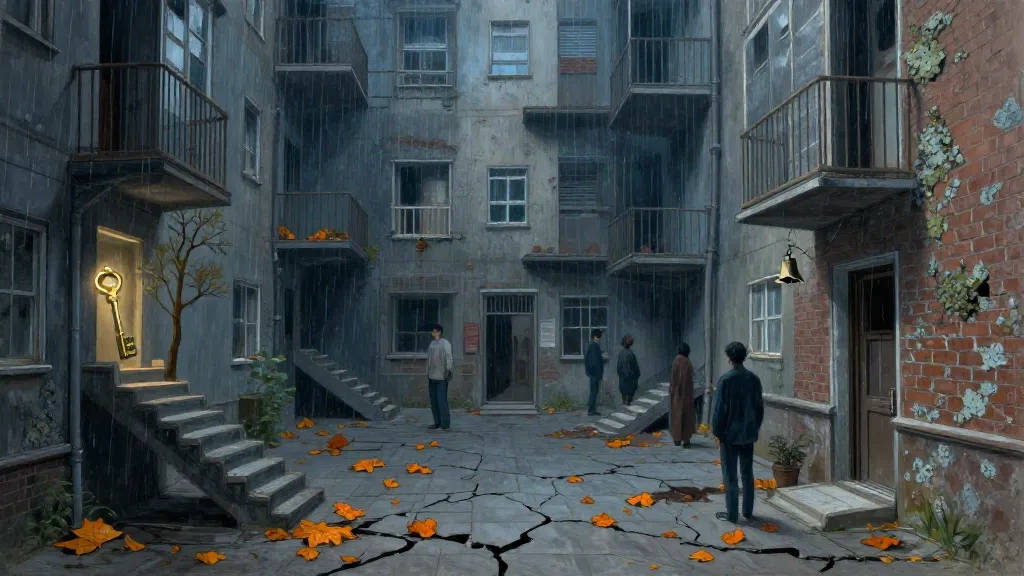
Surrealism.
The Memory of Unbuilt Rooms
On the ninth floor of the Ardent Apartments, every window faced tomorrow. The residents could remember breakfast they had not eaten, reunions they had not earned, and the exact expressions of people who had not yet been born. They never remembered childhood, birthdays, or the names of their mothers. Their memories arrived wearing blue storm-light and left without saying goodbye.
Below them, neglected courtyards waited beneath nets of dead vines. Mara was the municipal gardener, though no living plant could survive the residents’ collective forgetting. She carried a trowel made from an old survey marker and planted stories instead: a widow’s lie about rain, a baker’s dream of flying, a child’s imaginary dog who guarded forgotten stairwells.
Her own family story had been reduced to one object in a locked drawer: a brass key with a crooked bow. Her mother had left it behind when she moved into the future, saying, “When you need a shelter, open the place that is not there.”
Mara had spent years tending other people’s histories. She wanted to turn that one family story into a shelter for strangers.
A Machine Against Belief
The neglected courtyard beside the boiler room had no address. The city map showed a ventilation shaft; the residents remembered a swimming pool. Between the two descriptions stood a machine made of copper pipes and blue enamel, with a lever shaped like a question mark.
The machine’s notice read: THIS DEVICE PRODUCES A SHELTER ONLY WHEN NOBODY BELIEVES IN IT.
Mara fed it the story of her mother, a brass key, and a woman who kept returning to a courtyard where strangers slept beneath orange leaves. The machine shuddered. No shelter appeared.
Believers gathered. A widowed engineer placed his palm on the copper. A nurse promised it was a municipal project. Someone from the ninth floor insisted the courtyard had always been a refuge. The lever refused to move.
So Mara told them the truth: the machine was useless, the courtyard was empty, and the family story was only a key in a drawer.
The moment they stopped believing, the machine turned itself.
Rooms Made from Doubt
Under the courtyard, rooms unfolded in reverse. A narrow hallway became a kitchen, then a nursery, then a shelter with twelve cots and a stove that burned without fuel. Its walls were made of unfinished plans: a child’s red coat, a bus route erased from every map, a stranger’s handwritten apology. The windows looked out onto blue storm-light.
The cracked bell above the door rang once. Nobody answered. It rang again, and the shelter’s walls thickened with the sound. Mara understood that doubt was not emptiness. It was space left for other people to enter.
But the machine had opened only one room. The family story was being divided among everyone who doubted it, thinning its walls, scattering its shelter into half-believed corners. The brass key grew warm in Mara’s pocket.
She climbed onto the machine and shattered the question-mark lever. The shelter shuddered. A thousand private stories poured through the new breach: a man promising to return, a girl describing a sea, an old woman calling a name she could not remember. The courtyard filled with strangers and the particular silence of people afraid to be sent away.
The Key Under Tomorrow
By morning, the residents remembered everything they had forgotten. Mara’s mother came back with a dry throat and an apology. The nine thousand windows remembered rain. The machine was gone, leaving only a line of rust across the courtyard stones.
Mara kept the brass key. It no longer opened doors. She planted it beneath a young tree, and every evening its crooked bow turned toward the shelter, catching burnt orange leaves and the first blue flicker of a storm.
Those who entered did so carrying doubts, and those who left returned with questions. In time, the family story became larger by being doubted. The shelter remained because no one could agree on what it was.
And when the cracked bell rang, Mara no longer counted the people who came. She counted the spaces left open.





