 Netwrck
Magical Realism.
The Gardener of Neglected Ground
At four in the morning, while the observatory's brass instruments dreamed of stars, Mara Venn unlocked the courtyard behind the old weather station with a brass key polished by her mother. Above her, the sleeping volcano held one immense midnight-blue breath. Below, the walls rose pearl-gray around a patch of hostile gravel where even hardy saxifrage surrendered.
Mara's municipal title said groundskeeper. Her inherited title, used only by children and dogs, was story-planter. She planted stories in neglected places: her aunt's hospital vigil in a fissure beneath the hospital steps; a ferryman's last lantern in the weeds beside the tram terminus. Given soil, shade, and time, each tale took root. A story rooted in stone made shelter.
She kept a ledger. Left page, the story, the place, the date of planting. Right page, the names.
There were eleven names on the right page now, and only three of the eleven still answered the phone when Mara called to ask what they remembered. The coal miner's story had grown a wall in a cut of hillside and the wall had held a survey team through a thaw season, and the miner himself could no longer recall the year he had worked the seam. The ferryman had forgotten lanterns entirely, in a town that had renamed its harbor after him. This was the price, and Mara had known it since she was nineteen, and she had planted Ida's story anyway, because the eight surviving families in the maintenance terraces were sleeping beneath pearl-colored dust and waking with ash on their tongues.
Since the steam vents failed, they lived in the observatory's maintenance terraces. Children slept under dust. The summit hotel stood empty with its windows boarded in a previous administration. The mountain roads ended at the crater's rim, and the rim had been the end of the world since the eruption of 1962.
Mara's own family had kept only one story. In 1962, Great-grandmother Ida wrapped the observatory's emergency bell in wool and rang it beneath the ash, and thirty-seven workers came home by the sound of it. Everyone remembered Ida. Nobody remembered the bell. There was a photograph of her in the family ledger — a broad woman in a felt coat, squinting, the wool bundle under one arm like a swaddled child — and beneath it, in her mother's careful capitals: she was not afraid, whatever the story says.
Mara had decided, at twenty-three, to plant it and turn it into a shelter for strangers. She had not yet told her mother, who was the clerk who wrote the letters.
The Clause in the Manual
The courtyard's center held a municipal machine called the Civic Bloom. It was a squat iron pavilion with a funnel for a roof, three delivery slots, and a warning painted in bureaucratic red: DO NOT DEMONSTRATE INTENDED FUNCTION.
The operator's manual was forty-one pages and honest in the way of a document that had been edited by committee. Page nine, section four, admitted an impossible condition. The machine converted local memory into usable shelter, but it worked only when nobody involved believed it could. The manual offered no mechanism, no diagram, and one sentence of guidance set in bold: Operator confidence is a load-bearing defect.
Three prior attempts stood in the record, all in the same hand, all initialled by Mara's predecessor, a man named Ostermann who had retired to the coast and taken no telephone.
On the first attempt, the funnel coughed ash. On the second, every delivery slot opened onto the same small room containing one chair. A maintenance worker named Pell climbed in, surprised that the machine had found the correct shelter immediately — a bed, a lamp, the right room — and the pavilion folded flat around him like a fist closing on a coin.
They got him out with a jack and a great deal of noise. Pell lived. Pell did not, afterward, remember his own name, and when the town renamed the maintenance terrace in his honor he stood at the ceremony and applauded politely with everyone else.
On the third, six specialists arrived with permits, spirit levels, and photographic evidence. They stood at a respectful distance and politely believed nothing, and the machine assembled a beautiful arch and refused to complete it, holding the keystone in the funnel's throat all afternoon like a word on the tip of a tongue.
Belief is not an argument here. It is a wall the machine must lean against.
Four Rules for Not Believing
So Mara devised rules. No explanations. No watching. She posted them nowhere, because a posted rule is read.
One: scatter, do not describe. Two: speak a fragment, never the whole. Three: never say the word shelter within the walls. Four: if you catch yourself hoping, go and do something with your hands.
Every morning she crossed the courtyard with a sieve and scattered ash where the gravel was thinnest, and whispered a different piece of Ida to it. The wool. The names of the doors. The sound of the strike traveling through packed ash like a rumor through a crowd. Her mother found her there in June, in her good coat, and stood at the gate for a long moment before saying, Your father is buried in ground like this. And Mara, who had not expected her, said, I know. And her mother said, It held him. And Mara said, That is exactly what I'm afraid of.
None of that was the argument. That came later, on paper. Neighbors complained about machinery noise. The municipality sent six increasingly alarming letters, and then a seventh with a number in the subject line, and the clerk who wrote them was Ilse Venn, who had polished the key for twenty years without being asked and had never once said what it opened.
The letters were not cruel. That was the worst of it. They were procedural, and each one asked, in effect, for Mara to state her intent so that the matter could be resolved. By July she had inspired more skepticism than she had soil.
The Twenty-Second of August
The cracked bell began ringing inside the sealed equipment locker at some hour past midnight, and it did not stop.
The sound was not loud. It was the thin strike of a spoon against a cracked tea cup, but every tool in the courtyard loosened by a fraction of a turn: the sieve, the shovel, the jack they still kept from Pell's rescue, the nuts on the funnel.
Mara found the bell beneath decades of discarded calibration weights. Hairline fractures crossed its bronze like rivers on a map. The locker had been locked. The brass key had been sewn inside her coat since her mother returned it, beneath a patch where the lining had mysteriously come undone — and Ilse Venn, who mended her own hems and did not mend other people's, was a woman who had once, in grief, re-tread an entire winter's worth of shoes because walking was the only argument she trusted.
The crack meant the story had broken. The key meant it could still be opened.
That night she carried the bell out and set it in the gravel. She gave the machine no plan, no measurement, no assurance. She spoke only what she knew, and what she knew was not the version the town told.
Ida had been afraid. The photograph showed it if you looked at the mouth, held slightly open, the face of a woman listening to a sound she was not sure she would survive. The wool had caught fire; that was in the ledger, recorded by a different hand, a line that had been struck through and written again. The ash was hot enough to blister the inside of a mouth. Still, the bell had spoken long enough to say the names of the doors, and then it had cracked, and she had gone up the slope on her knees, and she had not been the one who came home last.
Mara left the brass key beside the bell and went home without turning around, which was a discipline and not a small one, because every instinct she had said stay and watch it work.
By dawn the volcano had lifted a new shoulder of snow.
A Door for the Road
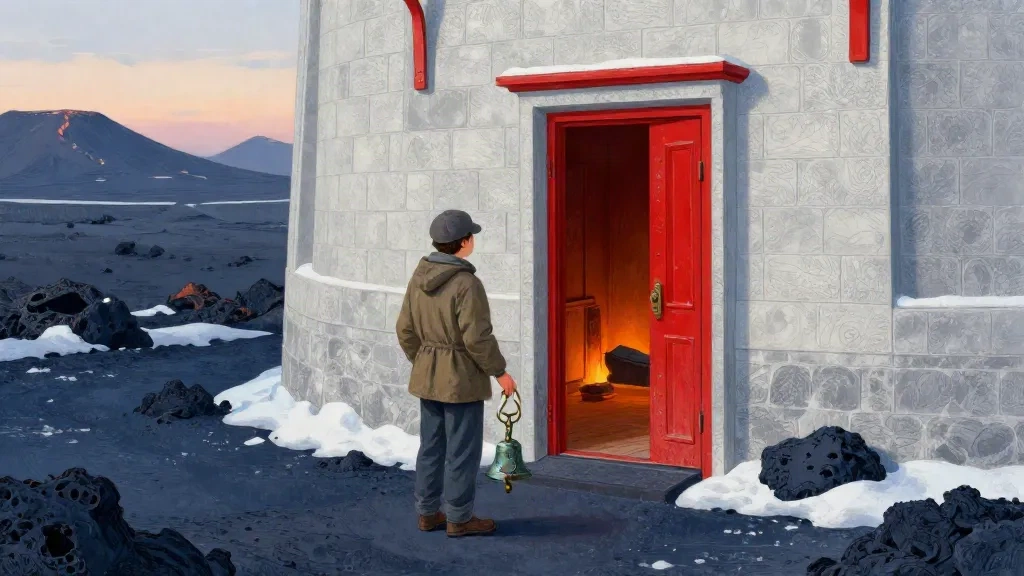
At first the only change was a narrow red door standing in the courtyard, its paint still wet and bright as a cut in midnight blue. Mara almost touched it. A notice fastened across it with wire read: UNCONFIRMED SHELTER. DO NOT TRUST. The notice was hers; the wire was the municipality's.
At noon a courier came up the crater road, lost and snow-blind, having walked out of a valley road that no longer joined anything. He stood in the doorway of the red door with his hands open and said, I have nowhere else to go, and the door opened for him the way a door does when it has been left unlocked.
Beyond it lay rooms without blueprints. Cots, bread, dry clothes, a stove, a bucket of water that stayed clean. From the courtyard came the smell of wet ash and warm bread. Around the machine's funnel, strangers who had not yet gone in shared out the food they had carried, and this — not the rooms, not the door — was the thing that made the following three weeks possible.
Mara understood then that belief was not an argument. Belief was a door left unlocked.
She found the cracked bell in her coat pocket, ringing without a clapper. The brass key was warm. When she used it, no new room appeared. Instead, every bell in the mountain answered: the tram terminus, the hospital steps, the chapel in the lower village, the ferryman's weeds, the fissure where her aunt had kept her vigil. Eleven stories, ringing at once, and eleven places on the mountain briefly forgetting why they had been left.
That evening the official from the weather station climbed the crater road to inspect the miracle. Mara met him at the red door, where the ash lay undisturbed beneath the lintel, and where she had, without deciding to, put her foot across the threshold.
He was younger than the letters. He said, I do not believe this is structurally sound.
Neither do I, Mara said, and gave him the brass key.
He entered. By morning, twenty-two strangers had shelter, and the courtyard walls had turned pearl-white behind them, and in the gravel where the hostile ground had been, red flowers opened in the shape of an old woman's hands.
What the Machine Took in Exchange
The ledger found her on the third day, left on the machine's housing, weighted with a calibration weight, which was the machine's handwriting, if a machine had one.
Left page, unchanged. Right page, crossed out in a single clean line — every name, all eleven, including the three who still answered the phone. Beneath the line, in Mara's own hand from years ago, the list had been returned to her with one name restored: Ida Venn.
She understood, then, what had been traded. Not memory of the story. The story. The bell, the wool, the ash hot enough to blister a mouth, the names of the thirty-seven — she still had every word of it, and when she said it aloud to the courtyard gravel it landed like a coin on a table, meaning nothing, and stayed there.
She had traded her family's oldest story for twenty-two strangers' rooms, and she had done it believing, in some private chamber she had not inspected, that the two were separate. They never had been. That was the clause in the manual that had not been on page nine. That was why Pell could not remember his name, and why the ferryman had forgotten lanterns, and why the coal miner's wall had held: the machine did not copy memory. It spent it, and the spending had to come from somebody who loved it.
So she went to the photograph in the family ledger, the broad woman with the wool bundle under one arm, and found that she could remember the felt coat, the squint, the way the picture had been retouched twice. She could remember that the family had kept one story. She could not, now, remember a single thing the story had been.
She wrote the loss down in the left page, in the correct column, under date of planting.
Consequences After the Red Door
The municipality could not classify the shelter. That was the first consequence, and it cost eleven weeks.
Classification required an intended function. Intended function required a statement of intent from the operator. The operator was a woman who had lost the story she intended, and so the file went into a holding pattern that nobody named and everybody understood, and the twenty-two stayed, and the children in the maintenance terraces came down in the afternoons because the bread was there and the stove was warm, and one of them, a boy of nine named Teo, began sleeping in the courtyard on a pallet because he said the air tasted less like a thing you were dying of.
The second consequence was her mother. Ilse Venn stopped writing the letters and came to the courtyard instead, and stood at the gate, and did not cross.
I sewed the pocket, she said.
I know.
Not to help you. To see whether you would use it. If you used it on your own, it was a key and I had given you a key. If you never used it, it was a story about a bell, and I had raised a woman with a head for stories. She smoothed the sleeve of her coat with both hands. I did not decide which. I have spent a great deal of my life arranging to be the kind of mother whose arrangements pay either way.
Did they?
No, said Ilse Venn. It is a very poor machine, Mara. I do not say that to be kind. She looked at the red door, at the flour of ash on the threshold, and did not go in.
The third consequence was that the red door stayed shut, and that this was by design. It opened, as the courier had opened it, for people who said they had nowhere else to go. The young official tested this for eleven days with a clipboard and no faith at all, walking the rim road, and brought back four, and turned four away at the threshold with a courtesy and a printed card, and the four who were turned away slept in their vehicles and did not complain, because he had told them the truth, which was that the door was not a promise, it was a question, and they had not yet answered it in a way the door recognized.
He resigned in October and rented a room above the bakery in the lower village, and on the first evening he came up the crater road with a sack of flour, and stood a long time in front of the notice wired across the door, and then said, I do not believe this is structurally sound, and I would like to stay, — and the wire came off in his hands.
By winter the courtyard held thirty-one people, and the flowers had gone back into the gravel, and the walls stayed pearl-white. Pell came up in November, on a pretext about his transit card, and stood in the doorway and could not say his own name, and Mara told it to him, and he wrote it down, and asked her to spell it.
She keeps the ledger on the machine's housing, under a calibration weight. Left page: the story, the place, the date of planting. Right page: the names, and the names no longer answer, and the one name she gave away, and the thirty-one, one by one, in a hand that has started to lean.
What she has left of Ida is the photograph, and the retouching, and the sentence underneath it, which she can still read, and which she no longer believes or disbelieves, because a sentence that says she was not afraid, whatever the story says requires the story to be there in the room, and it is not. What she has left is the key, and it is warm, and she does not know what it opens now.
What she has left is the door, unlocked, and the twenty-two people who have nowhere else to go.





