 Netwrck
Mystery.
Two Hundred Eighty-Nine Ways In
Ansa Vey’s municipal gardening cart had one bent wheel, three packets of star-moss, and permission to work only in neglected courtyards. The monastery inside comet Serephos had thirty-seven. Its lowest courtyard occupied the crater where the abbey’s first telescope had struck ice, and for two centuries no door had opened there.
Ansa had inherited the courtyard from her grandmother, who left behind a brass key and an instruction: plant what you know where no one stays.
So Ansa planted a story.
She folded her grandmother’s account of Cousin Mara into paper stars and set them beneath the empty basin. Mara, she claimed, had opened her house to seven fugitives during the Ash Winter, fed them when the ration engines failed, and hidden them in the cellar until spring. The family had forgotten everything except the key.
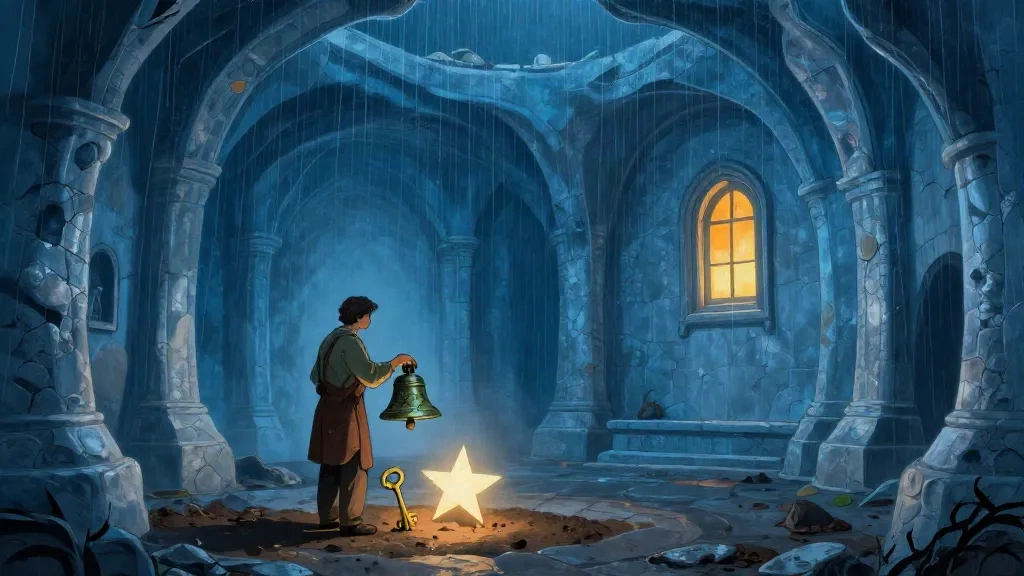
Ansa arranged the paper stars around it. Above them hung the courtyard bell, cracked through its bronze cheek. She struck it once.
A brass seam opened in the crater wall.
Beyond it waited a narrow room with straw beds, a water pump, shelves of tins, and one amber window shining through a storm that existed nowhere outside. Its lintel read: THE HOUSE OF MOTHERS AND STRANGERS.
Ansa brought in the first three guests before noon: a dockworker with a fever, a choir girl fleeing an arranged marriage, and an old mapmaker who had been sleeping beneath the public stairs.
They laughed when she told them the story had opened the shelter. Then they stopped laughing, because the shelter worked.
The Engine of Disbelief
On the second morning, the room would not admit anyone.
Every person who crossed the brass seam became translucent. Beds split and vanished. The pump coughed out black dust. By noon, the fugitives were shouting across the courtyard, insisting the refuge had been a fever dream.
Ansa found a maintenance diagram riveted inside the wall. It called the shelter a consensus engine. Its engraved instructions were blunt: belief is fuel; witnessed belief is poison. Each person who entered must first remain unconvinced. Doubt must be held alone, without warning or argument.
She replaced the paper stars with newsprint, carrying contradictory reports, disputed genealogies, and notices of miracles claimed in four different counties. The next arrival was a man carrying a numbered parcel across the comet.
He did not know the shelter existed. He looked for shelter.
That afternoon, seven more passed through.
Then the brass key vanished from the basin.
Ansa checked the drainage channels, the monastery herbarium, and the chapel bell chamber. The cracked bell remained cold. That night, writing scratched itself into its inner lip:
Ask the house who held the key. Ask the house why it is afraid of the bell.
What the Bell Remembered
Ansa finally remembered her grandmother’s last visit to Serephos.
She had hidden in the bell tower during an inspection, certain the abbey would erase the family story. When the abbots found her, Mara’s old key was already in the courtyard lock. They had believed Mara a saint. A saint required no shelter.
The key had not opened the room. It had named the room, tying it to a family’s claim. Once Ansa publicly authenticated the story, the engine burned that identity away. The shelter remained, but without a name it treated every guest as another miracle.
So Ansa took the cracked bell to the courtyard and broke it cleanly in two.
The noise brought every refugee running.
“There is no magical house,” they cried. “Only pipes, paper, and a municipal gardener with bad ideas.”
The brass seam widened. Amber light poured across the stone. Inside, the seven guests appeared on their beds.
The choir girl was still first to cross the threshold. “I heard a bell,” she said.
“There isn’t one,” said the dockworker.
“Not anymore,” Ansa agreed.
The Room Without a Story
The shelter survived that winter, but Ansa planted no stories after it. The monastery hired her as keeper of the court, and she kept the courtyard honestly: beans, winter onions, star-moss cut back from the forbidden moss.
Travelers still found the brass door.
Some came with documents, some with quarrels, some carrying no names at all. Ansa admitted them without announcing that she could. She repaired the cracked bell, though she never hung it.
On the two hundred eighty-ninth night of her keeping, a woman arrived from the outer ridge, carrying a child’s carved horse.
“My family keeps a story,” she said. “A dead man shelters us in winter. I want to plant it here.”
Ansa looked toward the deep, rain-blue sky. A single amber window watched between the monastery’s buttresses.
“We can try,” she said. “But you must not tell anyone whether it works.”
The brass key had reappeared that morning beside her cuttings. It carried no family name, only a tiny line scratched along its bow:
ONE STAY. ONE WARM WINDOW. STRANGERS TO COME.
Ansa put it in the woman’s hand and led her toward the neglected court.





