 Netwrck
Magical Realism.
The Garden Below the First Floor
At midnight, beneath the night market, the city had no street.
There were only the market’s legs: stone columns wrapped in damp canvas, stalls balanced on beams, lanterns lowered from above by people who never climbed down. Beneath them lay a narrow shelf of soil, swept clean every morning by municipal gardeners whose work was officially called maintenance. Their instructions said to remove weeds, mend drains, and discourage stories.
Mara had ignored the last instruction for years.
She carried a silver trowel, a brass key with no lock, and a cracked bell whose sound seemed to come from inside her teeth. In neglected courtyards she planted stories: a memory of rain on tin roofs, an argument between two sisters, the name of a dog buried beneath a vanished staircase. She planted them in careful circles and watered them with rainwater collected from market awnings.
Her grandmother’s story was the first Mara had not been allowed to plant.
It began before the city rose. A woman carried a blue bowl from house to house, telling everyone where the rain would fall. The rain obeyed her until the night she grew tired. Then it stopped.
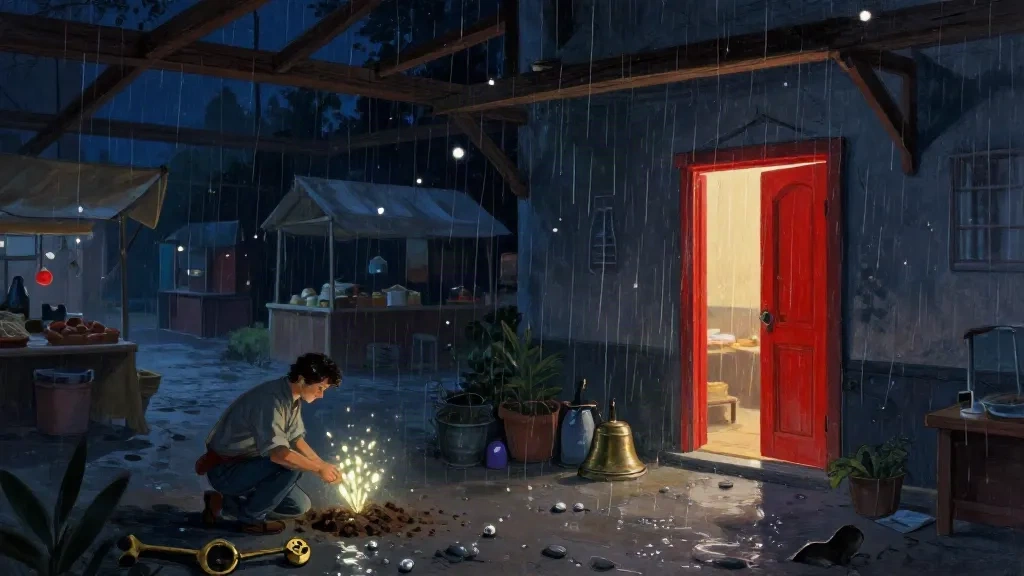
Mara carried the story in a cloth bag beneath her coat. Every evening, she passed the empty lot behind the market, where brick walls met brick walls and no window looked outward. The courtyard contained a red door, painted shut, and a machine shaped like a copper kettle.
The Engine of Doubt
The machine worked only when nobody believed in it.
Mara discovered this by accident. She told the story aloud to two market porters, promising that the courtyard would become a shelter if they carried the old woman’s blue bowl there. The porters laughed. At once, the kettle coughed blue fire, the red door swung inward, and warm light spilled across the neglected ground.
Inside was a room with no walls, only rain descending into a silver basin. A bench waited beneath it. The porters stood in the doorway, astonished.
“It needs disbelief,” Mara said.
“Then we should leave,” one porter told her.
They left. The room remained.
By morning, strangers had found it. A woman with a dead son slept beneath the rain. A boy who had run away from school shared bread with an old man who had forgotten his address. They believed the room was a miracle, and the kettle went silent. The rain became ordinary water. The bench vanished.
Mara repaired the shelter by telling each newcomer a different reason not to trust it. She said the basin leaked, the red door was painted on, the room belonged to a vanished woman. The doubts were kind enough to survive.
When the Bell Cracked
On the seventh night, the city inspectors arrived with demolition orders. The market’s lowest beams were unstable, they said, and the courtyard had no legal owner. Mara showed them the brass key.
“It opens the room,” she said.
The lead inspector pocketed it. He did not believe in rooms. The machine started with a violent shudder. The cracked bell in Mara’s bag split from rim to crown.
Silence filled the courtyard. The red door buckled. Strangers gathered beneath the market, clutching their blankets and bread, asking where they were meant to sleep.
Mara could have defended the room with the truth: that her grandmother’s story had made it, that the rain remembered the woman who carried the blue bowl. Instead she said, “The shelter is only a story. It has no owner, no address, and no reason to exist.”
Her grandmother’s voice emerged from the basin. “You always were a poor liar.”
The inspector laughed. That was enough. The door opened. Rain fell again, and the room took in every stranger.
What the City Kept
By dawn, the demolition men had left. The market opened above the courtyard, boots striking timber, sellers calling prices into the blue-black air. No street existed below the first floor, but people now knew the way down.
Mara planted the story where the cracked bell had fallen. From its two halves came a thin, continuous note, too faint to be believed and too steady to disappear. The brass key remained in the inspector’s pocket, warming his hand whenever he passed the red door.
He never returned it. Nor did Mara ask. She had learned that some doors open because a person carries the key, and some rooms survive because a person chooses not to believe they deserve them.
At midnight, the shelter filled. Beneath the market’s noise, rain fell into a silver basin. Mara stood among the strangers, saying nothing, tending a garden made of doubt.





