 Netwrck
Mystery.
The Gardener of Empty Lots
Mara Venn was municipal gardener of the Ninth Ward, though municipal maps showed her district as a blank space between two avenues. She worked before dawn, when the shadows of chimneys gathered in doorways and the citizens who owned them slept beneath their own dark feet.
Her tools were a silver trowel, a brass watering can, and a ledger of complaints nobody had submitted. When a courtyard went unused, Mara planted a story there. Not flowers. Stories.
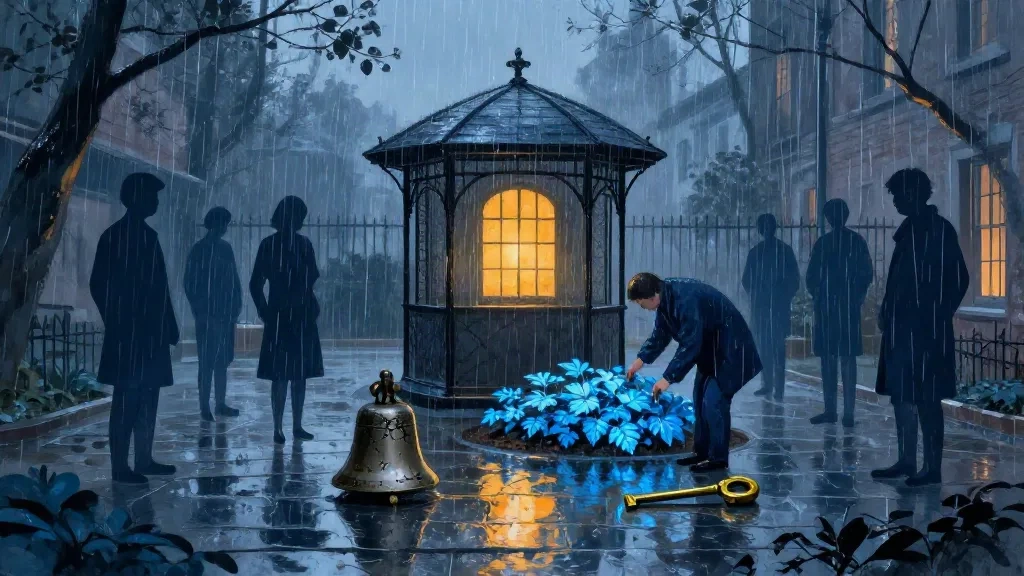
She planted one in the courtyard behind Mrs. Pell’s shuttered bakery: a daughter who had crossed the river carrying a red umbrella and returned without it. At night the story grew low blue leaves that trembled whenever someone spoke a true lie.
On the third morning, a stranger slept beneath them.
By winter, Mara had made shelters from the city’s abandoned memories. A child’s lost shoe became a door. A drowned musician’s melody became a staircase. Her work was illegal under Ordinance 88, which classified unwitnessed events as unsafe construction.
Her own family story remained unplanted. It concerned her brother, Tomas, who had vanished from the city’s records before Mara was born. The only evidence was a cracked bell and a brass key with one tooth filed into the shape of a seed.
The Machine in the Courtyard
The machine appeared behind the abandoned tram station on Saint Orra’s Street. It was a black iron cabinet with a brass crank and no maker’s plate. Its single window glowed the warm amber of a kitchen at midnight.
Beside it stood a handwritten sign: THE SHELTER OF THINGS NOBODY BELIEVES. One NIGHT ONLY. ADMISSION FREE.
Mara turned the crank. A voice inside asked, “Do you believe this works?”
“No,” she said.
The door opened.
Inside was a small room made of folded paper, rain, and the shadows of people who had never existed. The machine offered beds, water, and a recorded name for anyone who entered. It could preserve a family story, Mara realized, even if the city forgot the family.
But the room vanished whenever someone looked directly at it.
On the first night, twelve people entered. On the second, a hundred. By the third, the queue reached the avenue. Mayor Voss arrived with inspectors and ordered Mara to shut it down.
“Belief is a public resource,” he said. “You are wasting it.”
Mara placed the brass key in the machine’s lock. Nothing happened. The machine’s voice repeated its question.
At midnight, Tomas stepped from the paper walls.
What the City Owed
He looked older than the boy in the old photograph, but he wore the same blue coat. Mara reached for him. Her hands passed through his shadow.
“You planted the wrong story,” he said. “You planted ours before you planted me.”
“I wanted a shelter.”
“For whom?”
She thought of Mrs. Pell’s stranger sleeping under blue leaves. The musician’s staircase. All the forgotten people who had found one warm place in the city.
The bell began ringing inside the tram station. Mara carried the cracked bell from her satchel. With each strike, the machine’s amber window widened.
“The city made a bargain,” Tomas said. “Every citizen gave a shadow and received a name. The shadows keep the records. The names forget the shadows. I was erased because I tried to return something nobody owned.”
“What did you return?”
He pointed to the key.
Outside, the inspectors raised their lamps. The crowd looked toward the station. The machine shuddered.
“If they see me, I disappear,” Tomas said. “If they see the room, it disappears. If they believe, neither of us remains.”
Mara understood then. The machine had never needed faith. It needed the city’s practiced doubt, its willingness to leave some people outside the record.
She struck the cracked bell.
The Unlit Window
The note traveled through the Ninth Ward. It entered courtyards, kitchens, laundries, and tramcars. It was not a sound the city could answer. It was the sound of a place refusing to be full.
Mara turned the crank backward.
“Do you believe this works?” the machine asked.
“No,” she said. “But I believe they deserve somewhere to arrive.”
She planted Tomas’s story in the soil inside the cabinet: a brother who left a brass key beneath a cracked bell, and a sister who kept one amber window lit for whoever came home.
The paper walls opened into a courtyard. Rain silvered the stones. At its center, the bell hung without a tower, and the brass key rested in the lock.
People entered. Not because they believed in the machine, but because they had finally seen one another.
By dawn, the black cabinet was gone. So was Tomas.
Only Mara’s ledger remained, open to a new page. She wrote: One family. No walls. Shelter sufficient.
Across the ward, one warm amber window shone in every empty courtyard.





