 Netwrck
Magical Realism.
The Courtyard of Small Weather
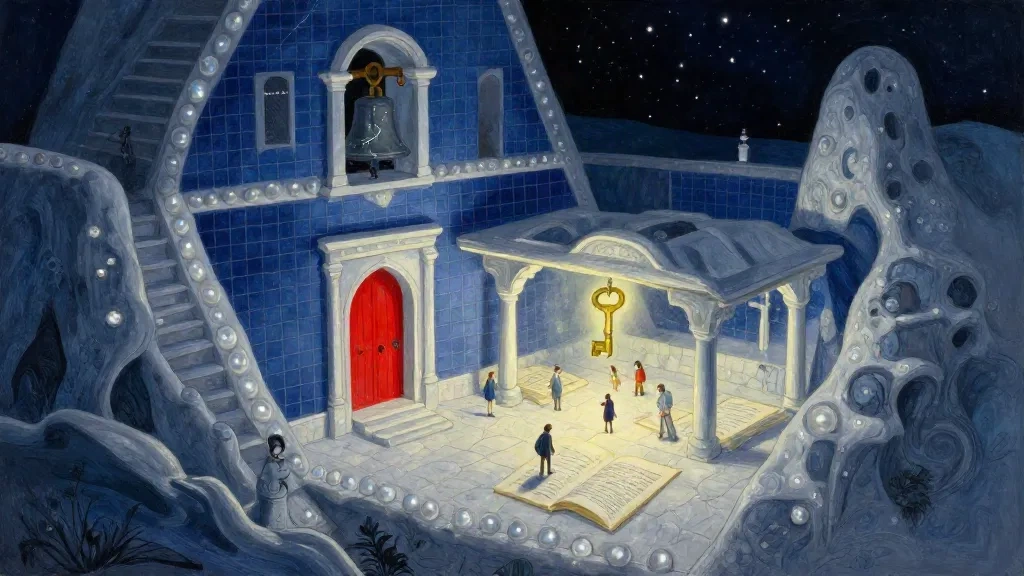
On the third terrace of the comet monastery, where the walls were pearl and the stairways curved like the inside of a horn, Mara Venn kept municipal appointments.
She carried a ledger with a rubber band around it, a brass watering can polished to the colour of a bruise, and a narrow trowel forged from the handle of a spoon. Her city had declared the monastery grounds neglected, which meant the courtyards belonged to weeds, silence, and the occasional fox that came up the drain cut with something stolen in its mouth. Mara was to make them beautiful. Instead she dug shallow holes and put folded pages inside them.
Each page held a story. A woman who had measured grief by the width of a river and would not say the river's name. A boy who found his own name engraved under a bridge, and carved it out, and then regretted it. A baker who fed the moon on cloudy nights and was never once thanked for the flour.
Mara read each one aloud, closed the soil over it, and waited. Nothing grew. The monastery's last gardener had died eighty years before Mara was born, and the monastery itself had been shut for sixty of those years, its chapel used for storage, its cisterns for firefighting practice, its bells too cracked to be rung and too heavy to be thrown away. Water stood in the lowest courtyard in a sheet the thickness of paper. In summer the pearl walls gave back a light that made people squint and believe the weather had turned.
She kept her appointments anyway. She had learned, at nineteen, from a woman who had not learned it, that a story needed roots as much as a seed, and that you could not tell the difference until the digging.
It was the story of her grandmother, then, that she planted last. The grandmother had survived the winter after the river froze, and had learned to open her door to travellers who had nowhere else to sleep, and had gone on opening it long after the danger passed, into a year when opening it cost her something she never itemized for anyone. As Mara closed the last handful of earth, something clicked beneath the soil, the sound of a machine deciding to be honest.
The Machine in the Wall
The sound came from the wall lined with midnight-blue tiles. A door stood in it that had not been there that morning: not brass, though it pretended, but red, the only red anywhere on the comet, red as the inside of a mouth.
It breathed.
Mara's mother had owned a machine for mending torn coats. It worked only when nobody believed in it, her mother used to say. If anyone watched, if anyone praised it, if anyone said how clever, the machine would sigh and turn out a string of buttons. Mara had inherited the sentence and nothing else, the way you inherit a coat with the pockets already mended.
Behind the red door was a small engine of glass tubes and copper wire, and a wheel the size of a child's palm, and a label in an engraved hand: SHELTER FOR THOSE WHO ARRIVE WITHOUT EXPLANATION.
She turned the wheel. The courtyard filled with the smell of rain on warm stone, and with the sound of it, unhurried, falling upward.
Then the machine died.
She turned it again. Nothing. She said, out loud, that it was certainly broken; that no machine could make a shelter out of a family story; that the monastery had been foolish to keep it, and the city foolish to let a woman like her keep it busy. She said it the way you talk to a dog you have just found bleeding on the stairs, all reassurance and no information.
The wall shuddered. A narrow passage opened beneath the cracked bell, where there had never been one, and inside it there were blankets, a stove, a copper basin, and a cot.
Mara stood a long time in the courtyard with her hand still on the wheel that had not turned.
So that was the trade. The shelter existed in the exact interval between wanting it and claiming it. It was not built by belief. It was built by the moment you gave up.
What the Strangers Needed
They came that night, up the lower stair, three of them, the way people arrive at a place they have not heard of, which is to say all at once and without arrangement.
One carried a suitcase with no handle, and carried it the way you carry something that is not really a suitcase. One spoke a language Mara did not have, and had clearly learned to survive without one, because he had crossed two countries on phrases. The third had been walking so long that he had forgotten the direction of home, and said so cheerfully, as though it were a fact about a river.
She showed them the passage. The machine stayed silent while they looked at it. She told them the grandmother's story, the door in the winter, the door after the danger. She took the old brass key down from where it had hung beside the bell since the first snowfall and put it in the hand of the man with the suitcase, and the man turned it over twice and gave it back, because, he said, he did not want to be the one who knew where the door was.
"You said it needed belief," said the stranger with the suitcase.
"No. It needed us to stop asking it to prove itself."
By morning there were nine, and then nineteen, and light under the red door, and then an argument about where the kitchen should be that lasted three days and produced one wall. Nobody wanted to leave. This was the difficulty nobody had mentioned: a refuge is a machine for producing attachment, and attachment, in a place like this, is structural. Load-bearing.
The machine worked only in the quiet moments. When a traveller slept, a kettle appeared. When a child laughed, clean water rose in the copper basin. And when someone began to believe the shelter was permanent, the blankets folded themselves into neat squares and vanished, one after another, the way a person you love will politely take their coat.
The Man Who Forgot the Direction of Home
He was called Ansa, though he answered to almost anything, and for eleven days he was the most useful man in the passage because he did not know where he was going and therefore could not be sent anywhere else. He dug. He carried. He sat with the feverish woman at the end of the cot and told her, in a mild and slightly tedious way, about the direction of home as one might discuss a road taken in childhood.
On the twelfth day his people found him.
They came up the lower stair with a form, a relative, and the absolute confidence of people who had money. He looked at them, and looked at the blankets, and Mara watched the exact moment he believed. She had heard the machine's rule a hundred times without understanding it. She understood it now: it was not that faith broke the shelter. It was that faith broke the shelter and the shelter took the belief with it, and everyone who had been inside that belief along with it.
The blankets folded. The basin went dry. There was a passage with a bell over it and nothing in the passage at all, and the kettle in the passage had been a gift to that specific man, and the man was going home to a house with a heating system.
He did not say goodbye. She has decided since that he could not have. She has also decided that this is the version she tells, and that the other version exists, and that the other version is the one in which she said nothing at all.
The Ledger and the Inspector
Inspectors came eventually. They always come eventually, because neglected ground is only a condition until someone with a clipboard develops an interest in it.
The first one was named Ovel, and he was a small, courteous, entirely sincere man with a clipboard and a great belief in the value of forms. He had a genuine, uncomplicated faith in the shelter, and this made him, without any malice whatever, the most dangerous person Mara had ever met.
He stood in the courtyard at dusk and said, "This is a remarkable thing, and it should be properly recorded."
"It shouldn't be recorded," Mara said.
"Everything should be recorded. Recording is how a thing outlasts us." He was not wrong. That was the horror of him. He sat on the cracked step with his ledger open and explained, patiently, that the shelter had no address, no cadastral parcel, no water connection, no sanitation provision, no occupant register, and no lawful reason to exist; that a structure with nineteen residents and no drains was a hazard, a fire risk, and a public-health matter; and that if she did not give him something to write, he would have to write no structure found, and the file would close, and then in six months another man would come with another clipboard and would find the passage and, in the proper course, fill it in.
He offered her a category. The passage was a sub-level chamber. Sub-level chambers belonged to the maintenance of grounds: drainage, culverting, reserve storage. If the residents were grounds staff, they were employees. If they were employees, they had wages, and wages had a municipal home, and a home had a line on a ledger.
Mara thought of the twenty folded pages in the earth, and of her grandmother, who had opened her door until the door cost her something she never itemized.
She took the rubber band off the ledger. She wrote SUB-LEVEL CULVERT INSPECTION, RESERVE STORAGE, ONGOING in her best official hand, and the shelter held, and the workers were paid in bread and tea and, once a month, in paper money that Ovel personally made out of the city's fund for the cultivation of ornamental grounds, and which nobody ever cashed, because nobody could, because it was, in the end, only a way of writing nineteen names down.
Moral arithmetic, she had learned, is the only arithmetic that works. She had taken the shelter's labour and called it groundskeeping. She had taken the city's money and called it gratitude. She had taken Ovel's sincerity and used it as a lock, and the lock held, and the price of the lock was that she could never once tell a person in that passage the truth about where the water came from.
What Was Spent
In the spring she dug up her grandmother's page.
She had been watering the ground every evening for two years, and the story was still in it, and it had gone thin. The ink had not faded so much as been taken: the letters stood up off the paper in little grey ridges, the way the letters of a word get softer as you say them. Where the sentence about the door in the winter had been, there was now only the faint scored line of something that had been there and was being forgotten by the object itself.
Mara sat down hard in the wet courtyard and understood, in the way you understand arithmetic late, that the machine did not make shelter. It converted. The story was the fuel, and the fuel was a person, and it had been spending one person since the first night.
She could keep the door open. That was the whole of the choice and it was a bad one. The machine was indifferent to which page it ate; it would eat a traveller's story the same as it ate her grandmother's, more willingly, and with better cheer, since nobody had ever argued with a story that had not yet been given.
So she began to ask. It was the worst thing she ever did, and she was competent at it, which is the part she cannot forgive. She asked the old man with the language she did not have to tell her the eleven words he used when he was very tired, and she wrote them down, and the water in the basin came up clean that night. She asked the feverish woman, who had said, the first time, that her story was hers, and who said it again, more sharply, and then said it a third time, differently, on a night when she was in pain and had stopped guarding the difference between hers and useful.
Serat, the carpenter from the third terrace, watched this happen for a week and then said what was true, which was: Build it out of brick.
"The wall is out of brick already," she said. "It has been for four hundred years. You are all very busy feeding something that cannot be measured to a thing that can." She did not leave. She stayed, and she shored the passage walls with salvaged beams, and she told Mara, the night she finished, that a shelter that exists only because nobody admits it is not a shelter but a rumour with a kettle. Mara did not answer, because the kettle was still there, and because the beam was holding, and because both of these things were true and she did not know which was the larger.
The Door Left Open
Years later, the comet monastery was no longer abandoned. Its courtyards bore pear trees, salt herbs, and blue flowers that opened only during meteor showers, which the city put down to soil composition and which the grounds staff put down to nothing, being careful never to look at each other during the explanation. The municipal ledger listed the site as restored. The sub-level culvert appeared in every survey thereafter, in perpetuity, a permanent fictional structure requiring occasional inspection and, in nineteen cases, a salary.
Mara kept the cracked bell above the red door. Beneath it hung the brass key, polished by many hands, and no one kept a spare, and this was discussed annually and never resolved.
Every evening, when the last of them had gone down to sleep, she loosened the soil around the place where her grandmother's story had been. She never read it aloud again. She never explained what it meant, or that it had been a gift spent down to the fibre, or that the page now in the ground is blank and she waters it anyway.
The shelter remained because no one, not even Mara, was willing to say the sentence that would end it. And this is the part she is least able to defend: she knows that a thing which exists only in the unsaid is not a refuge against anything. It survives on not being named. It survives on the same silence she used against Ovel, and against Serat, and against the woman whose eleven words are in a box under a floor and whose face she can no longer picture. She has a machine that works when nobody believes in it, and she has built a city on the same principle, and she is the last person in the world qualified to explain the difference.
So she waters the blank page. She checks the beams. She says, to anyone who asks her how it works, that it doesn't matter.
And on the coldest nights, when the comet turns its pearl face toward the dark and the water in the cistern goes to ice above the shored-up walls, the red door opens by itself, and the courtyard breathes warm, impossible rain, and everybody in the passage sleeps through it, the way you sleep through a sound you have been hearing your whole life and have stopped deciding to be grateful for.





