 Netwrck
Surrealism.
The Tenant Who Had Not Arrived
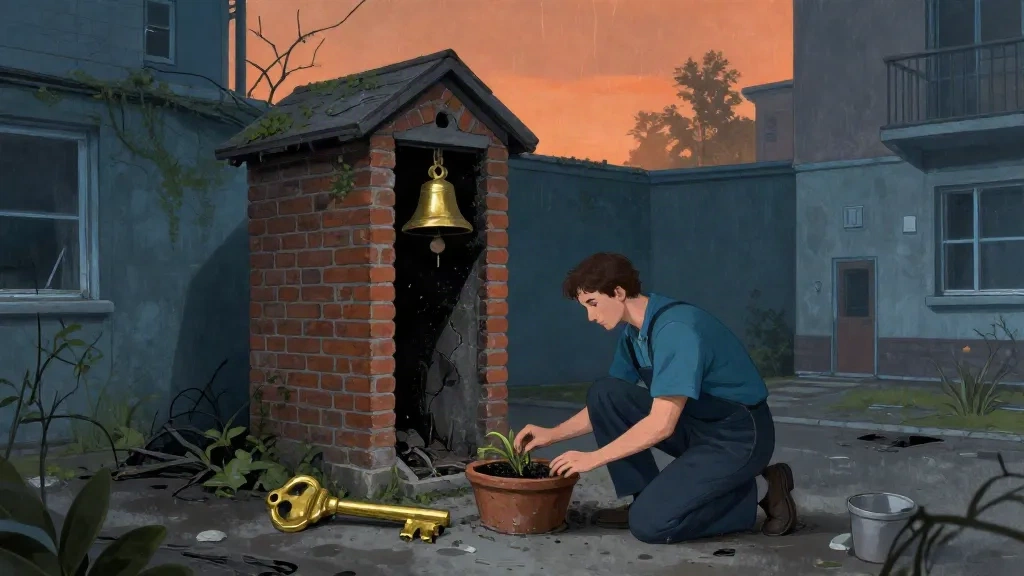
On the fourth floor of the building for people who could only remember the future, Mara Venn earned her wages by planting stories in neglected courtyards. She carried a trowel made from a teaspoon, a brass key with no lock, and a cracked bell whose note arrived several seconds before her hand struck it. The bell lived in her left pocket. The right hand did the planting.
The early warning was worth more than the sound. A person could be spared a step, a sentence, an apology, if the bell spoke first. The village of her childhood had had one bell like it, hung outside a house that was not there when she came back to look for it. She would not say more about the village. The building was polite about the future and merciless about the past, and it had never once asked her a second question, which she had come to understand as a kind of respect and also as a kind of eviction.
Her assignment was the courtyard behind the laundry: a rectangle of gray concrete holding three dead planters, a drain that smelled of iron filings, and a weather vane shaped like an open hand. The residents complained that the space remembered too much before it had happened. Yesterday a woman had opened her umbrella in anticipation of rain and walked home carrying it dry. Tuesday, a man had returned a set of keys to a door that had not yet been built, and the door, when it was built, had no lock for them.
Mara kept a ledger of her courtyards. The Ossary, where a story about a woman who waited had produced a waiting room with no exit and a bench that would not let anyone stand. The Kettle Yard, where a story about brothers had produced two brothers who could not stop being each other, and who had to be given separate keys and separate streets. The third entry she wrote only as a date, and the date had weather in it.
She knelt beside the largest planter and placed the brass key in the soil. The key sank until only its bow remained visible, and it did not ring against the clay, which was how she knew the ground was listening. She unfolded a yellowed sheet bearing a family story: a little girl named Elian had once given her coat to a stranger during a blue storm, and had received a warm room in return.
“That is the whole story,” she told the courtyard.
The courtyard gave no answer. The weather vane swung east, although from that angle the windows showed nothing but brick.
A Machine for Unbelief
Every building had one machine for making neglected places useful. Mara’s stood in a brick shelter shaped like a wardrobe, its brass levers green with lichen, a hairline fracture running from the third lever down into the base like a root that had found water and changed its mind. It converted a planted story into a shelter: a wall, a roof, a bench, a dry place where a stranger could sit without explaining themselves.
The machine worked only when nobody believed in it.
Mara had learned this from the inventor, Ottmar Vahl, who was now dead in a chronology she was not permitted to know. He had explained the mechanism over two cups of something that was not tea: belief, admitted, gave the structure a claim on the world, and a structure with a claim on the world could no longer tell which side of itself was inside. It would open onto itself. It would become a room you could walk out of in any direction and never arrive.
So she operated it by pretending it was a broken vending machine. She fed it coins she kept for the laundromat. When a lever did nothing, she said the coin was bad. When a lever produced a smell of wet metal, she said the motor was wet. The other tenants had been instructed to distrust the resulting structure, and they did so with enthusiasm, because distrusting a stranger's work in a courtyard at dusk is the most companionable thing a person can do.
This was the part of her profession she examined least. Mara no longer knew whether she distrusted the machine because the machine required it, or because distrusting it was what she had been taught to do at twenty-three in a room with a Vahl machine and a dead man’s gloves folded beside her. The machine read pretense, not doubt; it had never once corrected her. She had noticed this. She had decided it was a flaw in the machine.
She turned the first lever. Nothing.
The second produced a smell of wet metal.
The third rang the cracked bell inside the wardrobe, though Mara’s hands were in her pockets.
From beneath the soil came the sound of a child coughing — not the wet cough of a cold but the dry, deliberate cough of someone clearing a throat to see whether a room was listening. The brass key rose one inch, turned once, and sank again.
“There,” said a voice from the laundry balcony.
The Tenant Who Had Not Arrived
Every head turned toward it. On the balcony stood a man in a delivery coat, holding a parcel tied with green string. He had the parcel of a man who has carried something a long way and never been told what it weighs. His face Mara recognized before her hands did: it was the face of someone waiting to arrive.
She had seen him once, four years ago, in a courtyard on Vane Street, and had chosen not to know him. That courtyard had produced a shelter in eleven minutes, which no machine of hers ever had, because that morning eight people had stood in the rain and praised it. Saying so had cost the structure a brick, then a wall, then a floor, and what remained had walked out of the courtyard in a delivery coat with a parcel under its arm and had been walking ever since, toward a door that would be finished by somebody else. Vahl had written four lines about this in the notebook she kept folded in the ledger. She had read them at the time. She had not written anything beneath them.
“That is a shelter,” the man said. He said it the way a man says thank you in a language he has learned from listening.
He meant it. That was the whole catastrophe. Belief was not required to be loud or stupid; it was required only to be present in a person’s chest at the moment the words left it, and this man’s chest had it in him the way a cup has water — brimming, level, and entirely unaware of the crack running up the side.
The machine shuddered. Cracks spread through its brass casing and joined the fracture beneath the third lever, and the courtyard vanished behind a sheet of blue storm-light, the color of the storm in the story, which was the only weather the story had ever been about.
What the Family Kept
Mara ran through the laundry, past humming pipes and open doors full of weather that belonged to other people’s errands. She found Elian’s family in apartment 4C, though every member wore a different age.
The father was an infant, asleep in a laundry basket, his years folded neatly under his knees. The mother stood in the doorway with snow in her hair, and would not come inside, and would not say why not. Their grandmother sat at the table with the yellowed page, writing the family story over and over, changing one word each time.
Mara put her hand flat on the paper. The grandmother went still the way old instruments go still when the room changes temperature.
“We gave the story away,” the grandmother said.
“No,” Mara replied. “You kept the part that mattered.”
“We gave it generously.”
“You gave it without a name.”
The mother in the doorway said, “That is the same thing.” The snow in her hair moved, though the air in the room was warm, and the infant in the basket turned his face toward the sound of it.
Mara took the page. The first line had been crossed out, and beneath it a new sentence stood in brown ink, dried to the color of old tea: What is given to a stranger returns as shelter. Under that, slowly, in handwriting that was hers and that she had not written, a second line came through the fibres of the paper like water through cloth — Unless the giver is taken for the given.
Then the grandmother told her the rest, and it was worse than a lie, because it was a lie with a laundromat in it.
Elian had not owned the coat. The winter clothes had gone in October, before the storm, to settle a debt of the mother’s making; the coat had been left on the bench by the delivery man, who was out of his mind that night with a parcel he had opened and could not close, and never came back for it. Elian was nine. Elian was hungry in a way that made a nine-year-old inventive. She took the coat off the bench and she gave it to a stranger, and the stranger gave her a room with a stove in it, and in the morning the stranger was gone and the room stayed, and Elian told everyone the way you tell a thing that has to be survivable: that she had been kind, and had been rewarded for it.
“There was no kindness in it,” the grandmother said. “There was a child who needed a dry place and a woman who needed somewhere to not be for one night. That is all. That is the whole of it.” She dipped the pen. “We were not robbed. We were not generous. We were used, and then we edited.”
“And the editing feeds the courtyard,” Mara said.
“The editing feeds us.” The grandmother turned the page over. On the back, in the same small careful hand, was a column of dates, each one annotated with a single changed word. coat became sweater, and the storm came down harder. sweater became blanket, and the storm came down softer. blanket became her own coat, and the rain stopped, and stayed stopped, and the courtyard behind the laundry had been dry for eleven days, which was why the laundry had started to smell of iron.
“Every family is fed by the sentence it improves on,” the grandmother said. “Ask the machine why it is called a machine.”
The House With No Doors
Outside, the delivery man rang the courtyard bell. Its cracked note arrived before the sound, as it always did, but this time the silence between them contained footsteps — not the bell’s, not his, going the other way.
Mara ran back and found the machine had made a narrow house with no doors, its interior lit by storm-light. Believers had gathered. They were not residents; nobody had invited them, and they were not the sort of people who wait to be invited to a wall. They stood with their hands on the brick, their coats already buttoned against rain that had not started, praising the work in the low voices of people confirming a suspicion.
Each praise made a brick vanish. Not collapse — vanish, the way a word vanishes when you decide you never said it. The house thinned upward as it filled with agreement, its roof going transparent, the storm-light inside it visible from the laundry roof, where someone would see it in a moment and mention it to someone else.
Mara seized the brass key from the soil, where it had been standing on end for forty minutes like a nail in a board, and threw it into the machine. It went into the housing without striking anything. The sound it made was the sound of a key entering a lock in a house on a street that did not exist yet.
“You are not a machine,” she shouted. “You are a place nobody has trusted yet.”
And the machine stopped, because she had finally said something true about it, and truth, in Vahl’s arithmetic, counted as disbelief with extra steps. She stood in front of it with her hands empty and understood the rest of it, all at once, the way you understand a debt.
She could not finish the house by arguing. A house nobody distrusts enough collapses inward. It needed a story planted in real soil, refused in real voices, by people who were willing to be thought badly of for planting it. The family’s story was already refused: the grandmother had called it, in front of a stranger, a transaction. What the courtyard needed was the version nobody in 4C would ever be able to say kindly.
Shelter Without a Witness
So Mara planted her own.
She put the teaspoon into the soil of the largest planter, and she told the courtyard about a village with a bell in it, and a house that was not there when she came back, and a winter coat she had taken off a bench because she was nine and hungry and had understood, with a clarity that had never once left her, exactly what the taking would cost the man who left it. She told them she had been given a room by a woman with a parcel under her arm, and that the room had been the woman’s payment to herself for not arriving that night, and that she had spent nine years in that room telling people she had earned it by being good.
Then she told them she had planted stories in nine courtyards and had let each one be softened.
The believers did not want to hear it. That was the correct response and it functioned as the refusal she needed. They argued with her specifics. They said everyone softens things. They said the coat was a symbol. They said, with the fluency of people defending a thing they have just learned is indefensible, that the point was the giving, and she said the point was a bench and a woman who needed to not be somewhere, and a child who took what was on the bench, and that the story survived only because four adults in 4C had made it unrecognizable, and that an unrecognizable story is a story with no room in it.
Across the courtyard, at the table in 4C, the grandmother wrote it down exactly. All of it. The debt in October. The bench. The parcel. The nine courtyards.
Then she read it back, and hated it, and did not change a word.
The house built itself the way frost builds a fence: from the outside in, without heat, each brick arriving already cold to the touch. It had a roof of storm-light, a bench under the eaves wide enough for two strangers who did not intend to share it, and no doors, because a shelter that a man like the delivery man could enter was not a shelter but a way of finishing him. Lichen took the corners in the first minute. Strangers came out of the laundry with their shopping and sat down without explaining themselves, and the courtyard smelled of iron and wet stone, and the weather vane above the roof spun once, hard, and stopped.
By dark, Mara Venn had become unverifiable.
It was not dramatic. A woman at the bench looked up and said, “Was someone here?” and could not say who. The grandmother came to the doorway with snow in her hair and asked Mara’s name, and held the word in her mouth the way you hold water in a sieve, and it ran out. The ledger in Mara’s coat had a line for the courtyard, and the line was blank, and beside it, in her own shorthand, Vahl had written, four years ago: the cost is the gardener. This is not a metaphor. Do not pretend it is. She had underlined it twice. She had read it as a joke about credit.
Shelter Without a Witness
The delivery man found her there, in the room without doors, among sleepers who had not exchanged names. He held out the parcel tied with green string. She untied it. Inside was another brass key, colder than the first, and dry, which no key from a working machine ever was.
“For the next courtyard,” he said.
“There is always a next courtyard,” Mara said. “That is the trouble with us.”
He nodded, and it was the nod of a man who has made this delivery before and will make it again, and she understood now that he was not the courtyard’s failure. He was its receipt. Somewhere on Vane Street, in a morning she had walked away from, eight people had said a true thing out loud about a wall, and the wall had sent for a courier, and the courier had been walking toward this courtyard ever since, carrying the only parcel that had ever come out of a machine built to refuse belief: proof that a refusal can be inhabited.
She looked toward the rooftops. A thousand windows glowed with memories of rooms not yet built, and behind every one of them a story was waiting to be told kindly by somebody who would be the poorer for it.
She took the key. The cracked bell sounded somewhere below the city, three seconds before anyone moved to answer it, and the sound came up through the pavement and into the soles of her boots, and Mara Venn, who could no longer be named by the woman who had just spoken to her, listened to the warning and moved anyway — which is the entire difference between a person and a mechanism, and the only thing her machine had ever been able to make.





