 Netwrck
Surrealism.
The Seed Beneath the Bell
At the end of Pier Nine, where the harbor turned from gray water into rust, Maren Sill kept a municipal garden in a courtyard no city map admitted to. She planted stories in neglected places: a child’s lost shoe beneath a broken bench, a widow’s goodbye inside an abandoned kiosk, her own mother’s warning beneath the roots of a scorched fig.
The stories were not written down. They germinated when someone pruned a thorn from the right branch, swept a doorway, or poured water into a crack. A story could become a bench, a cool room, a roof against rain. Maren’s work was to prepare the ground and trust strangers to provide the weather.
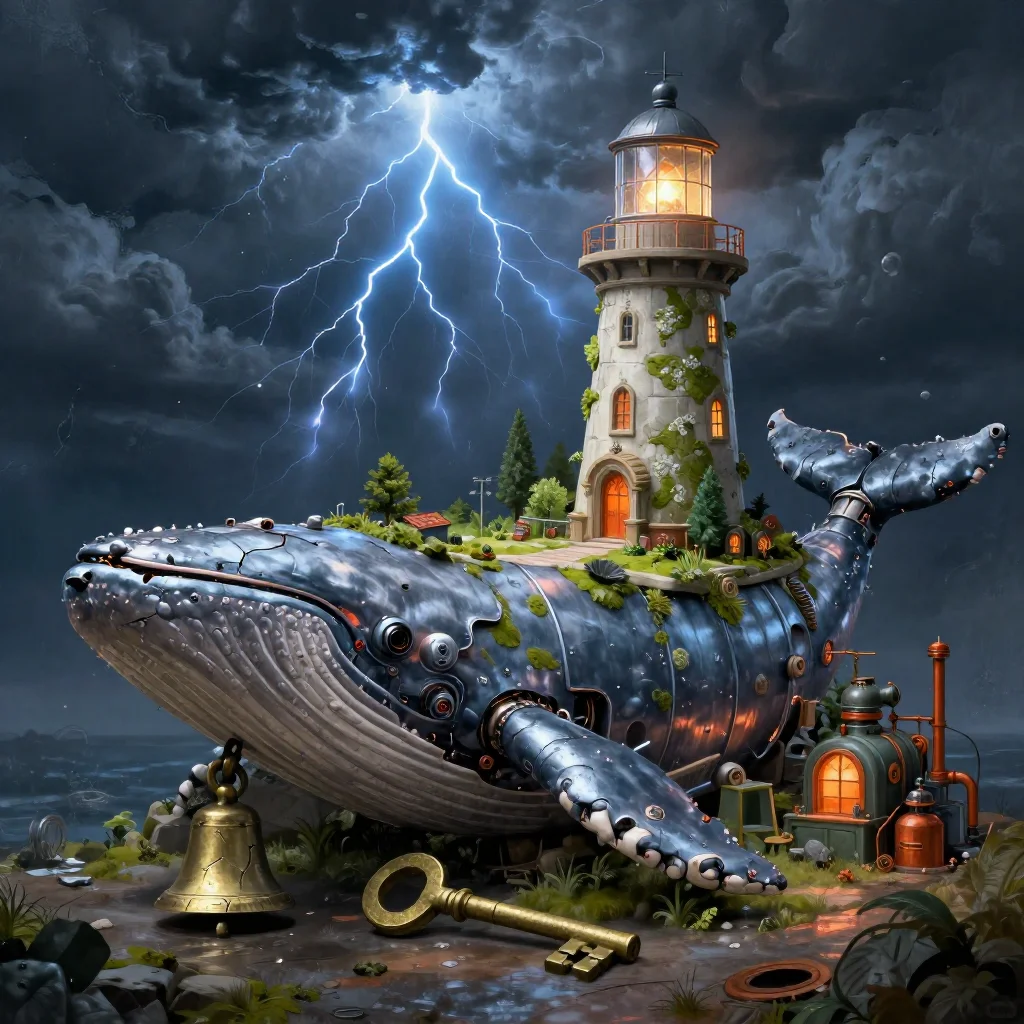
Behind the courtyard rose the lighthouse. It stood on the back of a sleeping mechanical whale, a vast iron animal whose ribs were girders and whose eyes were blue lenses. The whale had surfaced decades ago, never moving again. Its skin carried barnacles shaped like clocks.
At its throat hung a cracked bell. Its voice had stopped during the night Maren’s mother disappeared. The official report said she had walked into the sea. Maren had heard the bell before dawn, followed by her mother’s laugh, and found only a brass key on the wet stones.
The Machine of Doubt
The key opened a maintenance hatch in the whale’s spine. Inside was the shelter engine: a copper heart joined to glass lungs, surrounded by dials with no numbers. The municipal archives called it a civic comfort machine. The sailors called it the thing that fed on faith.
Its instructions were pasted to the wall in three languages. Anyone could enter. Anyone could stay. But the machine would not work while a person believed in it. It moved only when nobody thought it was real.
Maren had come to turn her family story into a shelter for strangers. She imagined the courtyard filling with people from the ferry lines, night workers, children with wet shoes, men who had nowhere to be tomorrow. Inside her story, her mother would not be lost. She would be the woman who opened the lighthouse to those without a harbor.
Maren planted that story in the courtyard. She shaped the soil around a dead yew and spoke the beginning into its bark. By sunset, three strangers had arrived, drawn by the smell of rain on warm stone. The machine remained dead.
One of them, a tall woman in a conductor’s coat, looked at the whale and said, “This is a machine.”
Another said, “A machine is something that can be useful.”
The third whispered, “My brother used to say stories were just places people put their grief.”
Maren felt the shelter fold inward. Doubt had a weight, and it settled on every brick.
Belief Like Rain
She tried to persuade them. She told them the key had opened a door, that the bell remembered, that the whale was dreaming its own coastline. Every word made the engine colder. The strangers began leaving.
So Maren stopped explaining. She dug out the cracked bell, set it beneath the yew, and planted a thorn around it. She buried the brass key where the roots split. She asked the conductor to sweep the courtyard, not believing, merely sweeping. She asked the others to carry stones from the harbor and place them without purpose.
By nightfall, nobody was watching. Nobody had come to witness the impossible.
The whale’s ribs clicked. Blue storm-light leaked between them. The cracked bell trembled without ringing, and the ground beneath the key loosened. Maren crawled below the courtyard on her hands. A hidden staircase descended into the whale, warm as a sleeping animal.
At the bottom waited a room with no walls, only rain falling upward. In its center stood a small shelter, its door open.
Her mother stood beside it, not restored, not vanished, but present in the exact posture of someone who had been waiting for a question.
“Did you make a place,” her mother asked, “or did you make a reason to need one?”
Maren understood then. Shelter was not proof. It was what remained when belief stopped performing itself.
The Bell That Opened Nothing
They returned to the courtyard before dawn. The bell had cracked further, but its split edge shone. The brass key had rooted into the earth, becoming a black iron branch. The machine worked now without attention, shaping the impossible room into something modest: four walls, a kettle, dry benches, a latch that opened from either side.
The conductor brought twelve passengers from the first ferry. The next night came forty. No one spoke of magic. They spoke of salt, money, children, weather, and the need for a dry place to sit.
Maren planted her family story beneath the shelter, but no longer as a monument to her mother. She planted the part she had left out: her mother had once sheltered a stranger during the storm, then vanished because the stranger had mistaken kindness for a promise.
The whale breathed. Its blue eyes opened like shutters, and the lighthouse beam swept across the sleeping city.
Everywhere below, people looked up. Some believed it was a machine. Some believed it was a miracle. Maren did not ask them to choose. The shelter remained, the cracked bell remained, and beneath the bell the brass key held the darkness open.
That night, for the first time, the bell rang.
No one agreed afterward whether it had sounded.





