 Netwrck
Folk Horror.
The Door Between Timetables
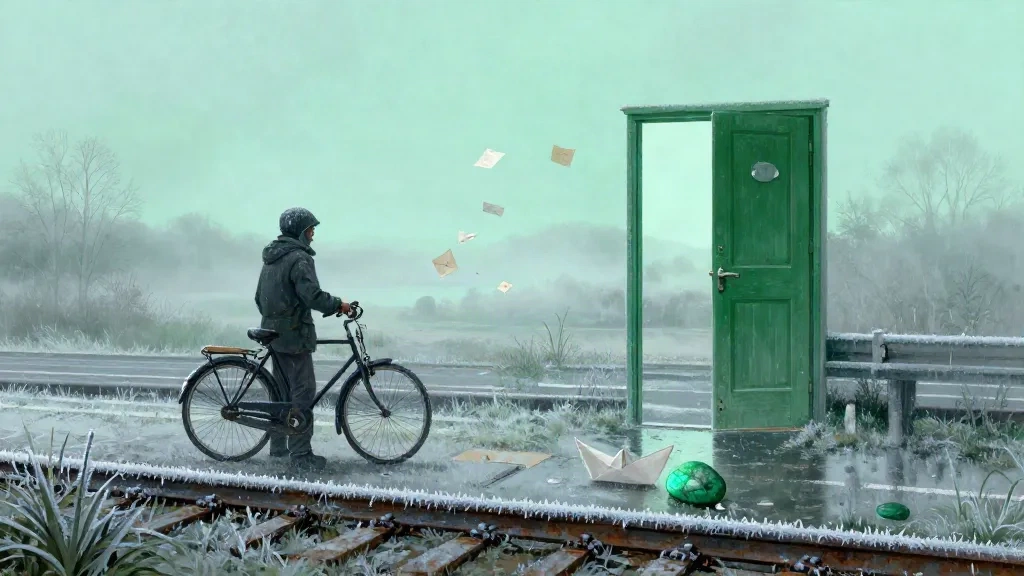
On the coldest morning of the year, Mara found a green stone on Platform 908.
It was smooth as a river mouth and warm beneath her glove. The station clock stood at 4:17, though noon had passed without its hands moving. Frost silvered the benches and stitched webs between the departure boards. Beyond the windows, the countryside lay white and silent, but along the tracks waited narrow doors: one painted moss green, one varnished red, one polished brown with a brass handle.
Mara was a courier. Her bicycle leaned against the ticket office, rear wheel turning slowly though no train had passed. In her satchel rested the morning's post: wages for a dead locksmith, dried seeds for a miller, a child's drawing addressed to a house demolished years ago.
No letters had come from the future for thirteen months.
Not delayed ones. The railway ledger ended at 4:17, and every envelope beyond that date had been returned unopened, stamped with the same sentence: No such receiving time.
The green door was locked. Mara tried the brass handle anyway. With a sound like a held breath, the bicycle rolled forward. Its front wheel touched the wood. The door swung inward.
The Land's Two Ears
Beyond it lay a road under summer rain.
Willow branches dragged the puddles. Insects shouted from unseen hedges. Warm air struck Mara's face, carrying cow parsley and hot iron. The road ran between fields where crops moved beneath a sky the color of green stone.
Her bicycle would not stop.
It carried her down the road, through a stone arch, and onto a platform where autumn hung in the trees. A train waited with its windows white as frost. An old woman in a conductor's coat folded a sheet of paper into a boat.
“You should not use the treaty door,” she said.
“What treaty?”
“The one your land signed with itself, long before roads had names.” She held up the paper boat. It trembled in her palm. “We granted the ground safe passage. In return, the ground was granted ears. Everything inside the borders may listen, remember, and answer.”
Mara searched the platform. “Answer whom?”
“That depends on which future you enter.”
The conductor placed the paper boat in Mara's hand. At once, the station clock in her pocket began to move. The green stone warmed against her wrist.
“Tomorrow still exists,” Mara said.
“Tomorrow is not refusing to speak.” The old woman glanced toward the dark tunnel. “Something has put its ear over tomorrow's mouth.”
A Country Listening Wrong
The bicycle rolled into the train. Mara followed, the paper boat tucked between her teeth.
Inside, no passengers sat. Mail sacks stretched the ceiling. Letters floated against the windows, each addressed in familiar handwriting: Mara, when the orchards are buried. Mara, before the river turns. Mara, from the year the swallows return.
None bore a postage stamp.
They had been opened by listening.
At the far end of the carriage stood a field gate embedded in the wall. Mara lifted the latch. Behind it lay a summer afternoon turning slowly to winter.
“Delivery point,” said a boy from beneath a seat. He had a fox's face and wore the uniform of the postal service. “Tomorrow's letters must be answered by somebody. If nobody answers, the field stops sending.”
“Then why use a courier?”
The boy pointed behind her.
Each sack was leaking silence. It pooled in the aisle, thick and blue, and in it Mara saw herself growing old. The bicycle stood alone outside the gate. Its bell shone beneath a thin cyan dawn.
“Because the dead have no return address,” the boy said.
Mara understood. The last letter from tomorrow had carried no sender because the person who wrote it had already died there. The treaty had intercepted it. The land, eager to know everything, had listened so long and so closely that it had mistaken the silence for absence.
The Silent Meridian
She opened every sack and read the trapped words.
They were not orders or debts. They were declarations:
We will not build the northern wall.
We will leave the black orchard standing.
We will remember your name when your voice is gone.
The future had stopped writing to the present because the present kept asking what it would become. The land had listened, feared every answer, and sealed the horizon.
Mara placed the green stone on the field gate. The paper boat unfolded in her hands, becoming a broad white sheet. She wrote one line in the blue silence:
We do not consent to the silence.
The boy raised his fox-shaped face. “That answer is not safe.”
“It is ours.”
She blew once.
The gate folded inward with a thunderclap. The bicycle rang its bell. Across the flooded fields, an impossible dawn lifted itself above the horizon, soft cyan against iron clouds.
Letters burst from the train and rose into the whitening sky.
When the station clock began to move again, Mara found the green stone gone from her wrist. The paper boat remained, dry and empty in her hand.
From then on, no one in the valley trusted silence. Whenever the wind pressed its ear to a wall, someone opened a door and sang.





