 Netwrck
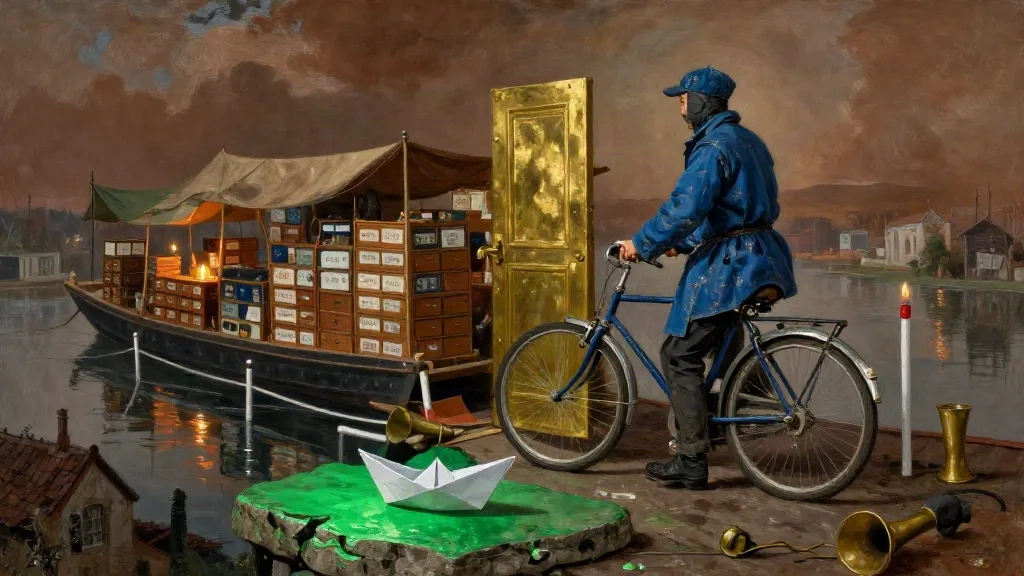
Historical Fantasy.
By the autumn of 1889, no letter had come from tomorrow. The Crown Post had called it a temporary suspension, then a postal reform, then a matter suitable for statisticians. Mara Venn, courier for the Floating Market of Ownerless Memory, cared only that her bicycle still carried wheels across closed thresholds.
The Door in the Corn Exchange
Her bicycle had belonged to the municipal registrar, who rode it nowhere. When its blue steel frame began passing through locked gates, chapel doors, and sealed cellar hatches, the registrar declared it unsuitable for inspection. Mara bought it for four silver marks and a memory of his mother's voice.
That morning it carried her through the brass doors of the abandoned Corn Exchange. Beyond them lay a market suspended above the flooded terraces. Stalls floated on barges of cork and cloud canvas. In their wicker drawers lay memories with no living claimant: a child's first tooth, the scent of a burned theater, a soldier remembering rain.
Each had a brass tag. Each was spoken for in the ledger.
At the first stall, a broad woman held a paper boat above a green stone.
Children had folded that boat from a letter dated 17 June 1901.
Who folded it?
The woman shook her head. The stone was the stall's anchor, cut from a hill demolished before Mara was born. Together they had traveled from a place called the Listening Field.
The Land Retains Its Evidence
Mara knew the Field only as a white scar on old maps. In 1712, the Crown, the parish, and three tenant families signed a treaty with the land. Humans received pasture and harvest. The land received the right to hear every spoken promise made upon it, whether or not its owner consented.
That right had outlasted the farmers, the parish, and nearly every living memory of the compact. Now the land listened through brass horns planted along the old boundary. The treaty made intrusion legal, trespass spiritual, and silence enforceable.
The paper boat opened without wetting. Inside, a narrow slip bore Mara's address and a postmark from 14 November 1911. She knew the address. It was the room she would rent after her mother's death, in a street not yet dug.
Her hands did not shake. Couriers who shook lost parcels in cloud markets.
Her hands shook.
The woman slid the green stone across the counter. Set beneath the paper boat, it glowed with reflected candlelight. In its tobacco-brown depths, Mara saw a line of roofs burning beneath a steel-blue sky.
Letters Arrived as Debts
The market had not lost tomorrow's post. It had received it.
Each future letter became a memory only after its owner was legally dead. The Listening Field had claimed them all for unpaid listening, extracting years from the senders and storing the remainder here among ownerless things.
At the far stall, thousands of folded messages trembled in tobacco jars. Dates from 1890 to 1999 crowded their envelopes. Mara opened one addressed to the registrar.
It contained the reason he had really sold her his bicycle.
He had been the Field's last appointed listener. Without him, the brass horns had begun answering themselves. Every answered letter removed another possible future from circulation. The market traded increasingly empty days because there were fewer tomorrows left to remember.
Mara learned the cure from the ledger: one living memory willingly given in place of every future still owed. The treaty demanded equivalence, not charity. She possessed the only sufficient deposit: all memory of her daughter, though no daughter had yet been born.
The Last Closed Door
Sunset narrowed the barges into a single field of candlelight. Mara unfolded the paper boat and placed it beneath the green stone. She understood then why its maker had returned it to the stall. Memory survived by another was inventory. Memory surrendered freely became passage.
She mounted the blue bicycle. Behind her, the brass horns called her name in the voices of everyone the land had listened to.
The market's last door belonged to a house scheduled for demolition in 1972. Mara pedaled through it into an empty lot below the Listening Field. The stone in her pocket was warm as bread. The paper boat in her satchel had become heavier with water.
She placed both objects on the boundary stone. In candlelight reflected from its facets, she imagined a green door, paper wings, and all the mornings arriving at once.
Then she began to remember.
Not her daughter. Her own name, letter by letter, while the first morning mail gathered beyond the field.





