 Netwrck
Folk Horror.
The Market of Unclaimed Things
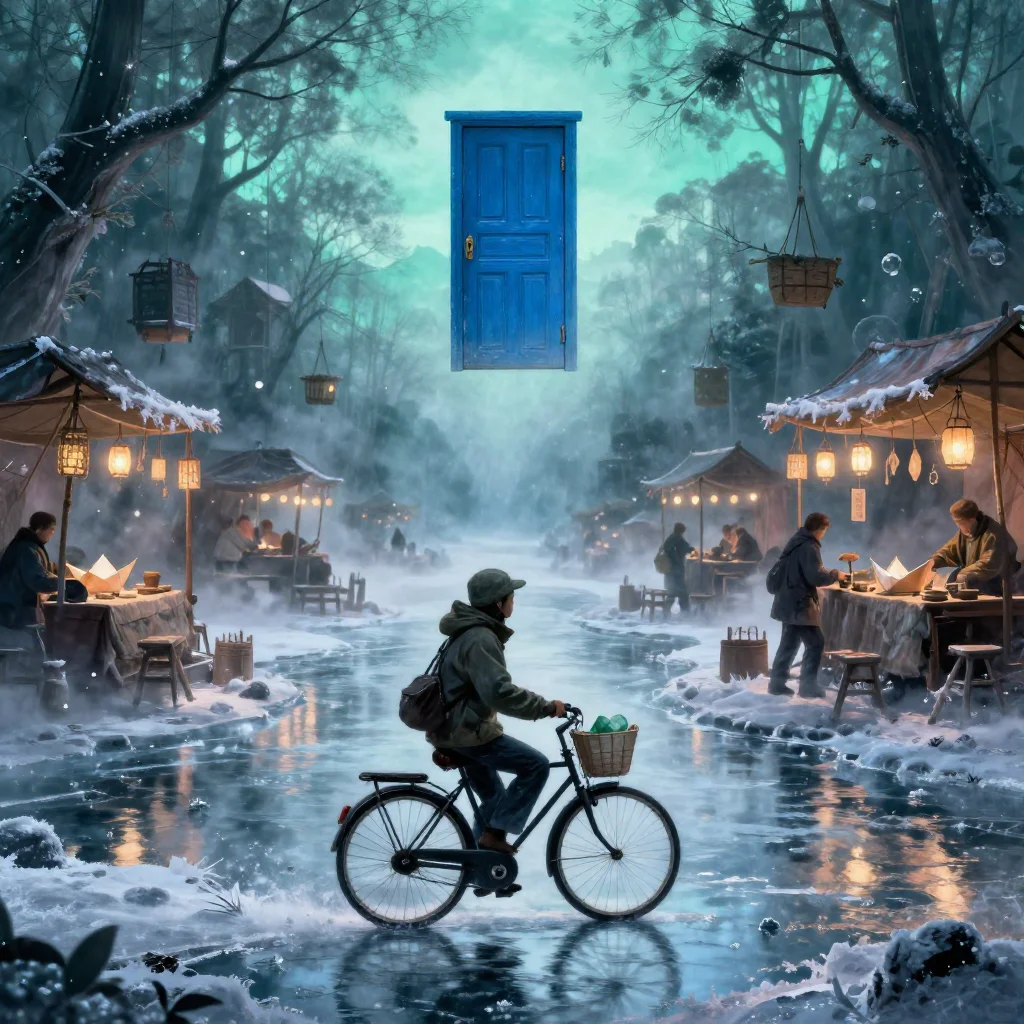
The floating market opened only when the river forgot its name. It drifted beneath a sky the color of iron filings, tethered to nothing, its stalls crowded with memories that had outlived the people who owned them.
There were shoes remembering a child’s first winter. A jar of laughter sealed with blue wax. A pocket full of sunsets, each one scratched onto a thumbnail. People came with questions and left with objects, though they rarely remembered what they had asked.
Mara Vale came for work. She was a courier, lean and weather-bitten, with a bicycle whose front wheel had never once touched the market’s rotten planks. The bicycle waited at the edge of the water, its frame painted the dull green of river weeds.
In the saddlebasket lay a paper boat, folded from a letter that had arrived without a sender. Beneath it rested a green stone, smooth as a tooth and warm even in the frost.
The letter contained one sentence: The future has stopped writing.
Mara had waited six years for an explanation. She turned the note over. No address. No postmark. Only a thin smear of iron across the fold.
The Door in the Stairwell
Her bicycle rang its bell once.
A door appeared behind the nearest stall, set into a wall that had been empty a moment before. It was narrow, blue, and fastened with a brass plate bearing a date: tomorrow.
Couriers were taught never to open doors addressed to the future. The rule existed because the future was not finished. It was still deciding which versions of a life deserved to be remembered.
Mara put her foot on the pedal.
The bicycle surged forward. The wheel went through the door without touching it.
Cold struck her knees. She found herself in a stairwell climbing through a house built from sealed rooms. Behind one door, a woman sorted letters into piles labeled received and never sent. Behind another, a child practiced writing her name in blue frost.
At the top stood a brass speaking tube. When Mara raised it to her mouth, she heard a procession of footsteps crossing a room that did not exist.
Then a voice said, “The land is listening.”
Mara lowered the tube. “Listening to what?”
Silence, then the scrape of a pen.
The Treaty Beneath the Market
She returned to the market with the paper boat crushed in her fist. The green stone had grown colder. At the river’s edge, beneath a lantern shaped like an ear, she found a slab of stone covered in legal script.
The writing was old, but the ink shone. Mara read the first line by lantern-light:
By ancient compact, the land may borrow the voices of those who leave no witness, provided no voice is named in return.
The second line was newer.
All future correspondence is thereby surrendered to the soil.
She struck the slab with the green stone. A crack opened beneath her feet, and the market tilted.
The memories began to speak. A drowned man reciting his daughter’s bedtime. A bride remembering the ring she never received. A million small voices pressed upward through the water, asking who had signed away their tomorrows.
Mara climbed onto her bicycle. The paper boat unfolded itself in the basket, filling with rainwater. She steered toward the crack.
Behind her, the old treaty tore free from the stone. It unfolded into a pale banner and rose into the impossible dawn, where the horizon shone soft cyan.
What the Future Sent
She pedaled through the crack, through the market, through the blue door marked tomorrow. The bicycle carried her beneath frozen fields where shadows moved independently of their owners.
At last she reached a white room. Inside, a clerk sat sorting envelopes. His face was smooth, without eyes, mouth, or age.
“Why no letters?” Mara asked.
The clerk touched an envelope stamped with her name.
“You signed the treaty.”
She looked down. The green stone in her hand had become a seal.
Mara remembered a winter when she had buried her brother beneath a hill. She had promised to send him a letter every year. She had forgotten after the first.
The clerk placed the envelope in her basket.
“The future stopped sending,” he said, “when everyone agreed the past had the right to keep it.”
Mara took the paper boat from the envelope. Inside it lay one small, impossible dawn.
She returned to the river, released the boat, and watched the water carry it toward a shore that had not yet been built. The market bells began to ring. One by one, the lost memories lifted from their stalls and followed the boat into the cyan light.
By morning, only the bicycle remained.
Its front wheel was wet, though the river was far behind them.
Mara mounted it and pedaled home.





