 Netwrck
Folk Horror.
The Green Door
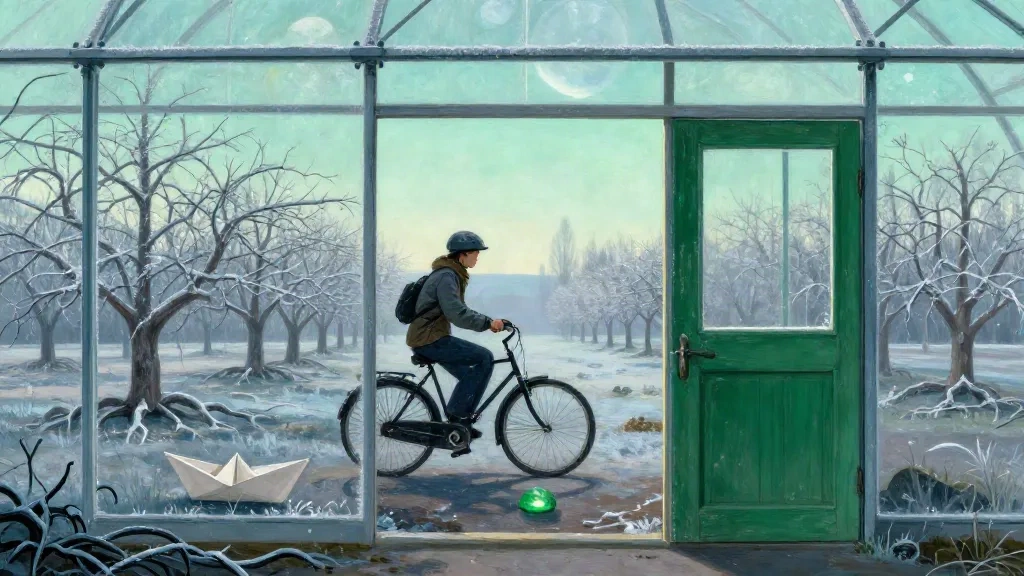
Mara Venn's bicycle had one bad habit: it went through closed doors.
Not violently. It simply continued forward while the door forgot its purpose. On Earth this had made her a courier of small importance. In the orbital greenhouse, where six continents had been folded into a single ring of iron and glass, it made her indispensable.
She carried letters, seed packets, and narrow tubes of blood between the settlement domes. Her bicycle had black tires powdered with frost and a brass bell that rang in winter even when the air was warm.
That morning the greenhouse gave her a door that did not exist.
It stood at the end of the frost orchard, painted the green of deep water. Mara checked her route, the delivery ledger, and the frost on her sleeves. The address was written in her mother's hand.
To the last people of the remembered forests.
The future had stopped sending letters six years ago.
Mara had received the same message from every post office in the ring: no outbound correspondence, no return address, no cause. The old settlement had gone quiet first. Then the seed vaults. Then the children.
She wanted to know why.
The Land That Listened
Behind the green door was a corridor full of roots. They crossed the floor in braided ropes, pierced the walls with pale fingers, and ended at listening dishes aimed at the planet below.
An old treaty hung beside the entrance, preserved under glass. The greenhouse had been built around a seed recovered from a forest erased before human memory. The seed remembered the trees' roots, their fungi, their birdsong, their deaths.
The treaty declared that the land retained the right to listen.
People called it a legal precaution. Mara's mother had called it a promise with teeth.
At the end of the corridor she found the last post room. Its sorting cases were full of unopened letters, all addressed to names that no longer appeared on any census. A paper boat sat beneath the desk, its folds sharp as knives. Beside it lay a green stone, smooth, warm, and veined with white.
Mara recognized the stone from her childhood. Her mother had carried it during the evacuation, saying it was a piece of the forest's memory.
When she touched it, every listening dish turned toward her.
Letters From the Unsent
Then the forest began to speak.
Not in voices. In absences.
It showed her a winter morning beneath the original trees. Children planting seeds while frost silvered the leaves. It showed the seed being taken from the soil, then the soil being covered, then the cities, then the long quiet after people forgot the names of the vanished species.
The treaty had not merely allowed the land to listen. It had allowed the land to answer.
Mara opened the nearest letter. Her mother's handwriting moved across the page without ink.
Do not bring them back. They have already answered.
The bicycle rang behind her.
One of the unopened letters had slipped from its case. The paper boat had begun to drift toward the door, riding a thin current of green light. The stone split beneath Mara's thumb.
Inside it was a seed.
The Dawn That Refused
She could have planted it. The greenhouse's oldest instinct rose in her: put the missing thing back into earth and make the future continue.
Instead she read the treaty beneath the green door's glass.
The final clause said that if the land requested a witness, the witness must remain until the last remembered root had heard its name.
The light beyond the listening dishes turned cyan. Frost gathered on the windows, each crystal burning with a soft impossible dawn. Somewhere below, the planet's clouds began to move in the shape of a forest.
Mara understood then that the future had not stopped sending letters because it had ended. It had stopped because the old treaty made silence a legal language, and the land had learned to speak it.
She placed the green stone in the paper boat. The boat crossed the threshold, and the bicycle followed without touching the ground.
By morning the greenhouse had no frost orchard, no root corridor, and no letters waiting to be sent.
Only a green door in the eastern wall. Mara could not open it, but she could hear someone on the other side striking three times against the metal.
She did not answer.
She listened until the knocking became a tree remembering how to grow.





