 Netwrck
Weird Fiction.
The Door in the Bell Tower
By morning, the monastery had lost its yesterday.
No one announced it. The saffron banners hanging from the cloister beams were still bright, but the ink on their dates had faded to pinpricks. In the kitchens, the cooks compared shadows and found them disagreeing. Outside, the country’s villages had sealed their doors against a wind that moved from the west while blowing smoke-grey from the east.
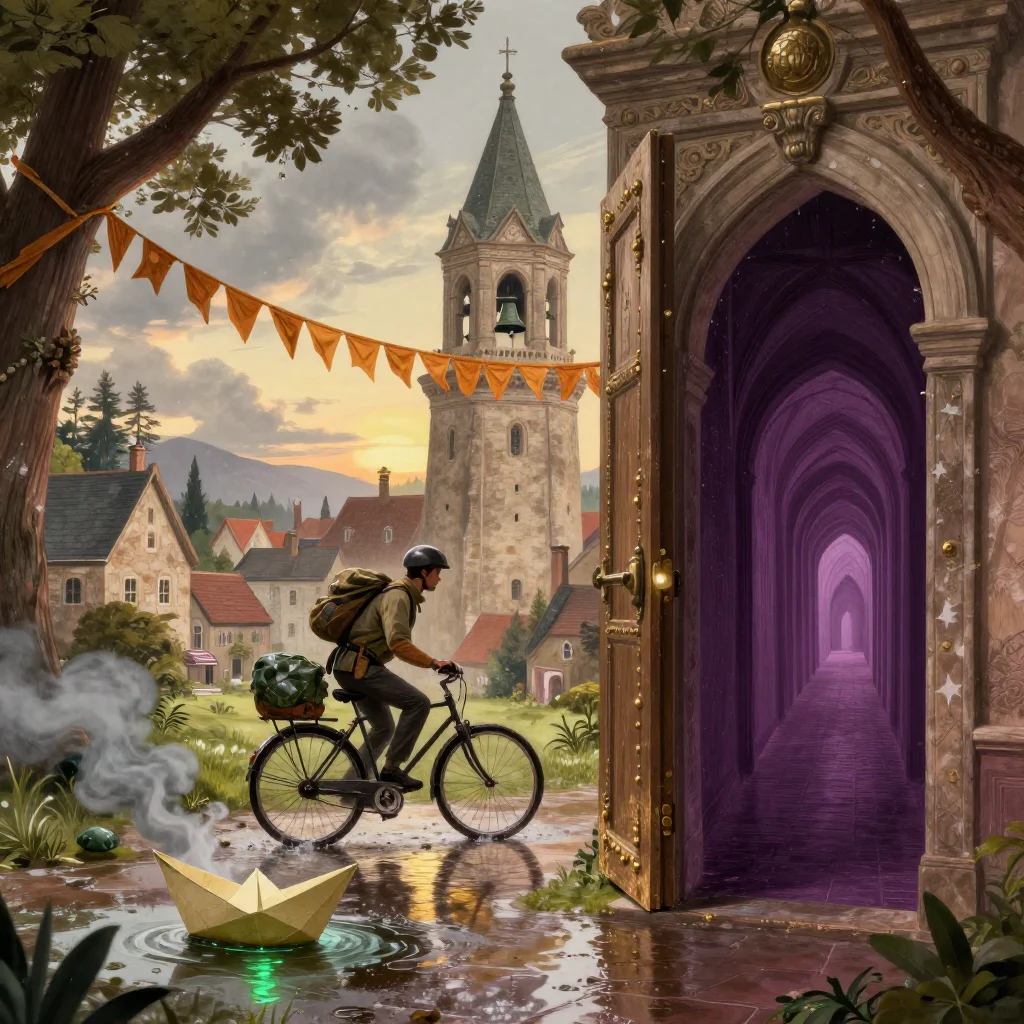
Mira unfolded the delivery route across the bell-tower floor. The ink began at the monastery and ended at a place marked only by a small black door. Her bicycle leaned against the rack, its front wheel ticking against the stone. A bicycle could pass through any doorway if the rider believed the doorway was already open.
That was why couriers carried no keys. Keys insisted on permission. Mira’s bicycle merely arrived.
She pocketed the map, a folded paper boat, and the green stone she had found beneath the monastery’s oldest clock. Then she rode at the tower door.
The door was oak, swollen shut, crossed by seven iron bands. The bicycle went through.
The Land That Was Allowed to Hear
Mira found herself in a corridor made of open windows. Through them she saw the same village repeated in different years. In one, children chased a brass comet across a blue sky. In another, the fields were buried under black snow. In the last, every house stood empty beneath a saffron moon.
An archivist waited at the corridor’s end. He wore plum velvet, though dust had settled into its folds.
“You have come for the future,” he said.
“Letters used to come from there.”
“They still do.”
He opened a ledger. Every page contained Mira’s handwriting.
She read the first entry aloud. “Courier departs at noon.”
The second said, “Courier forgets the reason.”
The third said, “Courier remembers.”
Then the writing stopped.
“The future stopped sending letters because it has nothing left to say,” the archivist said. “Or because you have not asked the right question.”
Mira struck the green stone against the ledger. A deep plum light spilled between the pages. Beneath the tower, the land turned like an immense ear. The old treaty appeared in Mira’s mind, recited by bells: The land may listen to any voice that has crossed it lawfully.
She understood then. The treaty had not been made with a ruler. It had been made with the land itself, granting the country permission to listen for as long as the people remained silent enough to hear it.
Someone had stopped being silent.
The Future in the Mailbox
The archivist led her to a chamber beneath the monastery. A brass mailbox stood in the centre of the floor, surrounded by a circle of wet footprints. The mailbox was empty.
Then it began to click.
Letters arrived without a postmark. Each carried Mira’s name, though the handwriting changed with every delivery. One was written in a child’s careful capitals. Another was stained with seawater. A third smelled of rain on hot stone.
“These are from the years ahead?” Mira asked.
“They are from the years you refuse to enter.”
She opened the first letter. Do not deliver me.
The second said, I am sorry for what you will do.
The third contained only a paper boat identical to the one in her pocket.
When Mira placed her own boat beside it, the two boats drifted together across the wet floor. They turned toward a seam in the stone. Behind it, wheels rattled in a corridor that no longer existed. Voices called her name from the other side.
“You can deliver one letter,” the archivist said. “Then the future resumes.”
“Why one?”
“Because the treaty permits the land to listen, not to choose. Choose, and the land will listen to you instead.”
Mira looked at the mailbox. At the paper boats. At the green stone glowing beneath the brass.
The Courier’s Own Hour
She did not deliver a letter.
She opened the paper boat and placed the green stone inside. Then she wrote on the archivist’s blank page: I hear you. I cannot carry tomorrow unchanged.
The land answered before the ink dried.
Not with thunder. Not with bells. A small click came from every closed door in the monastery, followed by the creak of hinges turning in distant villages. Across the country, people heard the same silence where their own names should have been.
At midnight, Mira rode through the black door. Her bicycle crossed an old border, a kitchen wall, and finally the doorway of her childhood home, which had been locked for nine years.
Inside, an envelope waited on the table.
It was addressed to her, in her own handwriting, and dated tomorrow.
Mira sat down. After a while, she unfolded the paper boat again. The green stone had become a seed. Beneath the floorboards, something patient began to grow.
She read the letter aloud. At every word, the house opened another window. By dawn, the village had filled with light, and the country had finally received a reply.





