 Netwrck
Weird Fiction.
The Station Between Days
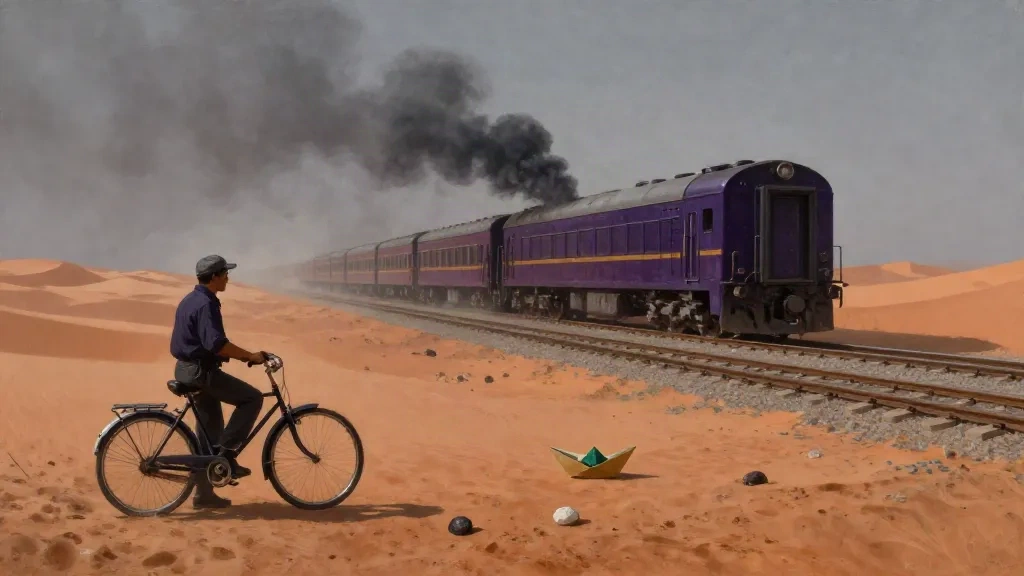
At four in the afternoon, the saffron sun sank into the hills behind Silt Halt, and the train arrived without a sound.
Mara was the station’s only courier. She had a grey uniform, a brass badge, and a bicycle with a bent rear fender. The bicycle had come to her twelve years ago, folded into an envelope addressed in handwriting she recognized as her own. Since then, it had opened every door she brought it to: locked storehouses, abandoned offices, the door of the dead stationmaster who had died before she was born.
It never opened a door in the town. It opened doors in the train.
The carriage was plum-dark inside, smelling of hot metal and rain on stone. Its windows showed a landscape of saffron dunes, each one crossed by rails that glinted like wet knives. The conductor wore seven white gloves and carried no ticket punch.
“Where does it stop?” Mara asked.
“After the last letter,” he said.
She had carried letters for years: invitations, apologies, birth notices, a strip of paper folded around a green stone. People placed them into her satchel and trusted her to deliver them to a person named on the envelope. But no one had sent a letter from the future in seven years.
Before that, they had arrived every morning.
At the far end of the carriage, a paper boat sat on the empty seat. Its folds were sharp, its paper the color of old cream. Beneath it rested the green stone from Mara’s oldest delivery.
The conductor would not meet her eyes.
The Land That Listened
The train stopped beside a low stone building half-buried in smoke-grey air. A brass plaque named it the Archive of Future Correspondence. Its doors were sealed with strips of yellow paper.
Across the threshold lay a treaty older than the railway.
Mara had seen copies in the station ledger. The land had once been a sovereign territory, and its rulers had signed permission for the future to listen to every word spoken within their borders. The clause survived every reform, war, and change of name. It read:
The territory grants the listening right to all arrivals, present and unborn, provided they do not take what is freely offered.
Inside the building, shelves rose into darkness. Letters hung from wires above her head, each one glowing faintly from within. Some were sealed. Some were blank. Thousands of them faced the walls.
Mara held up the green stone. Every lamp went out.
On the floor, the treaty glowed. Lines of writing moved across the stone like insects fleeing heat. Mara dropped to her knees and read the amendment: the future had revoked its permission to be heard.
“Why?” she whispered.
The room answered with a thousand dry clicks.
A letter slid from the shelf and landed at her feet. It bore tomorrow’s date. She opened it, but the paper contained only one sentence:
Because you answered.
What the Bicycle Carried
Mara remembered the final future letter. It had arrived in a bicycle basket, addressed to a child who had not yet been born. She had been instructed to deliver it after the child’s sixteenth birthday.
She had forgotten.
Not merely forgotten the letter. She had forgotten the child.
When the delivery failed, the future had no one left to write to. By law, the land could not listen if no one consented to be heard. The silence had begun then. The train kept arriving because treaties are stubborn things, but its cargo had vanished.
“Take the stone,” said the conductor.
He stood in the doorway, seven gloves pale against the plum shadows.
“Take it, and the land can listen again.”
“At what cost?”
“The courier must carry the silence until the first future letter is answered.”
Mara put the stone in her pocket. The paper boat lifted itself from the seat and settled into the bicycle basket.
Outside, smoke-grey air swallowed the dunes. The station clock struck one, then stopped.
The First Word
Mara rode back through the locked doors of the station, the stationmaster’s office, and the sealed signal room. With every threshold, the bicycle rang its bell. The sound arrived from somewhere ahead.
At dawn, she reached the western boundary. A boy waited there with a blank envelope.
“Are you the courier?” he asked.
Mara took out the green stone and the paper boat. She placed them in his hands.
“No,” she said. “I’m the person who was supposed to answer.”
The boy unfolded the envelope. Across its page, one line appeared in pale saffron ink: I hear you.
The desert inhaled. Far away, beneath the plum horizon, a train began to approach.





