 Netwrck
Historical Fantasy.
The Doors of Winter
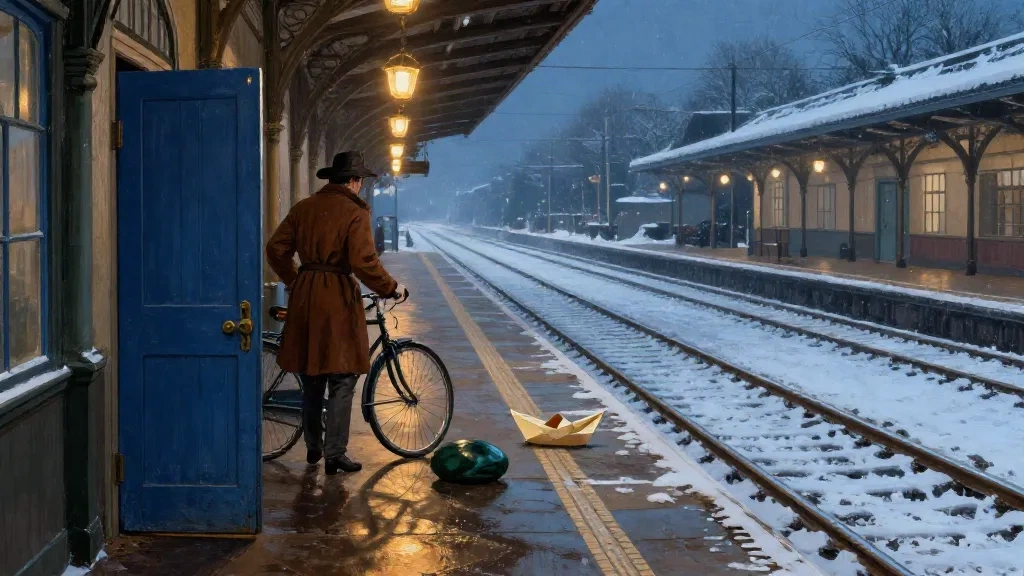
Mara Venn arrived at Brindle Station with frost in her eyelashes and a bicycle that had learned bad habits. Its front wheel turned toward sealed doors, and whenever Mara tried to steer elsewhere, the spokes developed a stubborn tremble.
The station stood beneath a steel-blue sky, though snow was falling in June. Passengers waited beside four platforms marked Spring, Summer, Autumn, and Winter. Their coats hung heavy with tobacco brown wool. Brass clocks disagreed about the hour. Reflected candlelight moved across the floor as if the lamps were underwater.
Mara's satchel held three letters, two return tickets, and a paper boat folded from a page of railway regulations. She had been a courier for eleven years. No one had ever explained why the future had stopped sending letters.
At the Winter platform, an old woman lifted a green stone from her pocket. It was smooth, dark, and veined with pale green. She placed it beneath Mara's bicycle bell.
“Do not open the wrong year,” the woman said. “The land has permission to listen.”
Then she boarded a carriage smelling of snow and woodsmoke. The stone rang once. A locked door at the end of the platform opened.
The Year Without Ink
Beyond it lay a station in summer noon. The tracks were white with dust, the flowers iron-dark, and every clock had stopped at 11:17. A boy in a conductor's cap waited beside an empty mail cart.
“There are no letters from tomorrow,” he said. “There have been none for thirty years.”
Mara showed him her letters. The paper softened in her hands. Each envelope bore a date from the coming months, but the addresses had been scraped away.
“Who took them?”
“Not who. What.” He pointed down the platform. Shadows moved beneath the benches, each one wearing the outline of a person listening.
In the station office, Mara found the treaty that governed the crossing. It had been signed after the War of Lost Seasons, when the living agreed to let the land hear every secret held within its borders. The land had listened. Then it had learned to answer.
The clause concerning the future was written in a hand unlike the others. The ink shone like candle flame. Mara read it aloud.
“No future correspondence shall be delivered, lest the years reveal what the present has chosen to conceal.”
The paper boat in her satchel began to drift toward the window.
A Door Under the Tracks
Mara followed the boat into a service tunnel where the rails ended at a red door. Her bicycle rolled after her without a rider, its bell chiming against the walls. Behind the door she found a room filled with listening fields: brass horns, wax cylinders, shells pressed to old maps, and winter boots standing ankle-deep in melted snow.
On every instrument hung a small green stone.
The boy from the summer station stood beside a table. “The treaty is not a spell,” he said. “It is a listener. The land asked what the future wanted to hear. The future answered that it wanted to be left alone.”
Mara placed her palm on the nearest stone. A voice entered her hand, thin and immense.
It showed her a century of messages traveling backward through winter. Each letter carried news of harvests, marriages, wars, and births. At the final date, the future had sent a single warning: a green stone was buried beneath the station, and the treaty had mistaken silence for safety.
Mara understood then. The future had not stopped writing. It had stopped trusting the land to carry its words.
What the Land Kept
She cut the paper boat's folded sail into narrow strips. Around the green stone she wrapped them, one for each winter platform, and spoke the courier's oldest promise.
“Nothing entrusted to me is lost.”
The station shook. Doors opened onto spring rain, autumn orchards, and a white morning untouched by treaty. The listening fields shrieked as if a thousand seasons had been forced through one keyhole.
Letters poured from the walls. They struck Mara's shoulders, her face, the bicycle's handlebars. Every future season had written to someone, but none had been allowed to arrive.
At dawn, the old treaty lay open in the office. Mara added one line beneath its solemn clauses.
“The land may listen, but the future may speak.”
The green stone cracked cleanly. A single letter emerged from it, addressed to Mara's first customer, who had died fifty years earlier.
She did not deliver it. Instead, she tied the paper boat around the stone and set it on Platform Winter. By noon, a child had found it, and the station had begun sending letters to the places people had stopped believing existed.
Mara mounted her bicycle. The wheels turned toward the open door, and beyond it the first train of autumn arrived with a bright, impossible bell.





