 Netwrck
Historical Fantasy.
The Door in the Wheel
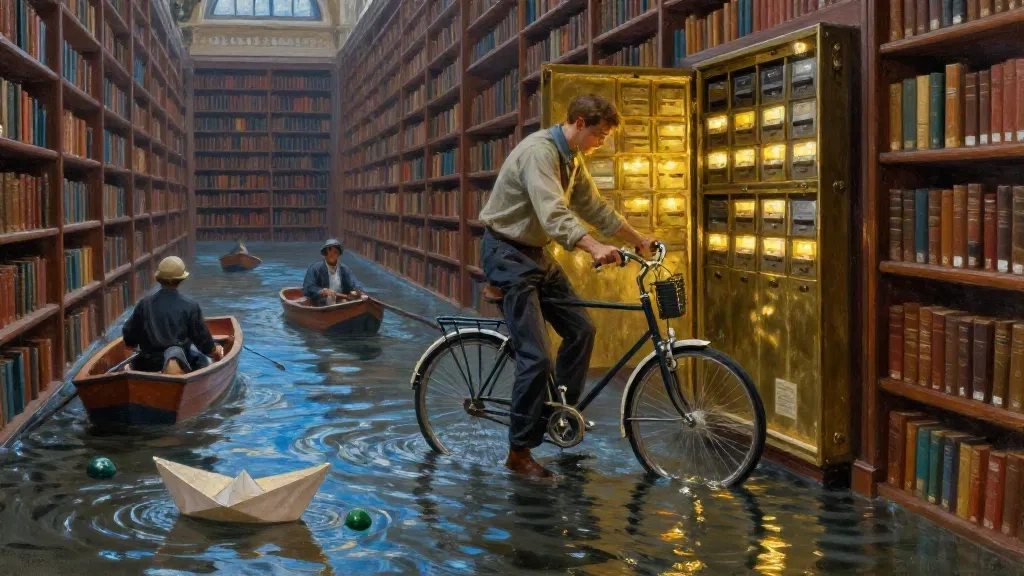
In the year the rain rose above the archive stairs, the couriers still came to the waterline on bicycles. They carried no saddles and no luggage. Each machine had one brass door set into its frame, shut with a latch of blackened silver, and behind that door lay the road assigned to its rider.
Nessa’s bicycle was painted tobacco brown, though its front wheel shone steel blue from years of passing through wet doorframes. The map stitched beneath its saddle was blank except for a green dot near the center. She had inherited the bicycle from the previous courier, along with a paper boat folded from a letter dated eighty-three years ahead.
“The future has stopped writing,” the chief librarian said.
He stood at the top of the flooded stacks, holding his lantern above the black water. Shelves rose from it in long ranks, their lower books swelling beneath the surface. Between them, librarians rowed flat-bottomed boats, calling shelf numbers to one another.
“Letters once arrived from places not built yet,” Nessa said.
“They did.”
“Then the future has gone silent.”
“Or something has begun listening too closely.”
He offered her the green stone from beneath the map. Warm as bread from the oven, it bore a thin silver vein.
The archive had been built before the flood, when paper was still cheaper than forgetting. Its oldest laws rested in waterproof cases. Nessa opened the case marked LISTENING, but water had swollen the binding. The pages resisted her knife until the librarian struck them with his oar.
The treaty appeared in a language of sealed lips. It bound every citizen to keep one ear open for the land. The land, in return, promised not to lie. This was the first treaty made with a country that could not speak, only listen through the walls of houses, roots, wells, and rooms.
The Archive Hears
At dusk, the candles in the water answered one another. Their reflections trembled across steel-blue shelves, and every reflected flame seemed to hold a face.
Nessa lifted the green stone into the candlelight. The silver vein brightened. Somewhere inside the bicycle’s door came a soft dragging noise, as if a heavy chair were being moved across a room.
She unlatched the door.
Warm air breathed over her face. Beyond the frame was a hallway she had never seen, lined with brass mailboxes. A sign above the nearest one read TOMORROW, ROOM THREE.
“I only wish to understand why the letters stopped,” Nessa said.
A clerk emerged with a stack of unopened envelopes. “That is not a permitted question.”
“Why not?”
“Because the answer is listening.”
He retreated. The mailboxes began knocking from the inside, one after another, each lid lifted by a finger of candlelight. Nessa set the paper boat on the water outside the door. It drifted toward the nearest mailbox and stopped at its threshold.
The clerk stared at it.
“That is not your property,” he said.
“It came from the future.”
“Then it carries no authority.”
He slammed the door.
Nessa did not stop the bicycle. She rode through the closing brass, through the stacks, and through the flooded nave where the treaty hung above the water. The land listened in the walls. Its breath lifted the loose pages, which stirred like a flock of gray birds.
What the Land Could Say
By midnight she reached the oldest shelf. Its label had been washed blank, but the books there smelled of tobacco and rain. She rowed alongside them, reading titles in the wavering light: Minutes of the Unborn Council, Inventory of Weather Not Yet Spent, and Letters Withheld by Mutual Consent.
The green stone pulsed in her palm. A brass door appeared in the shelf itself.
Behind it was a small room filled with paper. Letters from every possible year hung from ceiling to floor. They whispered, rustled, and pleaded in their own languages. Nessa saw one addressed to her in handwriting she recognized from her own desk.
“The future is not silent,” she said.
The room answered with a thousand sealed mouths.
“It is afraid. Your treaty permits the land to listen, but the land has learned to listen without asking. Every future letter gave it a shape. So the future stopped giving it names.”
She lifted the green stone. Its silver vein pointed not toward the letters, but toward the door behind her.
At the waterline, the chief librarian waited.
“You may take the letters,” he said, “or you may make the land forget them. Not both.”
Nessa understood the cost. Carry the future out, and the land would keep the shape of every unwritten life. Leave the letters sealed, and the silence would hold, but so would their protection.
The Unaddressed
She placed the paper boat in the center of the room and set the green stone inside it.
“I do not need the answer,” she said. “I need permission to ask again.”
Then she wrote on the boat’s sail: WHY NO MORE LETTERS?
The question left no address. The treaty required the land to listen, not to choose its reply. Candlelight moved across the flooded shelves, and somewhere beneath the water a bell rang once.
The next morning, a sealed letter floated beneath Nessa’s bicycle door. Its paper was damp, its ink pale, and the seal was a green stone split by silver.
She did not break it immediately. She listened first, as the treaty demanded, to the rain, the shelves, the rowers, and the quiet space where a future might still be choosing its words.





