 Netwrck
Folk Horror.
The Door in the Third Stacks
Mara had been a courier for eleven years, but she had never delivered a letter to a place rather than a person.
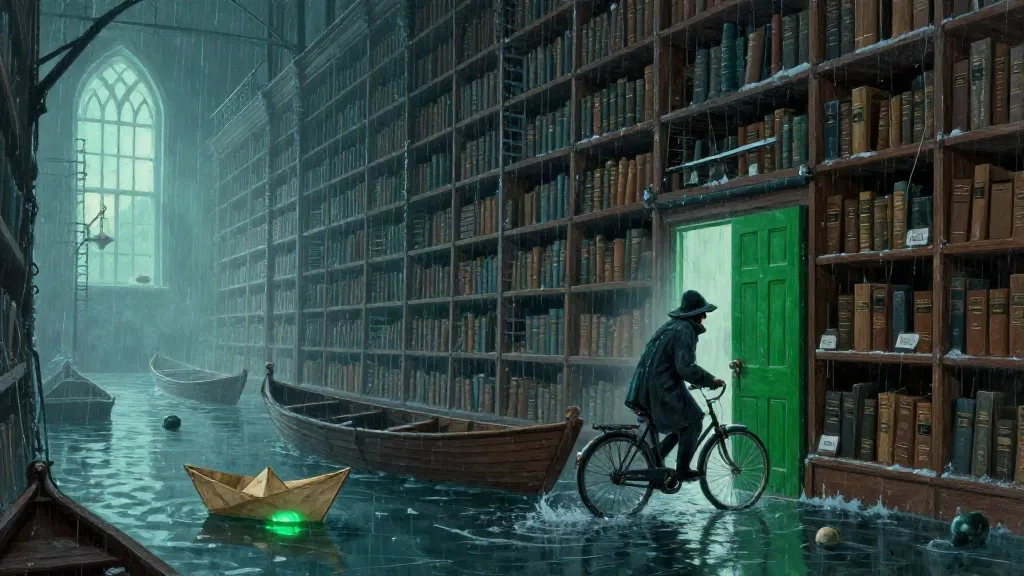
The archive rose from the floodwater like a drowned cathedral, its upper windows glazed with frost, its lower doors half-submerged. Librarians rowed between the shelves in narrow wooden boats, calling requests across the dark aisles. They wore wool coats beneath their rain cloaks and kept their voices low. The books breathed around them, pages lifting in currents no one could feel.
Mara's bicycle leaned against a reading desk, bells silvered by damp. Its front wheel pointed toward a green door marked STAFF ONLY. The door had no handle, only a small glazed square.
She had come for the letters from tomorrow. Every day for three years, the future had sent nothing. Not curses, not poems, not the threatening bills her mother used to invent. The absence had entered the city like a held breath. The postal authority called it a scheduling fault. Mara called it the end of a world she had not yet been born into.
The Land at the Listening Window
The green door opened when she brought the bicycle against it. The wheel passed through before the frame did.
Beyond lay a room shaped like an ear. Water covered the floor, and from its surface rose a low iron table. On the table rested a treaty written on translucent skin, sealed with a green stone. Beside it floated a paper boat, its folds sharp as knives.
The first clause named the people who had settled the valley. The second named the river. The third, written in a hand that shifted whenever Mara looked away, granted the land permission to listen.
Let the water hear the names spoken over it, and let the names remain.
Mara recognized the phrase from a civic notice. The old treaty had ended a war without a battle. The victors had promised the river a century of silence. The river had accepted.
When she touched the stone, every lamp in the archive went out. From the stacks came the sound of a bicycle bell, ringing in rooms that had no doors.
Letters Beneath the Waterline
The librarian rowing nearest her was ancient beneath his hood, with a face like wet parchment.
“You came for the letters,” he said.
“Yes.”
“They are not missing. They are being answered.”
He dipped his oar, and the archive shifted. A shelf slid forward, revealing a stairwell descending into black water. Mara took the paper boat. The stone fitted inside its hollow stern.
Below, letters floated everywhere, packed shoulder to shoulder in the submerged corridors. They were addressed to Mara, dated centuries apart. One described her bicycle as a metal bird. Another thanked her for arriving before the flood. A third was written in her own handwriting.
It said: Do not let the treaty finish its sentence.
She understood then that the future had not stopped sending letters. It had begun listening. Every answer she had ever given, every promise made by a city that believed water could not complain, had become evidence. The treaty made the land legal. The land made silence a lie.
Somewhere above them, a librarian rang a brass gong. The water began climbing the stairs.
The Permission of Frost
Mara pedaled through the flooded rooms, the bicycle wheels skimming beneath desks and passing through locked cupboards. The paper boat burned in her hand. The green stone beat like a heart.
She reached the treaty chamber and tore the final clause free. The green stone cracked. Beyond the windows, the impossible dawn spread across the water: frost, iron, and a soft cyan light that made every drowned shelf look briefly newly made.
The land exhaled. Ten thousand letters rose into the air. They did not reach the future. They returned to the living, each addressed to the person who had first spoken it into silence.
Mara's own letter opened. There was no warning, only a short sentence in handwriting she recognized from a life she had not yet lived.
When you reach the last door, ask what the river wants.
She looked down. The river had stopped listening.
It was waiting for her answer.





