 Netwrck
Folk Horror.
Letters Missing from the Morning
Mara kept her bicycle beneath the awning of the drowned post office, where rain ticked against the blue tiles and never reached the ground. Every morning the river brought in a yellow post boat, its hull packed with letters addressed to houses that had vanished. The letters were warm, recent, and written in handwriting that became less familiar each year.
Then the future stopped sending them.
For eleven days the post office received only blank envelopes. Mara opened them over the brass scale. Each contained a single grey speck, no worse than a grain of dust. The river still arrived, still knocked against the pilings, but the post boat came empty.
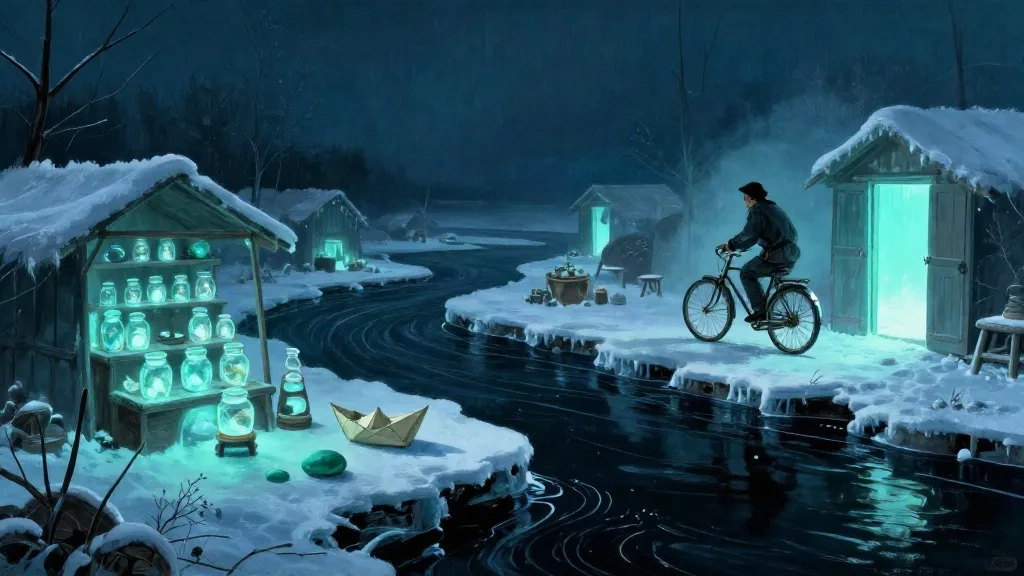
Her bicycle waited with its front wheel turned toward a green door in the alley. It had learned closed doors before she did. A locked gate became a path. A sealed attic became a hill. Mara followed the machine down the hill, carrying the blank letters in her coat.
At the end of the lane stood the memory market.
The Market Beneath the Frost
It floated above the river without rope or anchor: a field of blue stalls, iron bells, and narrow lanes tiled with frost. Memories without owners drifted between the counters in clear jars. A wedding breakfast repeated itself behind glass. A child laughed in a stairwell that no longer existed. A woman kept opening a blue door.
Booths had replaced names with numbers. The number 683 marked a stall piled with letters that had never reached their writers. Their paper smelled of rain and iron.
Mara set one on the counter.
The vendor wore seven mittens and no face. “Letters from the far side,” it said. “They arrive before they are sent. Each one contains the sound of the sender becoming nobody.”
Mara looked through the stall. Beyond it, the market floated above a black field. A bicycle wheel turned there, though no bicycle was visible.
She paid with a memory of her mother’s hands. The hush that entered her mind was worse than losing the hands themselves.
The Treaty Under the Stone
The bell at the market’s center rang once. Frost spread from its clapper and froze the stalls into a single white silence.
On the riverbank lay a green stone, flat and cold, carried there by a paper boat. Mara recognized the stone from her father’s pocket. He had said it was a seal. He had lied.
When she lifted the boat, the stone opened like a door.
Underneath the river was a chamber full of listening fields. Men and women in old-fashioned coats sat at wooden desks, heads bowed over the earth. Iron instruments pressed their ears to the soil. Frost filmed the walls. Far away, a cyan light trembled behind the horizon, neither sunrise nor evening.
An inscription ran across the chamber:
The land grants safe passage to those who carry memory, and accepts the hearing of all who speak within its borders.
The treaty had been signed after a flood, when the villagers believed they could bargain with the ground. The land had agreed. Since then it had listened to every footstep, every whispered name, every promise made indoors. The market existed because the land had grown tired of holding other people’s lives.
Mara lifted the green stone. In its center was a black notch.
“The future stopped writing,” the faceless vendor said behind her. “Not because it ceased. Because it no longer had a place to put its words.”
The Door That Answered
Mara placed the stone in the notch. The chamber jolted. Every listening field turned toward her.
Across the black field, the invisible bicycle rang its bell. A door appeared in the frost: red, swollen, fastened with a chain of letters. Each link carried a name Mara had delivered.
She rode toward it. The wheels crossed the chamber without touching the ground.
Behind the door, the future was not a city or a kingdom. It was a room of desks, abandoned beneath an impossible cyan dawn. Nobody sat there. Pens lay warm in every hand-shaped hollow of dust. On the wall, a single sign read:
NO LETTER MAY BE SENT WITHOUT A LISTENER.
Mara understood then. The future had stopped writing because the land had learned to listen and never stopped. Every unfinished sentence had been drawn underground. Every intended letter had been surrendered to the treaty. The blank envelopes were not refusals. They were warnings.
She opened her coat. The grey specks in the envelopes lifted into the cyan light, becoming words, becoming names, becoming the first thin lines of handwriting.
One by one, she placed them back into the paper boat.
The river began to rise. The market’s bells rang. On the far bank, doors opened in houses that had been sealed for years. People stepped out carrying letters they had never received.
Mara turned the green stone in her palm. Beneath it, faintly, another voice was listening.
She wrote her question on the last blank envelope:
Who taught the land our silence?
Then she rang her bicycle bell and rode into the dawn.





