 Netwrck
Historical Fantasy.
Letters from the Year Ahead
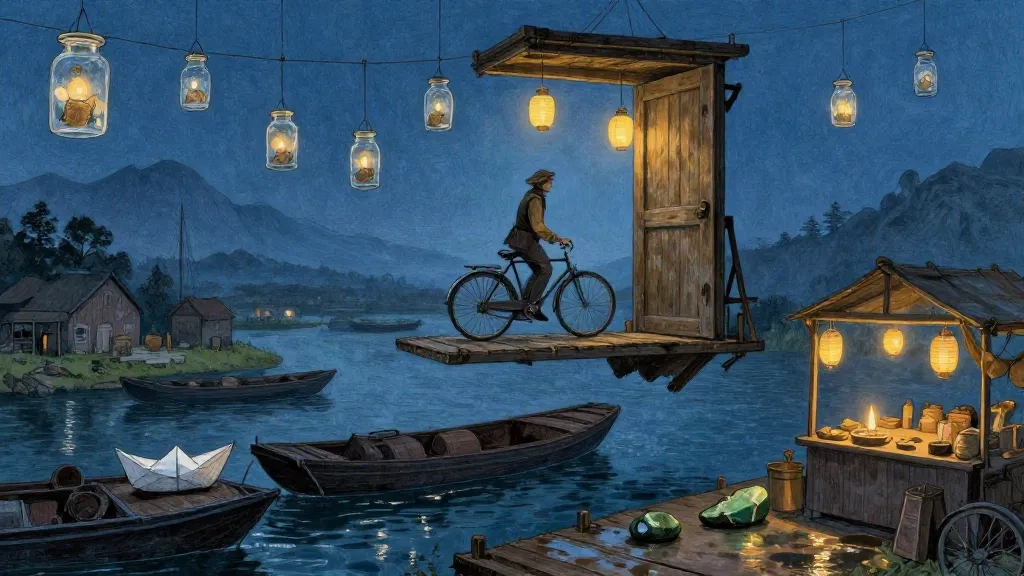
In the floating market above the old canal, memories without owners drifted between stalls like pale moths. They hung in jars, lay folded beneath glass, or clung wetly to the undersides of barges. Merchants sold them by the spoonful: a childhood winter, a soldier’s last whistle, the exact sound of a mother calling from a room that no longer existed.
Mara Venn arrived with a bicycle painted the color of a winter sky. Its frame was narrow, its bell missing, and one pedal clicked whenever it crossed a threshold. The courier badge at her waist had been inherited from her mother, along with a map of doors that existed only in the minutes before they opened.
She had come for a simple answer. Why had the future stopped sending letters?
For seven years, riders had arrived at the Lantern Market with mail from years ahead. The messages were always brief: warnings about rivers changing course, names of children not yet born, requests for old songs and uncut silver. Then, without warning, the deliveries ceased.
The market authorities said the road beyond the calendar had collapsed. Mara did not believe them. The bicycle believed even less. Since dawn it had pulled east, across floating planks and through a blue-painted door set into the side of a tea stall, then stopped before a shuttered house standing alone in the canal.
The Land That Listened
Inside, the air smelled of tobacco, old paper, and river mud. A brass plate hung beside the entrance, green with age. Its inscription read:
By the Treaty of Ear and Furrow, the land may listen where its owners have ceased to speak.
Mara had seen similar notices in archives. The treaty had been signed after the flood of 812, when the valley claimed a village and the surviving nobles declared the soil itself a legal witness. By ancient law, anything hidden in the ground could be heard if the land consented.
On the table lay a paper boat. Its folded sail bore the market’s seal. Beside it rested a green stone, smooth as a thumb worried for years. Mara recognized both from her mother’s account of the final delivery: a boat that could cross unwritten water, and a stone that opened paths sealed by law rather than iron.
She touched the boat. It unfolded itself, climbed upright, and pointed toward the floor.
Mara set the green stone against the boards. The floor opened without hinges or seam. Beneath it lay a narrow stairway descending into warm darkness. From somewhere below came the sound of a pen scratching continuously.
“You are late,” said a voice.
A clerk sat at a desk covered in unsealed envelopes. He had no face, only a brass mask polished to blindness. Beyond him, shelves climbed into the ceiling, each crowded with letters dated beyond any calendar the market had known.
The Unsent Future
“The letters are still being written,” Mara said.
“They have been written for eighteen months.” The clerk turned a page. “The future is not silent, courier. It is prevented from speaking.”
He explained the compact. The treaty had granted the land the right to listen, but the land had grown addicted to confession. It kept every secret entrusted to it, including the names of unborn years. Believing that silence would preserve them, the land refused to release even ordinary post.
Mara looked at the paper boat. The little vessel trembled on the clerk’s desk.
Her bicycle had carried one last letter that morning, hidden in its hollow frame. It was addressed to the future, and inside was a single question: What happened to us?
The clerk touched the envelope. The green stone cracked cleanly in two.
“To deliver that, someone must remain on the other side,” he said. “The land will not surrender a voice it has learned to keep.”
Mara mounted her bicycle. Its rear wheel passed through the brass mask of the clerk, then through the wall beyond. She followed the paper boat into a corridor where future years hung like lanterns, each one casting a different color across her face.
At the final door, she placed the broken green stone against the lock. The bicycle rang its missing bell with a clear, impossible note.
A Door Left Open
On the other side, children in unfamiliar clothes waited beside a river. One of them took Mara’s letter. Another handed her a bundle of new envelopes, already addressed to houses in the market.
“You will need to return before dawn,” the eldest child said.
Mara looked back. The paper boat had crossed after her, its sail bright beneath reflected candlelight. The land behind them was no longer listening. It was speaking, in a voice like rain striking tin roofs, carrying every sentence it had stolen.
She took the letters.
By morning, the floating market had received its first mail from the future. The messages were ordinary: births, farewells, recipes, warnings about rain. None offered answers, but each contained a future tense.
Mara left the green stone’s two halves on the stall where she had found them. The paper boat remained in her coat pocket, dry beneath the steel-blue sky.
Every closed door she crossed afterward opened from the far side. She no longer needed to know why.





