 Netwrck
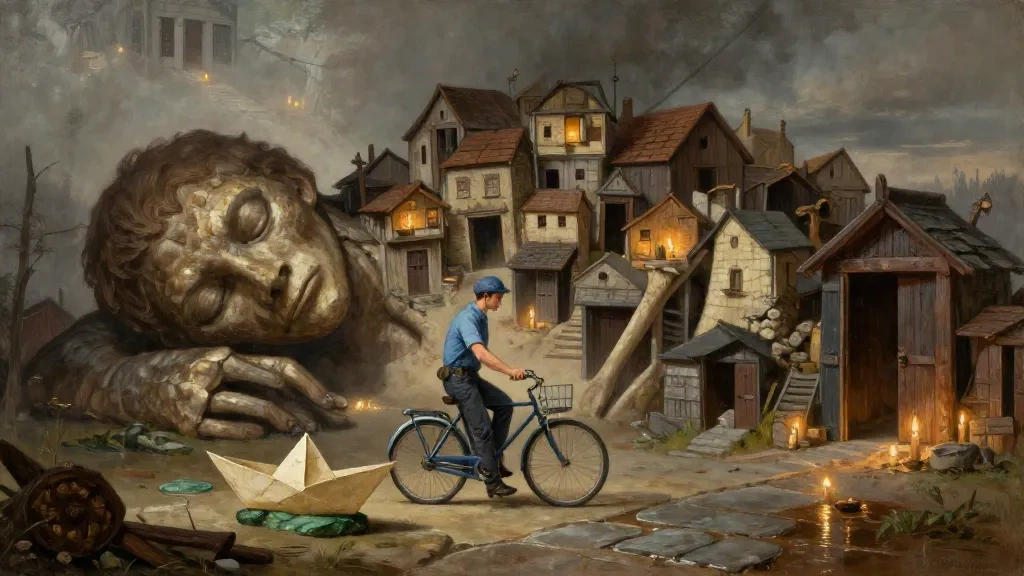
Historical Fantasy.
The Door in the North Rib
By dawn, Mara Venn had crossed the village twice without hearing her bicycle bell.
The village of Bellweather occupied the hollow chest of a giant who had fallen asleep beneath the peat marsh. His ribs arched overhead, black with age and green with rain. Between them hung washing lines, copper bells, and the narrow lanes where chimneys leaned like ears. Mara's bicycle had narrow iron wheels and a frame folded from blue steel. It was old enough that she had inherited it with the post.
That morning, its wheels rolled through a door in the northern rib and carried Mara inside a room she had never seen.
Beyond the door: no room, only the misty hollow of the giant's throat. The bicycle hung for a moment in the air, then settled gently onto a stone ledge. Mara climbed down. A paper boat rested beside her boot, its folded sail streaked with candle wax. In its hollow lay a green stone.
She knew both objects. The boat belonged to the postmaster. The stone had been sewn into every treaty messenger's coat since the year the giant first closed his eyes.
Mara had wanted only to ask why the future had stopped sending letters. For eleven years, couriers had crossed the sleeping giant's body. They brought medicine from the eastern provinces, ledgers from the marsh towns, and news of wars that had not yet happened. Then, on Saint Orra's Day, the road ahead had vanished.
No rupture. No storm. Simply a white line across the sky, and beyond it silence.
The Treaty of Borrowed Ears
At noon, the bell council met beneath the seventh rib. Mara placed the green stone on their table. Its surface held no reflection, only the faint movement of candlelight trapped beneath its surface.
Old Pell, who kept the treaty, read the clause aloud. Any land that sheltered the sleeping giant possessed lawful permission to listen. That permission had once meant hearing the giant's dreams before the law could condemn him. It also meant hearing the voices beneath the land.
“The treaty does not permit us to open a door to tomorrow,” Pell said.
“It permits listening.”
“To what?”
“To whatever has learned to answer.”
Mara looked at the stone. The candle flame beneath it flickered toward the floor.
That evening, she returned to the northern rib with the paper boat tucked beneath her arm. She placed it on the bicycle's rear rack, set the wheel against the closed door, and rang the bell.
The sound went inward.
Steel-blue fog filled the passage. The door opened onto a road suspended over darkness. Along its edges stood doors from every century: copper, oak, iron, black glass. Each bore a date. The earliest was 318. The latest was tomorrow.
Tomorrow's door was painted tobacco brown, its surface unmarked. Mara's bicycle rolled toward it.
What the Future Owes
The road tightened. Doors closed behind her with the sound of dropped pins. She rode until the candle flames in the giant's ribs became distant sparks. At last, the bicycle stopped before the brown door.
“A letter for Bellweather,” Mara called.
Nothing answered.
She placed the paper boat at the threshold. The green stone weighed down its folded sail.
“I am asking for the reason. Nothing more.”
A voice came through the wood, crowded and patient. It sounded like thousands of people whispering beneath closed lids.
“The future stopped sending because Bellweather stopped reading.”
Mara tightened her hands on the handlebars. “You sent letters.”
“We sent them. They arrived. They were opened after the next disaster, when knowing would no longer help. Your couriers carried the future's memory, but the village wanted only proof that it had survived.”
The brown door opened a finger's width. Candlelight spilled through the gap, warm and unsteady. Mara saw shelves beyond it, packed with letters. Every envelope was addressed to someone who had already died.
“Then I have failed,” she said.
“No,” said the voice. “You learned to listen.”
Mara turned the paper boat over. The green stone dropped into her palm. The letters in the hidden room began to rustle, their wax seals breaking one after another like small bells.
The Road That Answered
When Mara returned, the road behind her had folded into a single white seam. The bicycle carried her through the door in the northern rib and set her down beside the bell council's oldest notice board.
She opened the brown door again, this time with the stone. It opened onto the council chamber. Every present member of the council sat beneath the seventh rib, listening.
Mara placed the paper boat on the table.
“Tomorrow is not silent,” she said. “It has been waiting for someone to answer before it writes.”
The next morning, she returned to the road. The bicycle rang its bell at every closed door. Some opened onto rooms already familiar. Others opened onto rain, orchards, and towns not yet built. Mara delivered the messages exactly as written.
By evening, the giant stirred beneath the village. His ribs released a breath of cold air, carrying the smell of peat and distant tobacco. The treaty remained unchallenged, though the council later amended the boundary: permission to listen belonged not only to the land, but to anyone willing to receive what it heard.
Years after Mara retired, children raced paper boats through the northern rib. They no longer needed the green stone to find the road. The stone rested beside the bellpost, warm as bread, and each night the doors listened when it rang.





