 Netwrck
Historical Fantasy.
No Address for the Morning
In the autumn of the treaty’s two hundredth year, Nessa Venn rode into the village inside the ribs of the sleeping giant, carrying one letter for every household except those expecting tomorrow.
The village climbed the arched bone-streets of Stellan’s chest. Chimneys smoked from the hollow of his collarbone; lamplight trembled in the curved windows above his ribs. At dusk, the houses turned steel blue, and the wind worried the shutters with a long breath held too long to release.
Every post day, Nessa collected letters tied beneath doorknobs, tucked into gate hinges, or pushed by noon through invisible slots. None bore the seal of the city. Not a single one carried news of a funeral, a marriage, a war, or the price of lamp oil in the next year.
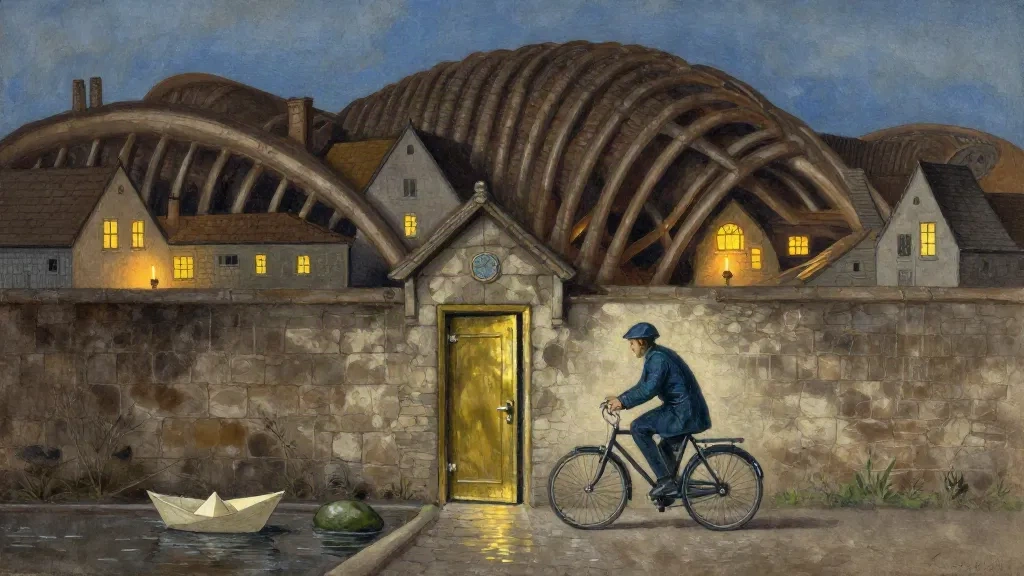
Then a folded paper boat appeared in her saddlebag, still wet with rain from no cloud. Beside it lay a green stone, thumb-smooth on one face.
Nessa was permitted to open locked doors. Her bicycle obeyed the postmaster’s older privilege: a wheel turned against any door that had once admitted a letter. It opened the customs house, the shuttered bathhouse, the customs house again. It had never opened a gate without a house behind it.
The paper boat pointed toward the west wall of the sleeping giant’s seventh rib.
The Door That Counted Her Breath
No door stood there. Only bone faced furred with soot, a market stall, and a faded treaty tablet cut into the cartilage.
Its language was older than the village. Nessa could read the first clause: The land, being silent, consents to hear. The next granted every resident “the right of inward ear,” provided no human mouth repeated what the soil heard. Beneath it ran the penalty: for every secret taken, one house’s address would be removed from the post.
She lifted the green stone against the tablet. The bicycle bell rang without being touched.
Bone split inward, softly as a coat unbuttoned. A narrow door appeared, its paint the deep tobacco brown of old letter paper. Its brass number had been scraped away.
Nessa wheeled the bicycle through.
Beyond lay a sorting room no larger than a bread locker. Candles floated above an oak desk, their flames reflected in rows of pigeonholes. Letters waited in every slot, seals facing outward, none addressed. Their dates ran forward: tomorrow, the day after, next midsummer, a century hence.
At the desk sat a man in a railway coat, motionless except for candlelight sliding across his cheek. He did not blink.
“I want to know why the future stopped sending letters,” Nessa said.
The clerk’s pen lifted, but no hand guided it. It wrote across a blank envelope: THE LISTENING HAS NO OBJECT. THE ADDRESSES HAVE NO OTHERS.
She looked at the paper boat in her hand. Its bow now pointed not at the clerk, but at the candle nearest his throat.
What the Giant Dreamed
When she touched the green stone to the flame, the room became as vast as the inside of Stellan.
Stars showed through the village rooftops without sky between them. Nessa saw people carrying beds along roads that did not yet lie on maps. She saw children born in cities with unfamiliar names, pulling blue fish from rivers that would spend another century underground. The future existed, vast and crowded, but nowhere could she see a roof.
The treaty shone through the giant like green fire in his veins. Every unheard thought passing through his body had been granted a legal hearing. Every spoken promise returned as silence. Every hope, fear, and private grief had entered the land, and the land had forgotten none of it.
Foreknowledge had grown weightless with use. The future no longer imagined itself worth addressing.
“It is not that the letters were lost,” Nessa said. “They were never asked for.”
Behind the desk, the clerk’s face began to crack along the seams of an old envelope.
“And the treaty?” she asked.
One candle went out. In its darkness, she heard a door being locked. Then another. Then hundreds, from the ribs above, their bolts falling like iron shot.
The clerk wrote again: UNLEASH WHAT IS HEARD, AND THE VILLAGE WILL HAVE NO QUIET.
Outside, the sleeping giant turned in his ancient sleep. Pavement shifted beneath remembered crowds. Shutters struck walls. Someone began to scream, and the treaty swallowed the sound before it became a name.
Nessa unfolded her delivery docket. In its columns were the living addresses of Stellan, gathered over twelve years: the chandler’s narrow attic, the fever house, the sisters beneath the fifth rib, the child born in an apothecary cupboard. She had ridden through every locked door on their behalf.
She began with her own.
Letters the Future Would Need
The first mark made a green spark in the bone wall. A door appeared above the candlelight, though there was no house behind it yet.
“For whoever lives there,” Nessa said, “there will be bread, clean water, and one enemy who becomes a friend.”
The clerk wrote a letter and fed it to the nearest flame. Heat carried it upward, through iron ribs, into the village.
One by one, Nessa filled the docket with news she could not know. Rain would fail the harvest, then return. The mayor would confess a harmless theft. A ship would arrive carrying a language no one had spoken, and its interpreter would need supper. In the old quarry, a vein of blue glass would open beneath a crow’s shadow.
The future had no addresses, but it had needs. Need was an address enough.
By candle number three, the treaty’s green veins dimmed. By the last, the paper boat had filled instead of folded, its bow aimed downriver where the sleeping giant’s fingers entered the sea.
The clerk opened his eyes.
“You have broken the listening,” he said.
“No.” Nessa gathered the undelivered seals, one for every year she had spent collecting them. “I have begun the answering.”
Outside, the west wall was ordinary bone again. Nessa set the paper boat in a gutter where rain would carry it toward the river. She pocketed the green stone and wheeled her bicycle toward the first lit window.
Before dawn, one sealed letter lay beneath the postmaster’s door.
Its paper was still warm.
The Address of Tomorrow
The postmaster read it twice and handed Nessa the registry. Every blank line had received a name.
He traced the newest entry with one tobacco-dark finger.
“The child beneath the fifth rib,” he said. “Born before noon, though no woman is pregnant.”
Across the village, a cry answered from an attic where a woman Nessa delivered medicine to each winter had suddenly gone into labor.
Nessa took the next bicycle.
Its front wheel turned toward a house that did not yet have a door, and the road beneath its tires was already shining with reflected candlelight.





