 Netwrck
Folk Horror.
The Last Unsent Letter
Mara had spent nine years delivering messages that could cross locked kitchen doors, prison gates, and even the black doors of houses where no one lived. Her bicycle knew the trick. It leaned into a door, the frame became a whisper, and the brass handle turned itself.
By dawn on the winter solstice, she had carried a letter addressed to the year 2091. It was written in the future's cramped blue hand and weighed nothing.
I have waited for your report. The sun rises, but nobody remembers why.
That was all. No sender. No return address. The future had sent its final complaint, then stopped sending letters altogether.
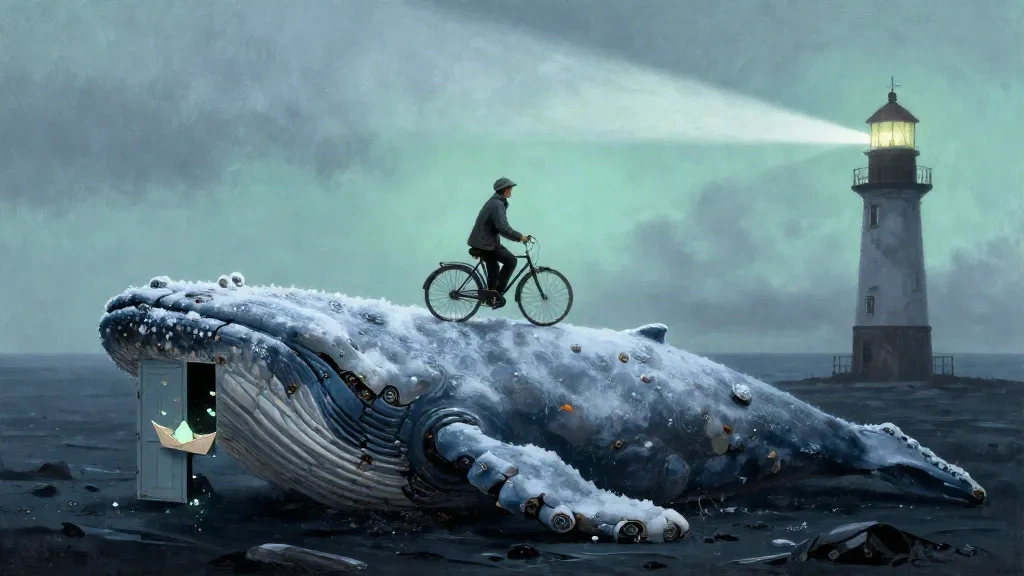
Mara wanted to know why. She crossed the frozen harbor by bicycle, its wheels ringing against the iron ribs of the pier. At the end of the mole stood the lighthouse, though no lighthouse could stand so steadily. It rose from the broad back of a mechanical whale, stranded in the shallows and sleeping beneath a skin of frost.
The Treaty of Listening Ears
The whale breathed through its brass nostrils. Each breath sent a warm iron gust across the snow.
At the lighthouse door, Mara found a brass plaque nailed to the wood: BY TREATY, THE LAND MAY LISTEN. The words had been polished by generations of hands. Beneath them lay a list of names, all crossed out.
She brought out the paper boat Mara had carried since childhood. It had been folded from the margin of her mother's last letter, which said nothing except, Do not wait for me where the land is listening.
The green stone in her pocket had belonged to her brother. He had placed it in her hand on the morning he vanished into the fog, then asked her to deliver it to the future. She had been eleven. She was thirty-four now, and the stone had never grown warmer.
Inside, the lighthouse keeper was gone. Her tea had cooled beside a radio tuned to dead air. On the wall, a map showed roads ending at the whale's ribs. Beneath the lantern room, a narrow stair descended into the whale.
Rooms That Answered
Her bicycle rolled down without her permission. It passed through the whale's side as if the iron were fog.
Inside was a city of sealed rooms. Behind one door, she heard a hundred typewriters clicking. Behind another, a child repeated the names of extinct birds. Behind the last door, someone knocked in the rhythm of her bicycle bell.
Every letter she delivered had made a small opening. The future had not vanished. It had been listening to the land, and the land had listened back.
The green stone warmed in her palm. A voice came from the walls, neither old nor young.
“You brought the wrong witness,” it said.
Mara lifted the paper boat toward the ceiling. “I brought the one who still asks questions.”
The knocking stopped. Frost spread across the rooms, sealing their edges. Somewhere beneath her, the whale shifted, and the buried lighthouse beam awakened.
The Future Had Been Waiting
At the whale's heart, Mara found a chamber filled with drowned postbags. Their letters bore future dates: 2088, 2090, 2094. None had reached their recipients because the future had mistaken the land for a locked door.
The treaty had been meant to prevent that. The land was permitted to listen, but never to answer. Over time, the listening changed. The land grew curious. It began sending back the voices it heard, filling the future with rumors of storms, wars, and names no one recognized.
So the future had sealed its correspondence.
Mara placed the green stone on the oldest bag. The paper boat floated in a basin of meltwater, navigating between the dark ribs. The bicycle rang once.
Doors opened throughout the chamber. Beyond them waited mornings that had not happened yet, each guarded by a frightened version of herself.
She understood then. The future had not stopped sending letters. It had stopped trusting anyone who could carry them.
So Mara wrote a reply on the blank side of the last unsent letter.
We are still listening.
She sent it through her bicycle, through the whale, and into the impossible cyan dawn gathering beyond the lighthouse. The paper boat set sail across the flooded floor.
Years later, villagers said that on certain mornings a bicycle could be heard unlocking doors far down the coast. Mara never corrected them. She kept the green stone in her pocket and waited for the first letter from the year 2091.
It arrived folded like a boat.





