 Netwrck
Historical Fantasy.
Platform Four
Mara Venn arrived at Mercy-under-Salt with a brass bicycle, a leather satchel, and the last letter the future had sent her. It weighed less than a moth. Its paper was green, its postmark bore a year erased by weather, and its single line read: We have stopped sending letters.
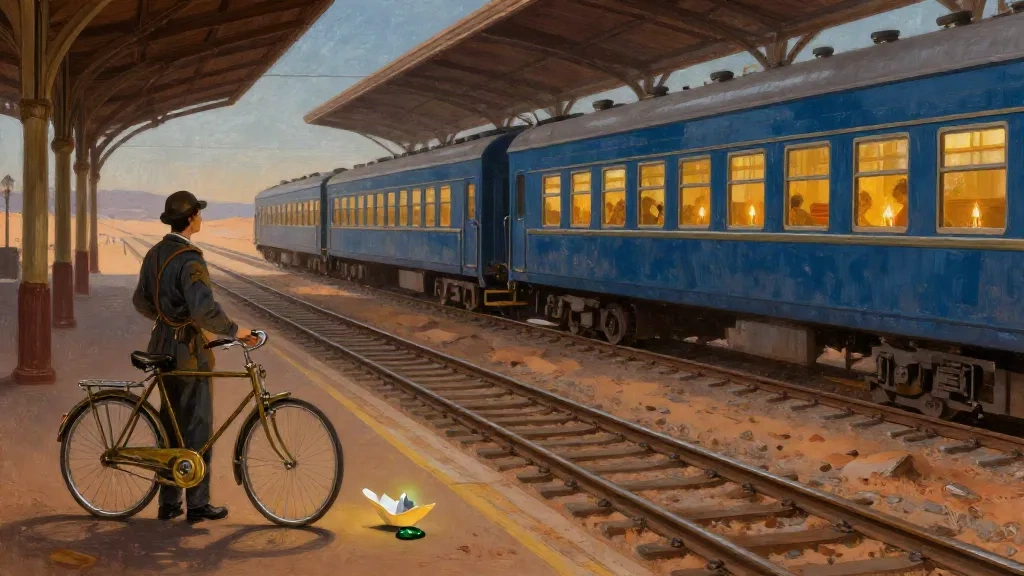
The station stood alone between rust-red dunes. Three tracks ran beneath a roof of blue steel, each rail polished by wheels no timetable admitted existed. Candles burned in wall niches, their flames leaning whenever Platform Four was empty. Beyond the platform, the desert shone tobacco brown beneath a sun the color of old tin.
Mara wheeled her bicycle toward the locked express room. The door had no handle, no keyhole, and a notice in three languages forbidding entry. As she approached, the bicycle’s front tire rolled forward by itself.
The frame slipped through the door. Mara followed, one hand on the handlebars.
Inside, a train waited in a station built from darkness. Its windows burned with reflected candlelight. Brass signs named cities that had not yet been founded.
The Land That Listened
On Platform Four, beneath a board marked TREATY OF LISTENING, 1841, Mara found the station master waiting with a brass trumpet and a face like a dried riverbed.
“The land has heard every message spoken across it,” he said. “By treaty, it may hold one sentence for a hundred years.”
He tapped the notice. “A sentence is being held now.”
“By whom?”
“By the future.”
The treaty permitted the desert to listen because, two centuries earlier, travelers had begged it to warn them of the coming trains. In return, the land was granted the right to keep a silence. Every century, it returned one message to its rightful sender. The last message had been sent from a platform like this one, where people still wrote letters by hand and believed the future would answer.
But the sender had vanished before receiving it. Since then, the sentence had traveled through closed years, searching for the one person who had authority to release it.
“That is me?” Mara asked.
The station master gave no answer. The trumpet’s bell turned toward her satchel.
Inside, something knocked softly against the paper boat she carried for luck. It was damp. Mara touched it and found green stones embedded in its folded hull.
Doors in the Sleeper
The first carriage smelled of tobacco, hot brass, and rain on a city that no longer existed. Mara stepped inside with her bicycle. The wheels turned on the floor without rolling. Doors opened before her and closed behind her.
Each compartment held a version of the same platform. In one, children in white summer clothes watched a red sun set behind the dunes. In another, soldiers slept beneath their coats while locusts clouded the horizon. In the last, an old woman sat beside a radio, listening to a station that broadcast only the sound of paper turning.
Mara searched every conductor’s desk, every timetable, every coat pocket. She found green stones, blue tickets, and small paper boats filled with ash. At the carriage’s end, a locked door carried her initials although she had never used them.
The bicycle placed its front wheel against the lock.
“That door does not open,” said the old woman from the radio carriage.
“It will for me.”
“The treaty says the land may listen. It does not say it may speak.”
Mara opened the door.
Beyond it, her own bicycle stood on a platform beneath a starless sky. A courier in a steel-blue uniform held a green stone. When the courier lifted it, the stars appeared one by one, and the platform became a bridge over a bottomless desert.
“You released the silence,” the courier said.
“I didn’t know how.”
“That is why it chose you.”
The Letter Returned
They crossed the bridge while the desert listened beneath their feet. The future was not a city or a machine. It was a crowd of people who had grown tired of being mistaken for a promised end. They had stopped writing because every letter arrived carrying the weight of what the sender expected from them.
The green stone had been the lock on the last letter. The paper boat had carried its message through time, gathering water from each century the train crossed. Now Mara held both in her palms.
“Can they write again?” she asked.
“If the silence is returned.”
She placed the green stone inside the paper boat and set it in the sand. The train passed overhead, steel wheels striking rails like distant thunder. Candlelight leapt along the platform.
At dawn, the station master found Mara beside the locked express room. Her bicycle stood outside, ordinary and patient. In her hand was a letter addressed to no one, dated in her own lifetime.
Its first sentence had begun: We are still here, but we will no longer promise you who we will become.
Mara read it once, then folded it into the boat.
“Does it answer the question?” the station master asked.
“No.”
She looked down the empty rails, where the desert light turned steel blue around the edges.
“It tells me where to listen.”
Somewhere beyond the horizon, a train began to whistle. Its doors opened before she reached them.





