 Netwrck
Weird Fiction.
The Promise Beneath the Blue Thread
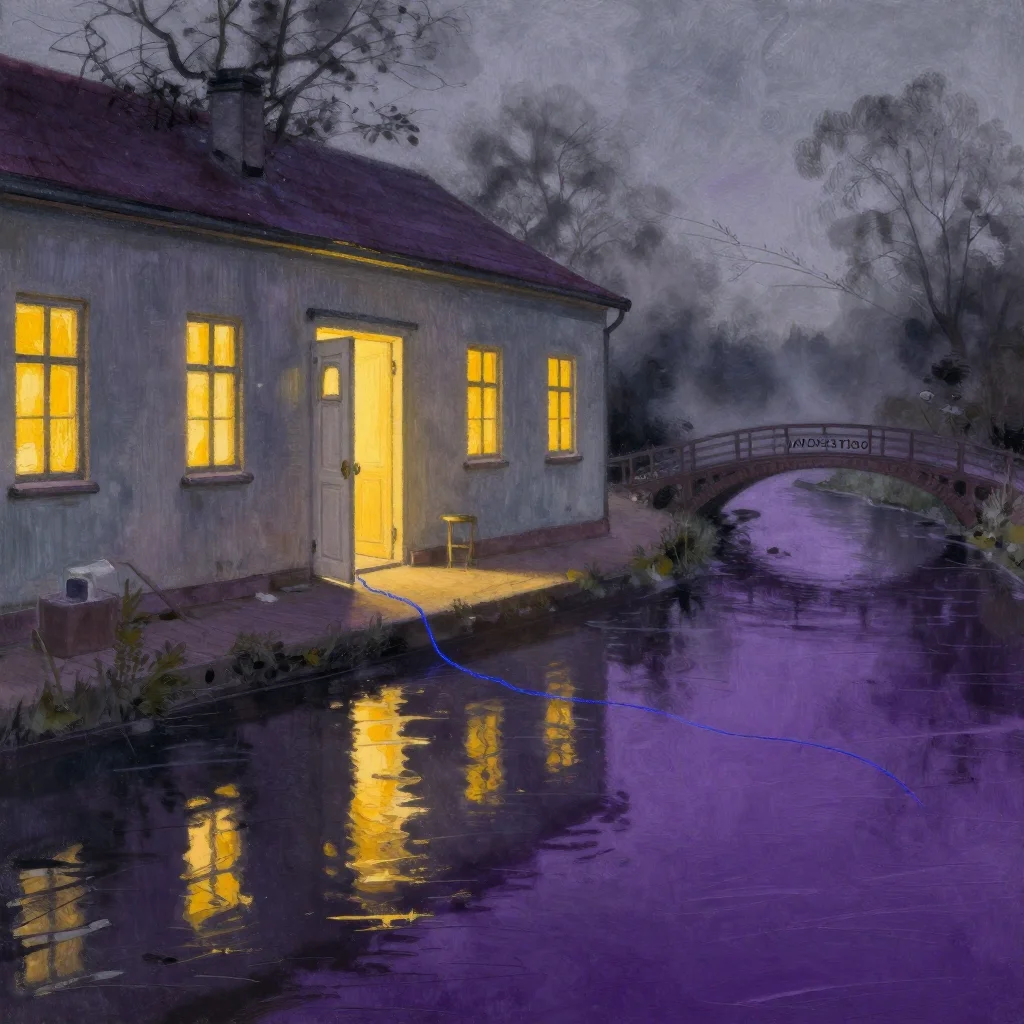
Mira Orris shaped windows for rooms in other worlds, though in the town of Bellwether she was thought merely peculiar. The river ran through the market in a straight, accusable line. Every bridge carried a carved sentence: I WILL HOLD. On wet mornings the letters sweated, and pedestrians hurried past as though witnessing shame.
Mira’s furnace occupied a narrow house where saffron-yellow glass cooled beside plum-dark plums in chipped bowls. Smoke-grey air gathered under her rafters. She worked with a blue thread tied around her right wrist, its loose end knotted to prevent her dreams from wandering too far.
That morning, her daughter knocked on the unmarked door at the back of the workshop.
“The school closed,” the girl said. “They say it was always holidays.”
“What about yesterday?”
“People insist there was a day, but nobody can agree what happened.”
Mira set down her blowpipe. She wanted only one ordinary morning preserved: her daughter’s first breakfast at home, toast split into uneven golden pieces, steam clouding the windows while rain worried the gutters. She wanted the milk to smell of metal and the jam to have a skin.
It was already becoming impossible.
Where the Road Improves
At the bridge, a tollkeeper named Oswin pointed toward the eastern path.
“The river bridge fell in a flood,” he said.
Mira looked at the clear water beneath its intact arches. “It has not fallen.”
“Then there was no river bridge.”
Each lie made the road brighter. The puddles lost their dirt. Thorns withdrew from the verge. A wagon that should have been trapped behind a locked gate now stood freely on the hill.
Oswin was not lying for pleasure. His face had gone grey at the edges, and when he spoke, his voice emerged from somewhere beneath the bridge.
“I had a daughter too,” he said. “I said she died. After that, the crossing became passable.”
They followed the safe road. With every polished falsehood, the landscape simplified. Houses lost their crooked doors. Windows became blank panes. A woman remembered a husband, then remembered a garden, then remembered nothing at all.
At the edge of town stood an unmarked door, pale wood, brassless hinges. Blue thread ran from Mira’s wrist into the keyhole.
Beyond it waited the missing morning.
The Cost of a Clear Path
“You can restore it,” said a voice from the other side, “if every bridge remembers the truth.”
Mira looked back. The road was crowded now. Citizens stood beneath its impossible clean sky, repeating convenient stories.
“I left a door unlocked,” one said. “So no one entered.”
“I never loved him,” another said. “So he never waited.”
“The river was dry,” a child cried. “Always dry.”
The witness below the water darkened. Bellwether’s oldest bridge groaned. A stone dropped from its promise, leaving the words I will hold split down the middle.
Mira could not mend the town with one truth. Truth demanded witnesses, and the town had been feeding them versions until the morning could be carried away unnoticed.
She opened her hand. The blue thread unwound from her wrist and across her palm.
“Then let them see the seams,” she said.
She pushed the unmarked door inward.
Toast at the Wrong Hour
The missing morning did not smell like breakfast. It smelled of cold ash and river stones. Along its sky floated kitchens, schoolrooms, and bedrooms, each containing people caught in the act of becoming certain of something false.
Mira entered. She found her daughter’s breakfast table beneath an apple tree, though no tree had ever grown there. Two plates. Two cups. The toast was already turning transparent.
She drew the blue thread around the table and tied it to a chair leg. Then she spoke plainly.
“I was afraid,” she said. “I made windows instead of asking what you needed. This morning existed. You existed with me in it.”
The table resisted. Ghosts of erased days crowded behind her.
“There is no proof,” said the voice.
“There is the person asking.”
Her daughter appeared at the far side, young and solid and furious.
“You are late,” she said.
“Yes.”
Mira sat. The thread tightened. Across Bellwether, doors opened onto rooms that had been hidden by careful denial. People looked at the things they had removed: the letter, the bruise, the empty chair.
The witnesses returned. The river grew deep plum under a saffron sky. Smoke-grey air lifted from the water.
At midnight, the town kept its mornings. Not because lies had vanished, but because no lie could carry a whole day away without someone willing to stand beside it and say, I was there.





