 Netwrck
Speculative Fiction.
The Country on Her Hand
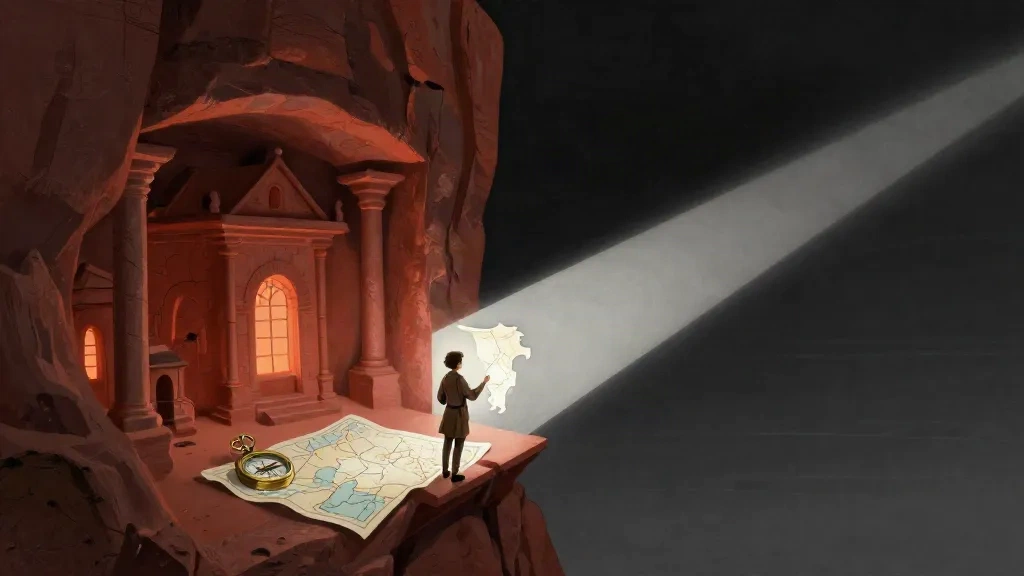
Every morning, Sister Vey poured charcoal dust over the apprentice maps until the monastery’s floor resembled a storm seen from above. The comet beneath them had no horizon, only a long curve of stone disappearing into rust-red mist. Pale winter light entered through the narrow windows and made the brass compass on Vey’s table gleam like a small, patient sun.
Vey was seventeen and had been apprenticed to the cartographer for two years. Her teacher drew maps of places that could not be visited: the interior of bells, the country behind closed doors, the last house before a person’s name was forgotten. He never spoke of the map folded in his coat, though Vey had seen its corners often enough to imagine them worn soft as skin.
That day, while copying a coastline, she noticed the coastline had moved.
It was not on the paper. It was on the back of her left hand, a thin rust-red ridge rising from the base of her thumb. She rubbed it with a wet cloth. The ridge remained, joined by a pale river and a cluster of black mountains.
“A country,” she whispered.
The brass compass spun beneath her palm. Its needle pointed not north, but toward the folded map in her teacher’s coat.
The Note in the Wall
Her teacher’s name was Orren, and he had spent forty years recording the songs of the comet. Each morning the villagers below the monastery sent up a melody through a brass speaking tube. Orren wrote the notes on vellum, then stored them in niches cut into the stone.
One melody had always been his favorite. Vey knew it by heart: a rising phrase for the first frost, a falling phrase for the dead, and a final note that should have held for as long as winter. That note was missing.
Orren listened to the tube whenever the village rang it. His face became still, and afterward he would climb to the highest chamber, where the comet’s tail brushed the sky in a rust-red mane.
“What happened to the last note?” Vey asked.
“It was taken,” he said.
“By whom?”
He looked at the country on her hand. “By someone who wanted it to remain unheard.”
That evening, a rival arrived. His name was Maen, a mapmaker from the lower monastery, where maps were made to be burned after use. He carried a black compass and a folded map stitched with red thread.
“Give me the hand,” he said.
“It is not yours to take.”
“No. But the note is.”
The Rival’s Reason
Maen unfolded his map. It showed the same country on Vey’s hand, but its borders had been deliberately erased. In its place stood a sequence of names: every villager who had died during the long winter.
“The note seals endings,” Maen said. “With it, I can keep the comet from forgetting us.”
Vey understood then. He did not want the sound for power or treasure. He wanted to bind the dead to the living, even if the living could no longer leave. His compass pointed toward the mountain on her hand, where a small black door had appeared.
“You would trap them,” she said.
“I would remember them.”
Orren stepped between them. “There is another way.”
He took out the folded map Vey had always seen. When he opened it, the paper was blank except for one line of pale ink, and the line ended at the edge of the page.
“The missing note is not stored,” he said. “It is the place where a map ends.”
The Last Border
At midnight, Vey climbed with Maen and Orren to the comet’s highest chamber. Outside, the tail of the comet burned rust red against charcoal sky. The winter light came without warmth, falling across the three of them in thin, pale sheets.
On Orren’s map, Vey’s country had become whole. Its northern edge touched the blankness beyond the page. She placed her hand over that edge. The country on her skin warmed.
Then she sang.
The melody climbed from her throat in the old familiar shape, but when she reached the ending, she did not invent a note. She let the silence stand where the missing sound had been.
Maen’s black compass cracked in his fist. On the map, the names of the dead faded—not erased, but released. The black mountain opened. Cold air poured through it, carrying the scent of snow and distant bells.
Orren’s eyes brightened. “The note was never lost. It was the space we refused to cross.”
Vey looked at her hand. The country remained, but its borders had softened. A new pale line ran beyond the last mountain, neither border nor blankness.
When the villagers asked what she had found, she said only that the map ended where the singing did.
And every winter afterward, when the brass tube carried the melody through the monastery walls, Vey listened for the pause before the final sound. In that pause, the comet remembered the way onward.





