 Netwrck
Fairy-Tale Fiction.
The Tide Brought Back a Compass
Mara Vale was apprenticed to a cartographer who measured coastlines by listening to them. Every morning she copied blue water onto paper until her wrist ached, and every evening she swept salt from the windows of the shop while the boards above Gull Stair groaned with the weight of the sea. Her master, Pell Halloway, held his ear to the cliff the way other men held a lamp to a wick, and he taught her that a coast is not a shape but a noise the land keeps making while it is being eaten.
Her favorite hour was dusk, when the lanterns along the stair came alight one by one and the water turned the color of a struck knife. She had not walked the shore in daylight for a year. Since the winter fever took her mother, Mara could not sing. She could hum. She could speak a melody's shape with her throat and stop dead at the same place every time, the way a road ends at a cliff edge and simply becomes air.
That evening the tide returned a compass.
It lay in the black lacquer tray where they kept instruments the harbor had given back, and Mara knew it at once, because the tray was the one place in the shop that was never dusty. Pell had told her once that the sea only gives a thing back when it has finished being needed elsewhere.
She touched the brass rim. The needle spun once, twice, then settled and pointed not north but inward, at the wall, at the floor, at the scab on her own knuckle.
Beneath the pale crescent scar she had earned at twelve from a broken drafting compass, a coastline appeared. Tiny mountains rose along one knuckle. A gold river crossed her smallest finger and vanished beneath the wrist.
“A country,” she whispered.
Pell saw it only for a moment, and then he looked away, at the songbook lying open on the stool beside the stove, at the page where the last line of The Bell at Low Water had been left blank for eleven months. Her mother had sung the whole song the night before she died, and every verse came back to Mara bright and familiar, and the last note did not exist anywhere she could reach.
“Some things return only to those who follow them,” Pell said. His hands were shaking now. He did not tell her to stop listening for it, and she noticed that he did not.
Mara took the ledger from its shelf. Everything the sea returned had a line: the date, the object, the name of whoever had lost it. She found the compass. The date was the night her mother died. The name in the column for who had lost it was her mother's, in handwriting Mara knew as well as her own.
The Rival Who Wanted Silence
He was waiting on the western cliffs, where the wind came off the water with the smell of tar and old iron.
“You are the cartographer's girl,” he said.
Ilyan Rook was the son of the town's drowned bell keeper, and he carried a silver knife instead of a compass because a knife needs no direction. Mara had seen him twice before, both times at funerals, both times dry-eyed and still.
“The song ends with a note that can wake the dead,” he said. “If it is ever finished, it will be finished in the water, and the drowned will rise.”
Mara's mouth went dry. “My mother sang it.”
“Your mother sang the beginning.” Ilyan turned the knife until cold moonlight ran along the flat of it. “The last note was taken out of her voice. She sang around the hole for the rest of her life and never told anyone what was missing. I want the note destroyed before somebody clever comes along and completes it.”
“Why does it matter to you what rises?”
He looked at her for a long moment, and she understood that she had asked the one question he had not prepared for, and that he was going to answer it badly rather than not at all.
“Because it will not be strangers,” he said, and did not say more, and they both let that stand where it fell.
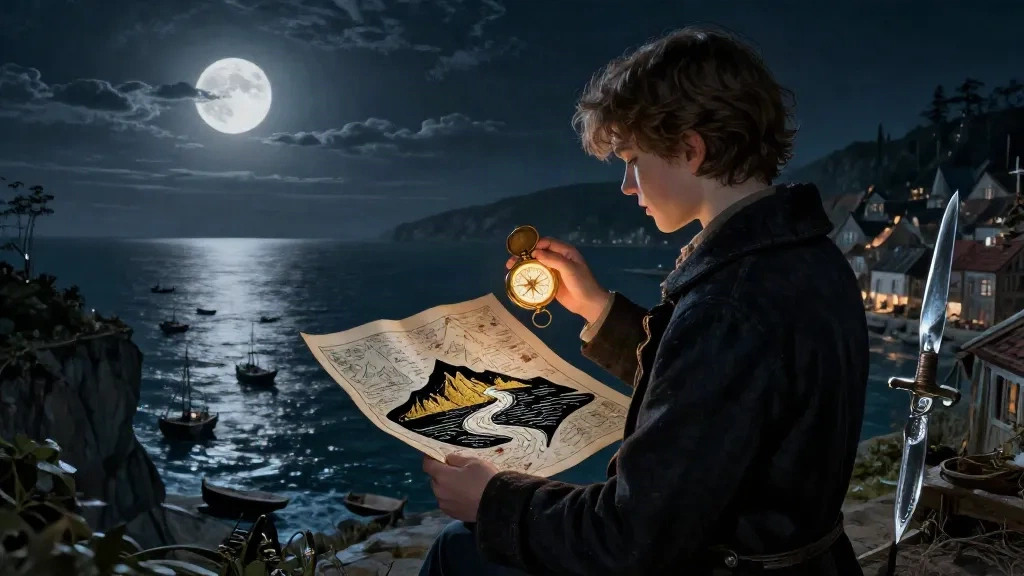
They set out together because neither could cross the drowned road alone. The road surfaced only in the hour after the tide withdrew, its stones shining wet and green beneath their boots, and it sank under you if you stood still too long. Mara unfolded her paper map. The country on her hand had already changed: a gold-dust mountain now rose from the base of her thumb, and a black lake had spread over her wrist like ink spilled and soaked in.
At the first threshold, the brass compass swung around and pointed at Ilyan.
He smiled without any warmth in it. “It knows who is carrying something.”
“Then you know where we are going.”
“It knows what you are carrying.” He turned his wrist so the knife caught the light again. “Ask it yourself, next time, before you trust it.”
The Map That Refused to Be Folded
The country inside Mara's hand would not agree with the country on her paper. Every time she spread the map flat, the drawn coastlines slid into new arrangements. Mountains became reefs. The gold river became a road. The black lake opened like an ear.
“Then stop drawing,” Ilyan said. “Draw what is there.”
“That is not how maps work.”
“It is how this one works.”
He cut the seal from the cliff shrine with the silver knife, and the sea answered at once, lifting a wall of water behind them so that the drowned road was no longer an exit but a closing door. The wall did not fall. It stood and listened.
“The shrine keeps forgotten things,” Ilyan called over the noise. “Your map has opened its door. Now nothing gets put back.”
Mara pressed her palm flat against the rock, and the painted country burned cold, the way iron burns when it has been in water too long. In the blackness of the lake on her wrist a small boat appeared, and in the boat a figure with no face sat holding a golden bell in its lap like a sleeping animal.
Then she heard the missing note.
It rose through the floor of the shrine and through the water and through her own teeth, one pure and impossible sound, and it was not beautiful, and she loved it. The compass slewed hard toward the drowned bell tower. Ilyan's knife rang out of his hand and into the surf and he did not go after it.
“Do not play it,” he said.
“You said you wanted it destroyed.”
“I wanted nobody else to hear it either.” His voice had gone to nothing. “I do not want to know what my father did.”
Mara understood then, and understanding did not make it lighter. The final note was not a weapon. It was a lock. And the lock had been put there by a woman with a fever and a blank page who had run out of season to turn it.
The Keeper's Ledger
The shrine kept what the sea gave back and would not give it to the sea again. In a chest below the altar, wrapped in oilcloth and salt, they found the drowned bell keeper's ledger, and Silas Rook had kept it as carefully as Pell kept his, which meant the two men had been afraid of the same arithmetic.
Silas had rung the bell on the night of the storm, on purpose, to call the fishing boats in. Eleven came. Two did not. He had gone out for them and the water had kept him, and the town had decided to call that a failure of nerve rather than a failure of arithmetic, because a keeper who is afraid is easier to mourn than a keeper who is simply outnumbered.
And in the ledger, in his careful clerk's hand, was the note. Not the music. The note, written as a single mark, described in forty years of a man's attention. Beside it, in different ink, younger: Taken from the singer by the singer. I will not write it whole.
“Your mother,” Ilyan said.
“My mother.”
“Then she did not steal a note from a song. She stole a song from a bell.” He sat down on the wet stone, which was the first time Mara had seen him do anything without a purpose in it. “My father rang it to call boats in. Your mother un-rang it so that nothing would ever answer again. Neither of them asked the town. Neither of them asked me.”
Mara turned the page. There was one more line, and it was in her mother's hand, and it was the only sentence in two hundred pages that was not a keeper's record.
It will come back. Be the one who decides what it opens.
An Ending Chosen by Hand
At the bell tower the tide climbed the stairs behind them, one step at a time, unhurried, the way a thing climbs when it has all night.
The tower stood in moonlight, black lacquer and cold silver, its bell gone from the yoke. Mara climbed with the compass in one hand and the folded map in the other. Ilyan followed, bleeding from the cut he had made forcing the shrine door, wrapping his hand in his own shirt without complaint, the way a man does when pain is the only orderly thing left to him.
Halfway up, the map opened itself in the wind. The country on her hand opened too, wider, the gold river running off the edge of her wrist and into the dark, and Mara stepped across a border drawn in gold dust that hung in the air for exactly as long as it took to believe in it.
There, at the end of everything, she found a child made of sea mist holding the final note behind its closed mouth. It was the size of a seven-year-old and it was the weather of a November afternoon, and it did not look at her so much as at the weather she had brought with her.
“I am the part she left behind,” it said.
“The note.”
“The part of the note that could be carried.” Its mouth did not open. “The rest is in the tower, and the rest is in your mother, and the rest is in the man on the stair who has been shouting his father's name for nine years without stopping to listen for an answer.”
Mara could have taken it. Her fingers were already open, and the compass was pointing straight at it, and the whole drowned night was arranged like a hand to take.
Instead she knelt, and held out the songbook.
Ilyan stood at the tower's broken edge with his bleeding hand open at his side, waiting for the drowned to rise, and did not move, and did not look away.
The mist-child placed the note into the page. The paper shone once, the way metal does when you strike it and hold it to the eye.
“You have given me an ending,” the child said.
“No,” Mara said. “We have.”
She began the song. Her voice came out thin and unpracticed and it did not matter, because Ilyan came in underneath her with something lower and rougher and very old, and then he sang the final note he had kept hidden in his chest, and it was not a shout, it was a bell.
The sea answered with one quiet chime.
No dead rose. The tower did not fill. What happened instead was quieter and harder to survive: the water went back, all of it, drawing itself down the stairs and out through the cliff, carrying with it every forgotten thing it had ever been paid to hold.
What the Shore Kept
Mara woke on the shingle below the tower with salt in her mouth and Ilyan's shoulder under her head and no bell anywhere in the world.
What came ashore that week was unendurable. Names, shoes, wedding bands, a child's shoe with the buckle still done up, a ledger from a ship that had gone down in her grandmother's time, a hundred small thefts the sea had taken as fees. Pell walked the waterline for two days with a sack and a ledger of his own, and the town came to help, and the town discovered how much of itself it had been quietly stealing.
And among it all, washed up in the wrack at low tide, the small black box that had once been her mother's, sealed with wax the color of a plum.
Inside was a blank page, a stick of sealing wax, and a knife handle with the blade gone. Her mother, it turned out, had come down to the water intending to end the song forever and had lost her nerve or run out of time, and had carried the tools of that intention home and put them in a box and said nothing to anyone for eleven months. Mara sat on the shingle and understood that grace was not something she had inherited. It had to be invented, daily, in the specific, and her mother's had run out before the winter did.
The country on her hand did not wash off. It thinned through the summer into something she could read at a glance, and she did put ink to paper, in the end, though the paper maps never once agreed with her again.
Pell gave up the cliffs that autumn. Not to death. He simply stopped being able to hear them, the way a man loses a language he has no one left to speak it with, and he handed her the ledger and the lacquer tray and the black ledger of returns, and he said, “Keep the column of names. People forget they were owed.”
Ilyan kept his knife, since it had come back with everything else, and did not put it in the water again. He stayed in the shop over the winter and learned to grind ink, which is work no one thanks you for and no one does badly twice.
And once a month, when the tide came in past the black rocks, something that was not her mother stood on the flat of the bay and did not come ashore, and did not leave. The smell of fever was gone from it. So was the smell of her wool, her lamp oil, the pear she kept in the pocket of her apron. The sea had returned the shape and kept the rest, and Mara understood that this was the whole of what mercy was: not the drowning stopped, but the account closed, and the closing signed by the person who lived.
She never sang the song again. But the shop's window stayed clear of salt, and the ledger filled up, and on the page of The Bell at Low Water where the last line should have been, there was a small burn mark in the shape of a gold river, and she never explained it to anyone.
The sea returned what it had taken. It could not return what they had chosen to carry.





