 Netwrck
Hopeful Science Fiction.
What the Mountain Kept
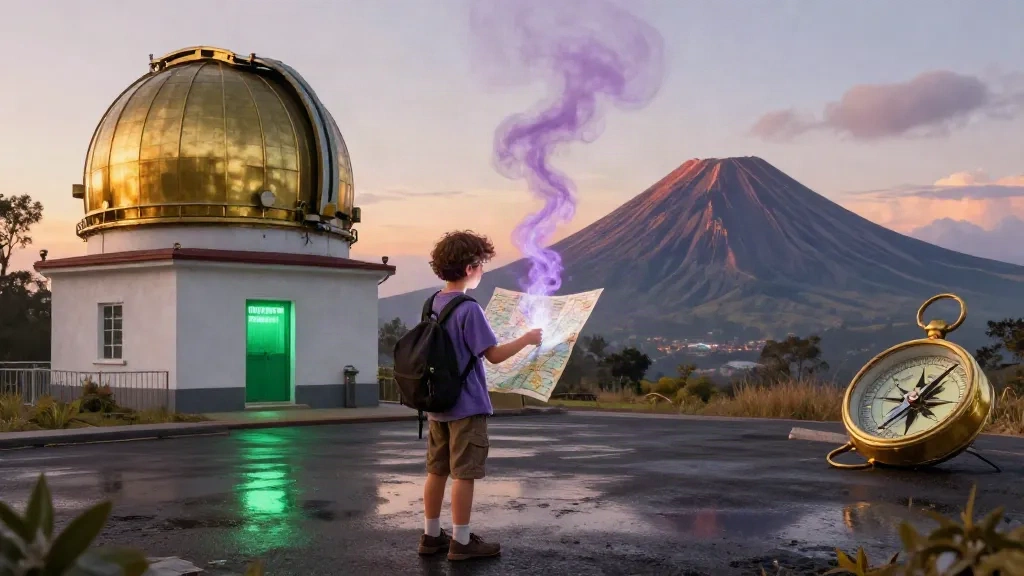
The mountain observatory occupied the inside of a volcano, though no one called it that. Its brass instruments lined the walls in patient rows, each one listening through a silver ear toward the buried valley. Lavender steam leaked from the vents and settled on the wet asphalt outside, where the night staff walked in green reflections from the pharmacy sign across the road.
Mira had been the observatory’s cartographer’s apprentice for eleven months. Her brass compass lived in her left pocket, its needle always pointing toward the nearest unrecorded thing. Her folded map lived in the right, though she had stopped unfolding it since the country appeared there.
It had arrived beneath her thumb.
At first she mistook the pale lines for ink transferred from a chart. Then the lines lifted. A river uncurled across the ridge of her hand, silver and deliberate. A mountain rose near her wrist. At the base of it, seven tiny roofs shone like wet asphalt under a green sky.
Mira carried her hand to the nearest lamp.
On the map, the roofs held still. Beyond them stood a gate.
“You found the border,” said Director Senn, without looking up from his ledger. His voice carried the exhaustion of someone who had stopped being surprised by new countries.
Mira closed her fingers. The gate vanished.
“I found a country.”
“You found a claim,” Senn said. “There is a difference.”
The Note Without a Sound
Her mother’s song began the same way every evening: a low note for the lamp, a higher note for the bread, then a final note that climbed until it disappeared into the chimney.
For years, Mira had believed the last note belonged to the mountain. It rose in her mother’s chest whenever the house settled. When her mother died, the song had stopped before that final climb.
Now, in the observatory’s western chamber, the brass compass trembled against Mira’s knee.
The valley answered with seventeen heartbeats.
She turned the compass until its needle touched the map’s unmarked border. A sound came from beneath the floor. Not music yet. The dull pressure of a bell trapped underwater.
Rival Tovan entered carrying a black case lined with red felt. He was the observatory’s best listener, and Mira’s only rival for the privilege of entering the lower archives.
“I heard the country wake,” he said.
“You weren’t here.”
“It woke everyone.” His fingers rested on the case latch. “The final note is not a sound. It is a key. Play it, and the country on your hand becomes real. Without it, the valley remains unmeasured.”
Mira looked at his brass compass. His needle pointed north.
“You want it for the map,” she said.
Tovan’s smile was brief and without warmth. “I want it to erase my name from the observatory records. One note can close a door. You can open one.”
A Country With No Name
They descended through the observatory’s oldest stairwell, where the walls shone damp and the emergency lamps burned lavender. The air grew warm. Beneath the floor, machinery clicked in the rhythm of a sleeping animal.
Tovan opened the case. Inside rested a tuning fork blackened at the tips.
“The missing note was removed by the first cartographer,” he said. “She wanted to keep the valley safe from discovery. Your country is not a place. It is the shape of the note after it learned to travel.”
Mira unfolded her map. The little roofs brightened. She saw paths between them, roads narrowing into a name written in no alphabet she knew.
“If the note stays here,” Tovan said, “my name disappears. If you take it, the country will open, and the observatory will finally know where it has been hiding.”
He raised the tuning fork.
Mira struck it against the map.
The mountain answered. A green pulse raced through the asphalt-colored roads. Every instrument in the chamber turned toward her hand, needles trembling, bells beginning to sing.
Tovan reached for the compass. Mira caught his wrist.
“You said one note can close a door,” she said. “Then let it close the right one.”
The Last Climb
Together they lifted the brass compass and held it beneath her palm. The country on her skin opened like a flower. Warm air rose from its green hills, carrying the scent of rain on stone.
The final note was there, waiting behind the gate.
Mira could finish the song alone. She could also give Tovan the choice he had come for.
“Play it,” he said.
“You lose your name.”
“I know.”
Mira struck the tuning fork.
The note climbed. It passed the volcano, the lavender steam, the wet asphalt, and the green glow of the pharmacy sign. It rose into the hidden sky where her mother’s voice had once gone.
This time, the mountain did not swallow it.
In the morning, Tovan’s name was gone from every ledger except the one Senn held open on the desk. Beside it he had written: Arrived by choice. Stayed by hope.
And on Mira’s folded map, the country had a road leading home.
The song had not been unfinished. It had been waiting for a voice willing to finish it together.





