 Netwrck
Mythic Fiction.
The Hand with No Border
In the monastery of clockmakers, time was not kept but repaired. Brass wheels slept in cedar cases. Sand passed through glass throats. Every morning, the monks wound the great moon in the eastern tower and trusted the country to follow.
The country had begun to disagree.
At dusk, clocks stopped at different minutes. Bells arrived before the hour they announced. Some travelers claimed the road outside had lengthened overnight, while others swore they had passed the same blue stone three times before breakfast.
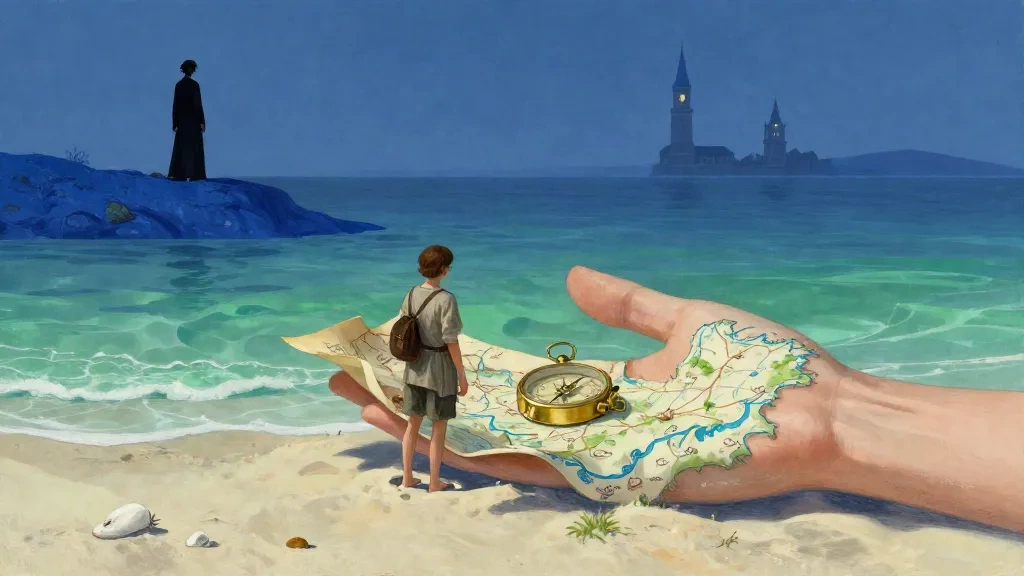
Ilyra was a cartographer’s apprentice, small and sharp, with ink beneath her fingernails. Her master had given her two things before he disappeared: a brass compass that trembled near forgotten places, and a folded map so old its creases had become white rivers.
She knew both objects were wrong. The compass needle did not point north. It turned toward the missing.
Every seventh evening, the monastery choir began the Song of Returning. It was the only song everyone remembered equally, though no one could say who had written it. The melody gathered the monks in the salt-white chapel, carried them through the long nave, and ended at a single high note.
That note was gone.
Their beloved song stopped one breath before its promise.
Ilyra heard the absence as a small cold door closing inside her chest.
The Country on Her Skin
On the night the moon clock stalled, Ilyra discovered the country on the back of her hand.
It appeared beneath a wash of sea-glass green. Tiny roads crossed her knuckles. A cobalt shadow gathered along the edge of her thumb. When she held it beneath the chapel lamp, the lines shifted and a coastline formed where her pulse beat.
Her folded map opened by itself.
On it, a blank place had been waiting for her.
Ilyra touched the blank with her other hand. The monastery vanished.
She stood ankle-deep in sand beneath a violet sky. A sea withdrew before her, dragging silver foam across a plain of dunes. Somewhere beyond the cobalt ridge, a bell rang once.
The compass pulled hard toward it.
“Do not cross the shadow,” said a voice behind her.
The rival cartographer stood at the top of the dune.
His name was Oran, though no one had used it since he returned from the western coast. He carried a second folded map, blacker than hers. His boots were caked with gray mud, and his expression held the stillness of someone who had already lost everything except a purpose.
“The note is mine,” he said.
“It belongs to the song.”
“The song belongs to no one.” He raised his map. “The missing note is a door. I heard it in the drowned city. It will let me return what was taken from my family.”
Ilyra’s fingers curled over her compass. “It will not help me.”
“Then we should not waste it.”
He unfolded his map. A black road appeared in the sand, leading toward the cobalt ridge. Hers showed a different path, narrower, marked by three tiny stars.
Three Ways to the Last Sound
They walked together because neither would allow the other the first route.
Oran’s road climbed through a forest of frozen rain. Ilyra’s followed the dry riverbed beneath the ridge. Between them lay a field of upright mirrors, each reflecting a different version of the monastery.
In one reflection, the monks still sang. In another, they had vanished and the clock towers stood empty. In the third, a young girl with ink-stained fingers stood at the tower door, holding a brass compass.
Ilyra stepped toward it.
“That is not you,” Oran said.
“It might be.”
She touched the mirror. The country on her hand burned. A voice inside it whispered the final note, but distance swallowed the pitch.
Oran struck the glass with his black map. The reflection cracked, and the sound escaped.
High above them, the chapel bells answered. One clear note crossed the broken sky.
Oran smiled. “You hear it? The door is opening.”
“No.” Ilyra watched the mirrors. In the nearest shard, the country on her hand was no longer a drawing. Mountains rose from her knuckles. Cities burned along her wrist. “It is a map of everywhere the note has traveled.”
She understood then why her master had vanished.
He had carried the unfinished song into the country hidden on his own skin.
The Last Bell
The compass pointed toward the mirror field, but Ilyra turned east, toward the dry riverbed.
Oran caught her arm. “The ridge is the only way.”
“Ridges are walls,” she said. “Rivers are roads.”
They descended together.
At midnight, the dry river filled with seawater. Ilyra’s map dissolved into blue fire. Oran’s black road sank beneath the waves. They had to swim.
She held the compass above the surface. Its needle spun, then settled toward a small boat drifting in the dark. Inside it lay a single brass bell, wet but unbroken.
Oran reached for it.
Ilyra caught his wrist. “Your family lost a time. Mine lost a direction. The song did not take them. Someone hid the note so no one would be able to return.”
“Then it is better hidden.”
“No.” She looked at the country moving beneath her skin. “It has been hidden so long it has forgotten how to be a song.”
She struck the bell with the compass.
The note rose over the water.
It was not bright. It traveled through sand, through salt, through every stopped clock in the monastery. The country on Ilyra’s hand rose beneath the moon and unfolded into roads she had not yet drawn.
Oran listened until the last vibration faded.
Then he placed his black map at his feet.
“My family may not return,” he said.
Ilyra answered, “Neither may mine.”
They rowed toward the monastery as dawn entered the sea-glass green horizon. Behind them, the river carried the final note onward, beyond every border, into the unmapped dark.
When the chapel doors opened, the choir began again. This time, when the melody reached its last turning point, Ilyra raised one ink-stained hand.
On her palm, a new road appeared.
She did not know where it led. For the first time, that was enough.





