 Netwrck
Romance.
The Hand as Country
Mara found the country on the morning the comet’s monastery rang without a bell.
She was copying coastlines in the scriptorium, her brass compass resting between thumb and forefinger. The ink had gone bright on her left palm, and there, beneath the skin, a green line had appeared. It wound north, divided at a mountain shaped like a closed hand, and ended in a tiny marigold star.
She traced the line with a fingertip. The stone beneath her warmed.
“You have found the Unwritten Province,” said Brother Elian.
He stood in the doorway with dust on his sleeves and rain in his gray beard. Beyond him, the monastery clung to the comet’s dark flank, its wet-stone corridors lit by mineral lamps. The monks called the place the Perihelion House, though most of them had stopped believing its oldest story.
“Is it real?” Mara asked.
“The maps are.” Elian glanced at her palm. “Whether the country is, depends on the song.”
Every evening, the monks climbed to the observatory and sang the hymn of return. Mara had known the melody since childhood, from her mother’s singing in a village that no longer appeared on any chart. It rose easily through six notes, bright as rain on a window.
The seventh note was missing.
She had spent three years trying to find it.
The Rival at the Bell
The seventh note waited in the voices of the dead, Brother Tomas said. The founder had carried it away during the long winter, and without it, the hymn ended in a silence that made every returning traveler sound lost.
“Then I will recover it,” Mara said.
Tomas laughed softly. “You want an explanation. I want a voice.”
He crossed the room and placed a folded map on the table. The paper was soft from years of opening. It showed the monastery as a spiral wound around a black heart.
“My sister sang the final note,” he said. “Before the comet carried her away, she promised she would come back when the hymn was complete. I have spent twelve years listening.”
His hand covered the marigold mark on Mara’s palm. She felt the hidden country tremble.
“You cannot take it,” she said.
“I can borrow it.”
That night, Tomas unfolded the map beside her lamp. Its lines moved when the wind touched the window. A red thread appeared at the map’s edge, winding toward the western bell.
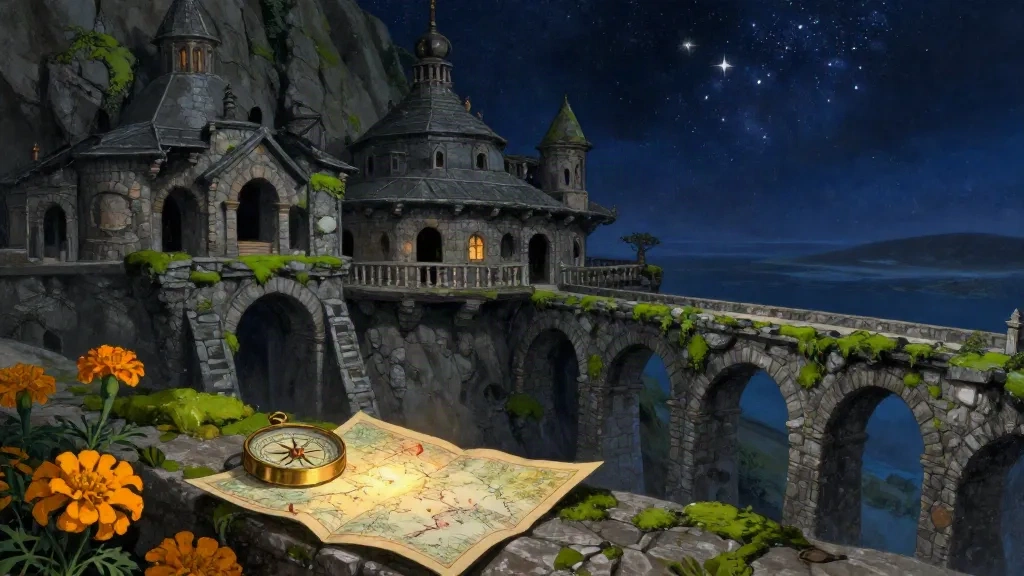
They crossed the moss bridge together. Below them, the comet’s forests clung to the rock in green handfuls. Marigolds burned in the cracks, small fires against the coming night.
At the western bell, Tomas drew a sword and cut the rope.
The bell fell without a sound.
The Note Inside the Stone
Silence moved through the monastery. Doors sealed. Lamps went dark. Mara felt the country on her hand contract, its borders folding inward.
“You did not lose the note,” she whispered. “You frightened it.”
The folded map lifted from Tomas’s hands. It struck the bell and opened flat.
On it, the missing note was written in black, beginning at the heart of the comet and ending beneath Mara’s thumbnail. She pressed her hand against the stone.
The melody entered her.
Not as sound. As memory. Her mother laughing in a kitchen. Tomas’s sister in a winter garden, her face turned toward a sky that had already gone dark. The founder carrying a lantern into the mountain, singing with a voice that could make stone remember being earth.
Mara understood then. The final note was not a sound the dead had stolen. It was the choice to remain reachable after love had changed you.
Tomas watched her. “Give it to me.”
“No.”
He struck.
Mara’s compass spun between them, pointing first at the bell, then at the country beneath her skin. She caught his blade on the brass rim. Sparks flashed marigold against wet stone.
“If you sing alone,” she said, “it will be an echo. If we sing together, it will be a road.”
The Return
They climbed to the observatory without the bell.
The monks gathered in silence. Tomas stood beside Mara, one hand pressed to the folded map, the other touching the compass she had carried since childhood. The country on her palm shone moss green beneath the mineral lamps.
Mara began the hymn.
Six notes crossed the comet. Tomas did not sing the last one. He let the silence stand, then joined her in the space after it.
The note sounded low and clear.
It traveled through the stone corridors, across the moss bridge, and out into the black. Somewhere beyond the observatory glass, a traveler answered.
Tomas closed his eyes. His shoulders shook, but he did not speak his sister’s name.
Mara’s palm stayed warm. The country there had gained a new road, narrow and bright as marigold. It did not belong to her alone.
Later, they folded the map between them. Tomas’s hand covered hers above the brass compass.
“I thought I wanted her back,” he said.
“I know.”
“Now I only want to know the way.”
Mara looked toward the dark window. The final note was no longer missing. It had become a door, and they had learned to open it together.





