 Netwrck
Adventure.
The Hand in the Lantern
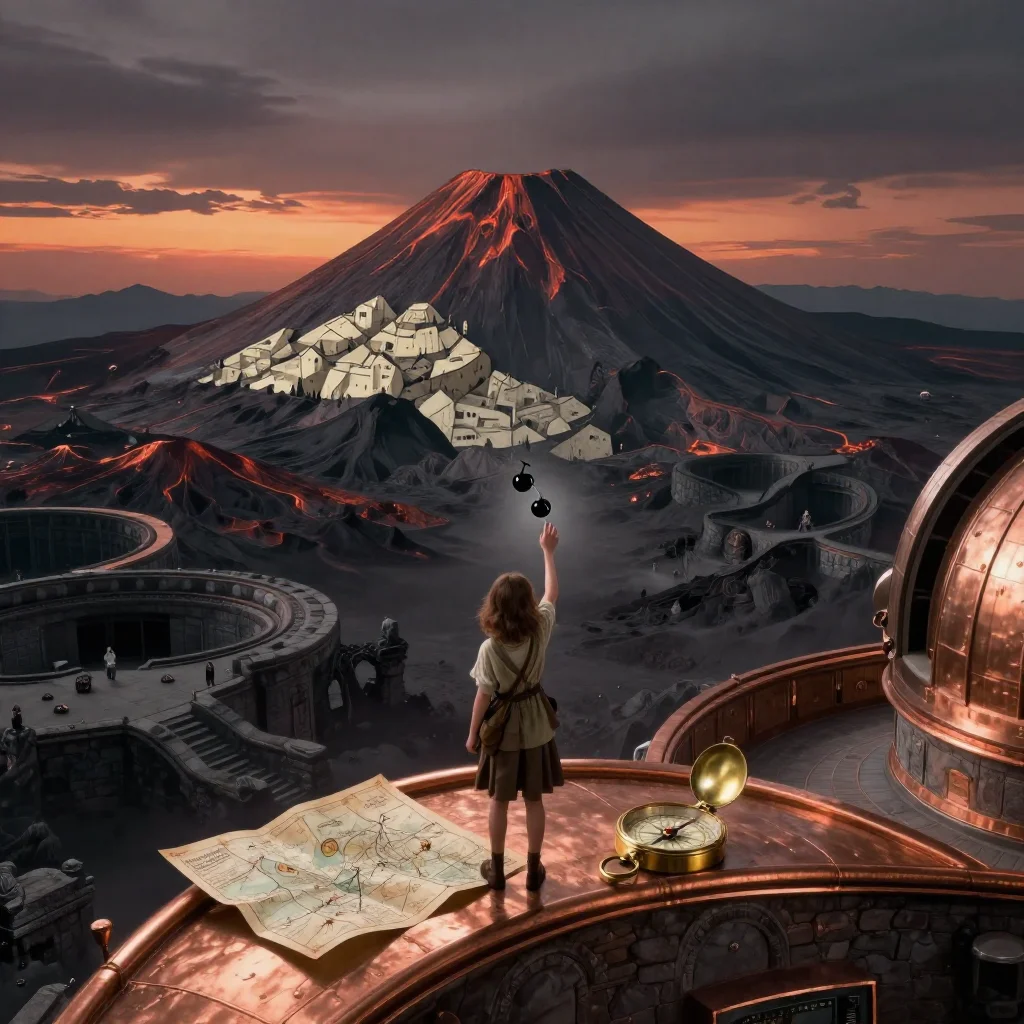
At seventeen, I could read a mountain by its shadows, but I could not read my own hand. It happened on the last night of autumn, when the observatory lamps burned low against the sleeping volcano.
I was copying coastlines for Master Orin when a crease appeared beneath my thumb. At first I thought it was ink. Then the ink lifted into black-cherry ridges, pale stone valleys, and a copper-colored horizon no larger than a fingernail.
A country. Mine, unless I rubbed it away.
That night the observatory’s brass bell gave one incomplete note. It had always answered the wind with a clear sequence, but now it stopped before the final sound.
The song was my mother’s favorite. She had sung it while packing my surveyor’s case, promising that every journey would end in a place where the ground recognized her footsteps.
She had disappeared three winters before, beyond the volcano’s lower slopes. I kept searching because the song kept opening doors in my memory. Now it had lost its ending.
On the table lay the brass compass my mother left me and a folded map, its creases worn soft from use. When I touched the country on my hand, the compass needle swung toward the observatory’s sealed western stair.
The Rival at the Copper Stair
Someone had already unlocked the stair.
“Sera Vale,” said a voice from the dark.
Captain Ilyan Rook stood beneath the broken dome, his silver coat bright as a blade. He had once been my friend. Once, he had taught me to read cloud shadows.
“You heard the missing note too,” I said.
His eyes closed. “I have heard nothing. I came for the western instrument.”
He wanted the lost thing, though not for my reason. While I believed the final note would return my mother’s direction, Ilyan intended to tune the observatory’s great array and call down the sky-rail. It would restore the vanished routes to the northern settlements, making him ruler of a new trade empire.
“The note is not yours,” I said.
“Neither is your mother.” He drew his sword. “But the mountain does not care who inherits its music.”
Behind him, the sealed stair groaned. Warm air rose through the cracks, smelling of sulfur and rain. On my hand, the tiny country trembled.
I folded the map and opened the brass compass. The needle pointed not down the stair, but across its wall.
“Your empire begins in the wrong direction,” I told him.
The Map That Breathed
Ilyan struck the wall. Stone became a map.
It peeled outward in vast paper folds, revealing a passage descending through the volcano’s throat. The passage existed only while the song remained incomplete. I saw that now: every unfinished note had loosened the world enough to let a forgotten route appear.
We ran together because the passage was closing behind us.
At its center stood the old heart of the observatory, a chamber of black cherry basalt. Suspended above a pool was a bronze mechanism shaped like an ear. The missing note hovered inside it, a trembling gold filament.
“Take it,” Ilyan said. “Without it, my array is useless. With it, your song is whole.”
He was wrong. I could feel the country on my hand tugging at the filament. It wanted the note too.
“Your empire,” I said, “would turn every home into a route.”
“My empire would turn hunger into hope.”
For a moment, I believed him. Then the hand-country opened its pale stone gates.
From inside it emerged a girl no taller than my thumb, carrying a banner of copper horizon. She pointed toward Ilyan, then toward the mechanism.
“That is the thief,” she said.
He lunged. I knocked the compass from his grip. Its needle spun wildly, catching the gold filament and fastening it to the map in my hands.
The Last Measure
The map began to sing.
Not through sound, but through pressure beneath my fingers. The country on my hand rose in relief, its valleys deepening, its horizon widening. Ilyan’s northern settlements appeared as pale sparks. His promised empire shrank to a handful of dots.
He turned toward the mechanism. The bronze ear began closing.
There was only time enough for one choice.
I could pull the filament free and save the country, letting the observatory remain silent forever. Or I could let the note pass through the compass, restoring my mother’s song and making the hidden route permanent.
“Sera,” Ilyan said. His voice had changed. “What do you hear?”
Behind the mechanism, beneath the mountain’s breathing, I heard my mother’s final line. Not a direction. Not a promise.
A name, spoken clearly enough to answer.
I let the note enter the compass.
The observatory woke. The bronze ear sang one bright, unbroken measure, and the country on my hand vanished beneath its border. Ilyan’s route opened in the north. The western passage sealed.
Then, from somewhere beyond the black-cherry stone, my mother answered.
I closed my hand around the compass and listened.





