 Netwrck
Adventure.
Tomorrow’s Brickwork
Every morning, the residents of the Vesper House stepped into the same day wearing different expressions.
Some remembered birthdays that had not happened. Some knew which stair would crack, whose cup would break, or where a red umbrella would lie abandoned after rain. They lived in rooms built from pale stone and black cherry wood, and they navigated the days by carrying tomorrow in their heads like sealed letters.
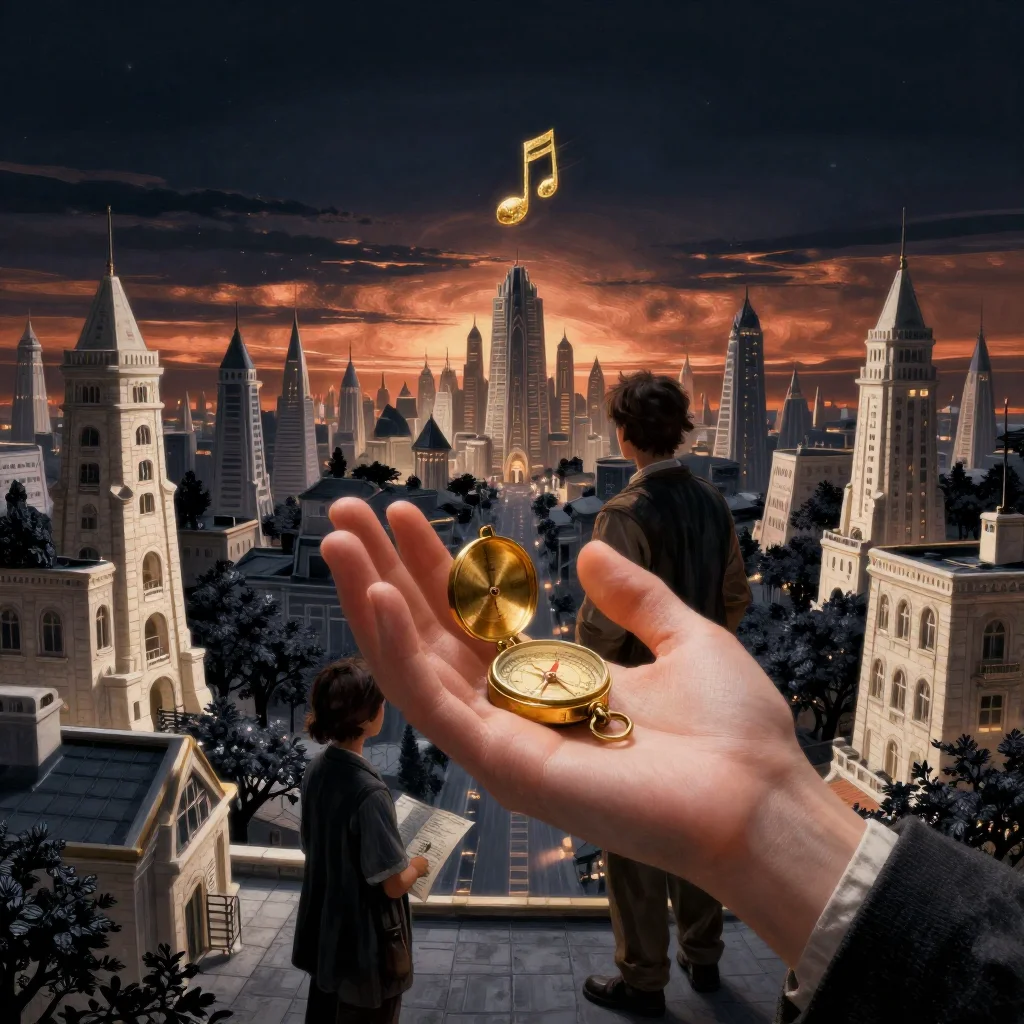
Mara Venn was the cartographer’s apprentice. Her work was to draw the city before it opened: its streets, its vanished gardens, the places where a remembered disaster had erased a street entirely. She kept a brass compass in her left pocket and a folded map beneath her belt. The compass pointed not north, but toward the strongest certainty in the room.
That morning, it trembled toward her own hand.
On the back of her wrist, between two pale freckles, a black cherry-colored line had appeared overnight. It curled across her skin like a river, branching into roads, tiny squares, and a coast with no sea.
“You have been given a country,” said Ilyan Sore, the building’s eldest resident, without looking up from his tea.
Mara rubbed the map with her thumb. The lines held. Beneath the skin, she felt a faint pulse, patient and immense.
“I asked for tomorrow,” she said.
“The country may be tomorrow.”
Then the song began.
It came from the stairwell, high and bright, with a melody Mara had known since childhood: When the Copper Horizon Opens, the song her mother used to hum while folding maps. Mara had sung it every day for sixteen years. Every singer in the building knew it too.
But that morning, the final note was missing.
The melody climbed, trembled, and stopped one step before its home. The silence was not empty. It had a shape, a hard bright edge, as if someone had cut the last note from the world.
Across the landing, a rival cartographer named Oren Vale lifted his own brass compass. Its needle pointed at Mara’s hand.
“Give it to me,” he said. “I can locate the missing measure.”
“Why do you want it?”
Oren folded his compass. His face closed like a map being shut.
“Because my daughter’s tomorrow ends before she learns to sing it.”
A Rival’s Border
They descended through the building by remembered routes. The elevator opened only when both of them agreed on the same future, so they used the stairs, passing doors marked with tomorrow’s disasters: WATER, FIRE, A LETTER ARRIVING TOO LATE.
Oren walked ahead. He knew the route because his daughter’s memory had repeated it six hundred times. Mara followed the country on her hand. Its black cherry roads widened whenever the song approached, then narrowed to a single pale-stone path.
At the roof, they found the missing note.
It hovered above the horizon, a copper-colored point no larger than a grain of rice. The city beyond the windows continued toward it in copper planes and black cherry shadows, a future made of weather, rooftops, and distant fires.
The compass in Mara’s pocket pulled so hard it burned through the lining.
“Do not take it,” Oren said.
He stood between her and the horizon. In his hand was not a weapon but a small folded map, its paper yellowed by repeated futures.
“My daughter saw this roof,” he told her. “She saw you take the note. Then she saw the city fall.”
Mara looked at the country on her skin. One road ended beneath the note. Beside it, another road led away from the horizon, toward a blank white space she had never mapped.
“You came to steal it,” she said.
“I came to prevent one ending.”
“There are other endings.”
He nodded. “That is why I need yours.”
The Unfinished Horizon
Mara unfolded her own map. The paper was crowded with official futures: every street, every sunrise, every possible disaster. She found the note’s place and drew a new road beside it, leading into the unnamed white space.
For the first time in her life, she drew something the building had not remembered.
The country on her hand burned. Black cherry rivers turned toward the white road, and the pale stone beneath the roof cracked with a sound like a distant bell. Oren grabbed the brass compass, but Mara closed her hand around it first.
“Your daughter saw me take it,” she said. “She did not see me leave a way out.”
Together they struck the note from the air. It was not taken. It was released, breaking into a thousand smaller notes that entered the windows, the brickwork, the folds of every map in Vesper House.
For one heartbeat, the building remembered the future in every direction at once.
Oren’s compass spun. Somewhere below, his daughter began to sing.
Then the song reached its final measure.
The note sounded across the copper horizon, and the city did not fall. It became larger.
Mara’s hand had changed. The country remained, but its borders no longer ended at her wrist. A tiny black cherry harbor opened beneath her thumb, and beyond it stretched a pale-stone road.
She had wanted to discover why the song was missing its ending.
It had ended because no one had been willing to map what came after it.





