 Netwrck
Speculative Fiction.
The Country on Her Hand
Ilyan found the country while copying the observatory’s winter charts. A pale blister had risen beneath the skin between her thumb and wrist, no larger than a lentil. When she touched it, the blister opened into a coastline.
There were charcoal cliffs, a rust-red bay, and a river winding north through miniature country. At its source stood a bell with no clapper. The map on the drafting table continued elsewhere, but the country on her hand insisted upon its own borders.
She copied it with a needle’s blunt end. The line sank beneath the skin, then reappeared as a road of pale winter light. By evening, Ilyan knew three things: the country was not a drawing, the observatory was not built on a mountain, and the song her mother had taught her was missing its final note.
She had sung it every winter since childhood. The melody climbed from low to high, describing a traveler crossing a frozen pass. At the end, the traveler reached a door beneath the snow. Her mother always stopped before the last sound.
“A door is not an ending,” she had said. “Sometimes the road continues inside.”
Ilyan had accepted that answer when she was seven. At twenty-two, she no longer did.
The Rival Cartographer
Master Vey found her over the brass compass in the eastern chamber. Its needle pointed not north, but toward her hand.
“You have made a private border,” he said.
“It made itself.”
He drew the compass from her grasp and folded the map beside it. On the vellum, her country had already begun to change. The bell was ringing. Thin lines of smoke rose from the little mountains.
Vey told her the song was a survey instrument. Generations of apprentices had used it to measure pressure beneath the volcano. Its final note opened a passage to the sleeping country under the observatory. The passage had been sealed after the last eruption.
“I need that note,” Vey said. “Not for a map. For the people below.”
Ilyan understood then why he kept the lower charts locked. He believed the sleeping country still held survivors. His daughter had vanished during an eruption, and Vey had spent thirty years searching for a route back.
“If the passage opens,” he said, “they will hear us.”
He offered her the brass compass. She refused. He placed the folded map on the table between them.
“Then we race the mountain.”
The Bell Without a Clapper
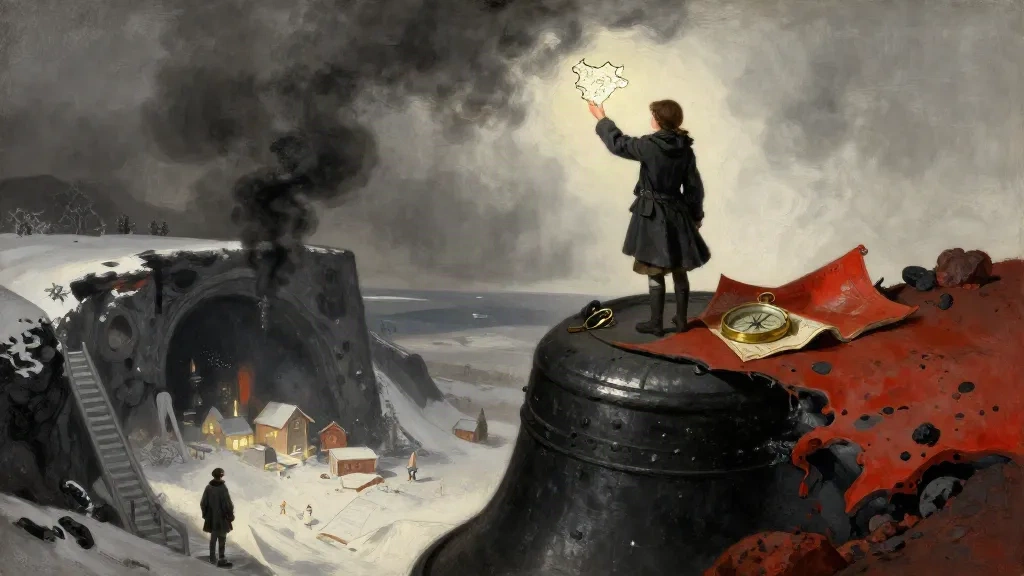
They descended through the abandoned levels by lamplight. The walls were warm despite the winter. At the final stair, the compass needle spun wildly, and the folded map began to unfold itself. Its creases softened. New roads appeared in rust red.
The bell waited at the bottom: a mountain-sized iron instrument sunk into a shaft of black stone. Ilyan climbed onto its rim and saw her country spread below her, not on her hand but in the cavern. Rivers shone beneath the floor. Tiny settlements crouched along their banks.
Every house had a light in its window.
Vey raised his lamp. The cavern answered with a low hum. Somewhere under the stone, the sleeping volcano shifted.
“If you sing the note,” he said, “the shaft opens. If the shaft opens, the mountain may wake.”
He wanted the door. The country wanted its bell. The mountain wanted silence.
Ilyan pressed her palm against the iron. The country on her hand became warm. For the first time, its northern shore had a road leading beyond the mountains. At the road’s end waited a traveler with a lantern.
She recognized the traveler’s coat.
Her mother had disappeared there.
What the Note Opened
Ilyan sang the melody from the beginning. Vey did not stop her. Each phrase shook dust from the shaft and brightened the windows below. The traveler on her hand raised the lantern.
At the final pause, Ilyan understood the missing note. It was not a sound to be recovered. It was a choice to leave a door unlatched.
She sang it.
The note was small and cold, the sound of snow slipping from a branch. The iron bell answered with a single clear strike. The cavern split without violence, revealing a passage filled with pale winter light.
Vey entered first. The sleeping country opened its roads, and every light moved at once.
On Ilyan’s hand, the coastline erased itself. In its place remained a thin brass compass, no larger than a splinter, pointing toward the open shaft.
She folded the map along the new road and followed without looking back.





