 Netwrck
Fairy-Tale Fiction.
The Door That Opened Leftward
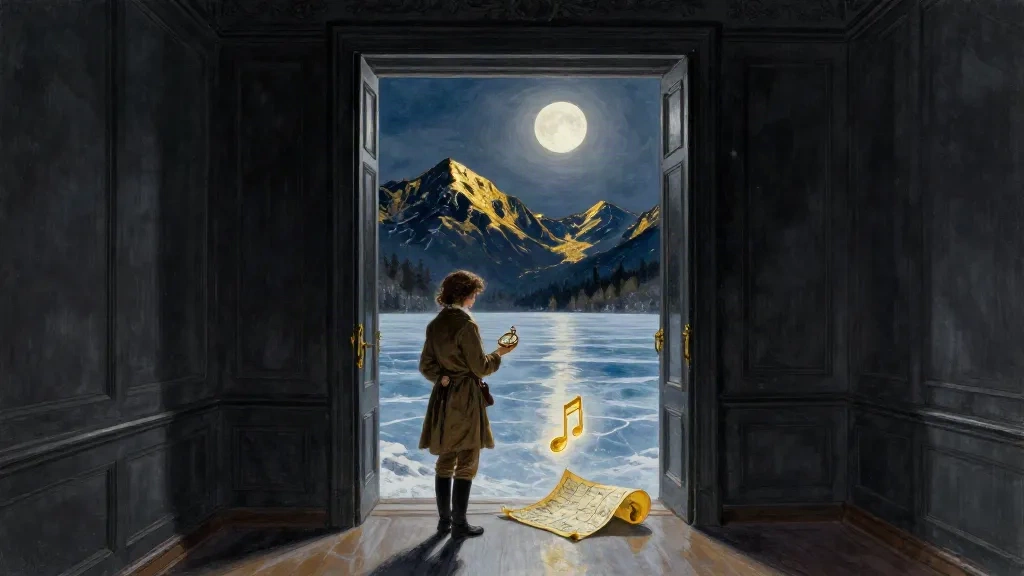
On the night the song lost its ending, Mara found a door in the museum that opened onto winter.
Cold moonlight spilled through its narrow glass, staining the black lacquer floor silver. Beyond the threshold, snow hung motionless above a frozen lake, and every breath Mara took arrived in another person’s voice.
She had spent seven years copying maps for her master, the cartographer Elian Voss. The maps were beautiful things, crowded with roads that led nowhere and rivers that flowed uphill. Yet none showed the country she discovered that morning on the back of her left hand.
It had appeared beneath her thumb while she sharpened a quill: a green coast, three black mountains, and a gold line winding inland. When she touched it, the ink lifted like rain from hot stone.
The song was the one her mother had sung before leaving. Mara remembered every note except the last. The melody turned toward a high window, climbed, and then surrendered to silence. For years she had believed the silence was her mother’s goodbye.
At the museum door, a brass compass trembled in her palm. Its needle pointed not north, but toward the map on her skin.
“You cannot enter that country,” said a voice behind her.
Rival Aster stood beneath the gallery’s tallest frame. He was the museum’s youngest doorwarden, known for finding courage in polished armor and borrowed weapons. He carried a folded map of his own, stitched with red thread.
“I know how to find the note,” he said. “You know how to find the road. Neither of us can do both.”
“What do you want with it?”
He looked toward the winter door. “My sister is inside there. The last note is the only thing that can call her out.”
The Gallery of Borrowed Bravery
Mara unfolded her map. The paper had come from a blank sheet, yet it was already creased along invisible borders. A gold speck trembled near the country’s northern edge.
“The note is not a sound,” she said. “It is a door.”
Aster’s jaw tightened. “Then it is a way home.”
They entered the winter.
At once, the museum vanished. Mara stood on the frozen lake with Aster beside her, the brass compass fixed to her palm and the folded map pressed between them. The black mountains rose ahead, powdered with gold dust, but their peaks were cut off by a vast dark shape moving beneath the ice.
The song began without either of them choosing to sing it.
It rose through Mara’s ribs, bright and wavering. She understood then that the final note had not vanished. It had been carried away by someone who feared endings.
“The Keeper of Last Breaths,” Aster whispered.
“You know it?”
“My sister became it.”
Across the lake, a woman in a hooded black cloak lifted one hand. Frostflowers opened in her palm. When she sang, the ice beneath Mara’s feet began to sing back.
“Give me the note,” the Keeper said, “and your mother’s song will be whole.”
Mara felt the country on her hand pulse. A road appeared beneath the frost, leading toward a narrow pass in the mountains. The compass swung toward it.
“It lies,” Aster said.
“No,” Mara replied. “It tells the truth, but not all of it.”
The Note That Refused an Ending
The pass was filled with doors.
They climbed through black lacquer galleries suspended over a moonlit abyss. One door opened onto a battlefield where courage meant standing still while arrows passed overhead. Another opened onto a flood, and another onto a stage where the audience demanded laughter from a woman who knew only sorrow.
At each threshold, Mara heard the missing note grow nearer. Aster unfolded his map, marking routes and retreating passages, but the red thread began to fray.
“My sister did not become the Keeper by choice,” he said.
“Then why did she take the note?”
“Because she believed a song should never end.”
Mara understood the lie inside the winter. The Keeper had trapped the note in her breath, keeping the melody suspended between departure and return. With it, every unfinished farewell remained unfinished.
They reached the last door: a small black gate shining with gold dust. The country on Mara’s hand split along its gold line, and a narrow path appeared through the mountains.
“You can take the note,” Mara said to the Keeper, “or you can give it back.”
The Keeper’s face softened. “If I give it back, your mother’s voice will vanish.”
Mara pressed her thumb to the country. “Not my mother. Only the song she could not finish.”
The note returned.
It entered the compass, then the folded map, then Mara’s throat. Her mother’s melody rose through the museum, through the mountains, through every door in the world. The Keeper became a pale reflection in the ice, and Aster’s sister stepped free of the cloak.
The Map That Chose a Future
At dawn, Mara stood before the museum’s black lacquer wall. The final note hovered in the air, bright as gold dust.
She sang it once. The doors trembled, each opening onto a different kind of courage: forgiveness, refusal, tenderness, the willingness to begin again.
Aster watched the compass settle at her side. “What will you map now?”
Mara looked at the country on her hand. It had changed. The road no longer ended at the gold line; it continued across her wrist, a tiny black mountain capped with silver snow.
“The way back,” she said.
Then she opened the door marked with a bird in flight and stepped through.
Behind her, the museum doors began to sing.





