 Netwrck
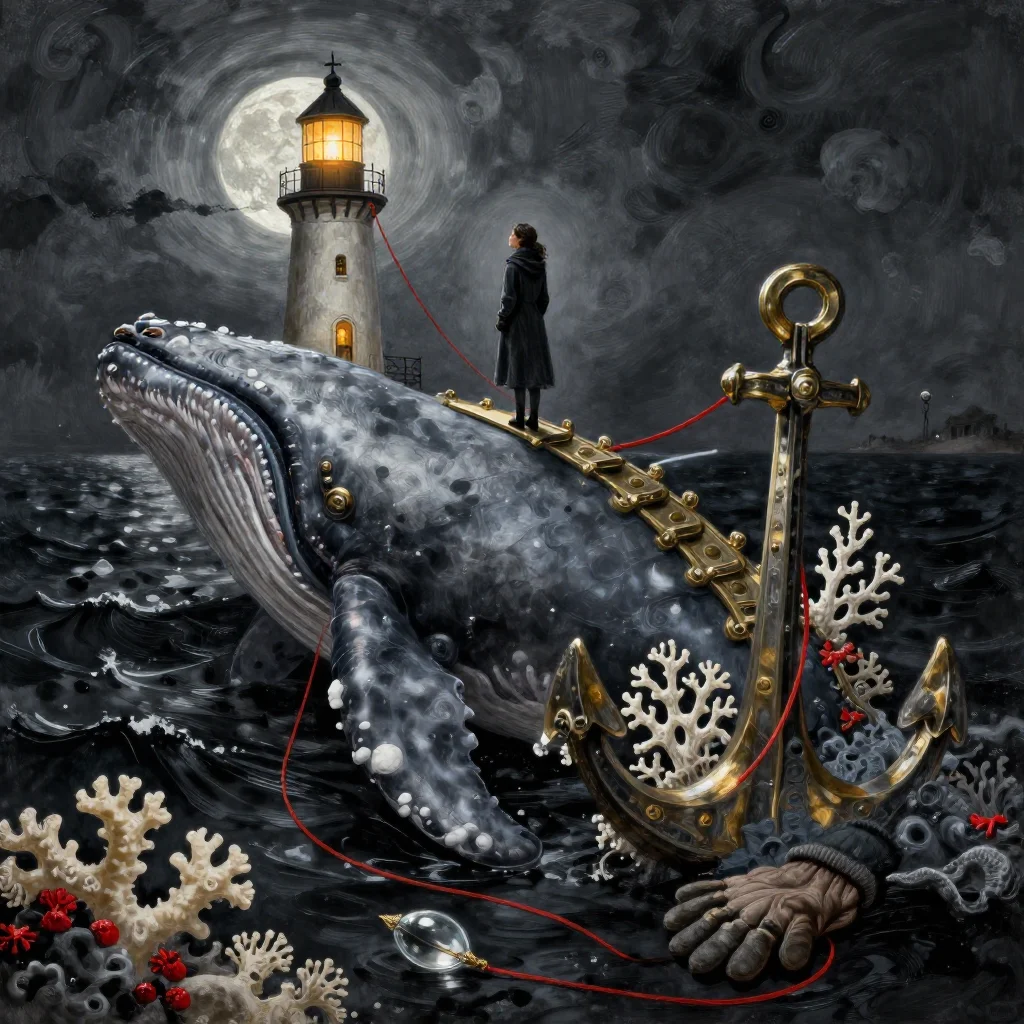
Gothic Fantasy.
The Name in the Catalogue
Mara Venn kept the lighthouse catalogue in a room shaped like a ribcage.
Each night, while the mechanical whale beneath her dreamed, the whale's iron ribs rose and fell with a breath like distant surf. Salt gathered in the seams of its vast metal flank. White coral grew around the old anchor scars, pale and knuckled, and beyond the lantern room the sea lay black and level.
Mara entered names into the catalogue: drowned children, vanished villages, harbours renamed by conquerors, saints whose bones had been scattered among the dunes. She wrote in ink thinned with rain. A red thread ran from shelf to shelf, crossing every surface, pinning loose pages and tying shut the drawers that complained in winter.
On the seventh night, she found her own entry.
MARA VENN, born of the salt meadow. Keeper of the last light. Name returned to the land in the year of the red tide.
The paper was new. The ink shone wetly. In the margin, a future hand had drawn a small glass seed split by a black root.
Below the name, someone had written: Ask what the shadow signed.
Mara had no shadow. The lamp behind her burned without a flame, and her feet cast nothing upon the whale's brass deck. She searched the room and found, beneath the floor, a wool glove stained with white coral dust.
The Whale Dreams Below
She followed the red thread downstairs.
It passed through the iron hatch and continued along a ladder into the whale's living machinery. Pipes clicked in the dark. Far below, a slow heartbeat worked the dormant engine. When Mara touched a lever, the whale turned a fraction of a degree, and the lighthouse swayed like a mast in a storm.
In the hollow of its chest, she found a desk.
The desk was covered with contracts. The shadow was there too.
It had no face, only a tall darkness wearing the shape of a man with a clerk's shoulders. It dipped a pen into a bottle of ink. When it lifted the pen, the paper trembled.
“You are late,” the shadow said.
“I have not yet returned a name.”
“You have been keeping it.”
The shadow pushed a contract across the desk. Mara saw her handwriting in the witness column.
“This grants the land its name in exchange for its memory,” the shadow said. “All names are purchases.”
“Then who bought mine?”
The shadow signed.
The signature appeared beneath the line: Mara Venn.
At the same moment, the whale groaned. Through the walls came the sound of bells, church bells, village bells, bells from places that had vanished from every map. Mara held the wool glove against the iron. Inside it lay a glass seed, no larger than a drop of water.
The seed contained a small red thread.
The Land That Refused
She climbed to the lantern and broke the seed against the glass.
Light entered the lens and divided into hundreds of white coral branches. The red thread snapped, then leapt from the instrument, across the whale's back, down into the water.
Mara followed it.
She walked the whale's broad spine until the metal gave way to a narrow beach. White coral rose around her boots. Beneath the tide lay a field of dark stones, each carved with a letter. She knew they formed a word, but the sea had taken the spaces between them.
The shadow stood at the waterline, signing the stones.
Each signature made a name disappear.
“You cannot restore every forgotten thing,” it said.
“I only have to return one.”
She drove the wool glove into the wet sand and placed the broken glass seed beside it. Then she unwound the red thread from her wrist and laid it across the stones, linking their carved letters.
The name rose from the seabed.
It did not return as a sound. It returned as weight: a pressure beneath her feet, a door opening in a stone wall, a mother calling from a house with no roof. The land remembered the person before it remembered the word.
The shadow tore its contract in half.
For a moment, its darkness showed the shape of a girl buried beneath the lighthouse. Then it dispersed into rain.
The Returned Name
At dawn, the whale opened one brass eye. Its other eyes remained dark.
Mara planted the wool glove on the highest coral mound. Inside it, the glass seed had become a red ember. She wrote the recovered name across the lighthouse wall in white pigment, large enough for ships to read from far away.
By noon, every chart in the archive had changed. A village appeared where no village had been. A road bent inland. The name she had restored now marked not a person, but a place, and the place bore her name too.
Mara opened the future catalogue.
The entry remained, though the final sentence had been erased. Beneath it, a new note appeared in red ink:
Returned by the keeper. Remembered by the ground.
The whale began to move south. Its wake carried the old bell-sound away from the coast, and Mara climbed the lantern stairs with the catalogue under her arm. She had come to save a name. Instead, she had returned the land's ability to remember, which was larger, and far less obedient.
Behind her, the red thread stitched the shelves together.
It crossed the black ink, the white coral, and the sleeping whale, holding every lost thing in a line that no shadow could sign away.





