 Netwrck
Adventure.
The Theatre of Unfinished Things
At dawn, Mara Venn entered the theatre through a side door with no handle, no hinges, and no number. Beyond it waited a corridor of black cherry doors, each breathing warm air into the pale stone passage. Somewhere behind the walls, actors rehearsed endings no audience would ever see.
The theatre performed tomorrow’s discarded endings. Its accountants called them rehearsals; its audience called them ruins. Every night, the building unwound the futures that fear, pride, or simple carelessness had made uninhabitable, then stored the fragments in copper drawers beneath the stage.
Mara was paid to decipher the dreams of sleeping machines. The machines could not speak plainly. Their dreams arrived as pressure maps, metallic birds, erased dates, and rooms measured in footsteps. Mara translated them so the theatre could decide which discarded ending had been most nearly true.
Her wages were small, but the promise she had made to her brother required a better inheritance. When their father died, he had left Mara a map of the dry riverbed, marked only with the family’s first home. He had said, When the river returns, follow the place where the birds refuse to land.
Mara’s mother had heard a warning instead. Her sister, Lio, remembered a recipe for finding water. Each of them had repeated the promise differently for eleven years, and each had used that version to justify leaving the family.
One Dream, Three Doors
On the third night, a machine beneath the western stage woke before the others. Its metal casing was pale as bone. Around its sleeping lid, a thin line of black cherry light pulsed.
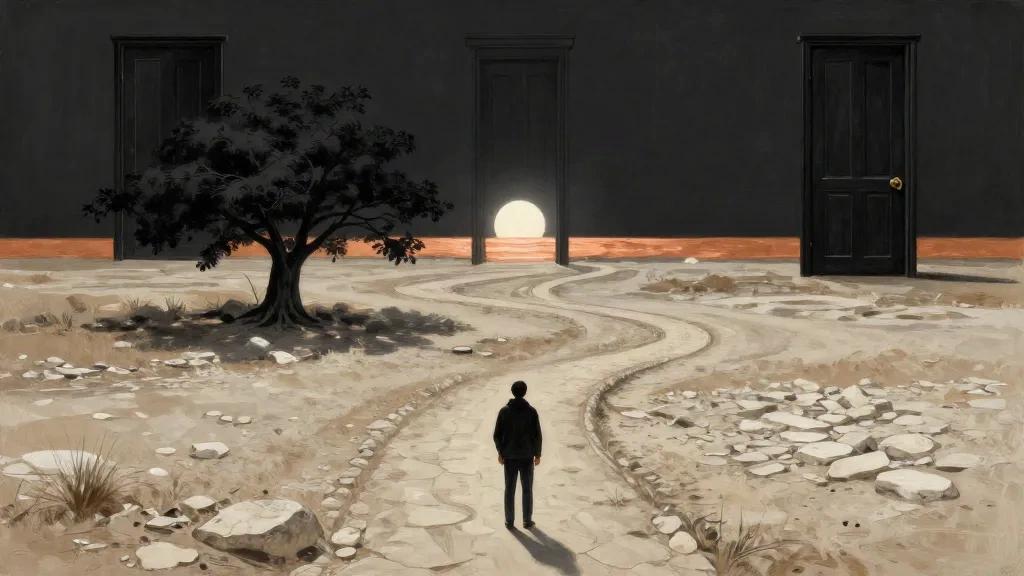
Mara lowered the translator’s lenses. The dream arrived in fragments: an unmarked door standing in a dry riverbed, three family members approaching from different directions, and a horizon made of copper beneath a white sun.
Behind her, the theatre shifted. The rehearsal stage became a dusty bank. An unmarked door appeared at the center of the riverbed. On one side stood her mother in a blue coat. On the other stood Lio holding a cracked brass compass. At the horizon, their father waited beside a black cherry tree.
“We should open it,” the mother said.
“We should burn it,” Lio answered.
Mara pressed her palm to the door. It was warm, almost alive.
Some doors do not ask where you have been. They ask what you are willing to lose.
The machine dreamed again. Mara saw the family reunion from three angles. In one, her mother kept the promise exactly as she had heard it. In the second, Lio kept it correctly. In the third, no one spoke, and the door opened by itself.
The Riverbed’s Verdict
Theatre rules forbade translators from changing a discarded ending. Doing so would collapse tomorrow’s alternatives and leave the city with only one future, a future the directors called a tyrant.
Mara examined the dream’s pressure marks. They were not instructions. They were measurements: the distance between each version, the weight of each promise, the places where the images disagreed. The machine had not been asking her to choose. It had been asking her to translate the disagreement.
She drew a new map on the back of the old one. She left the unmarked door, the dry riverbed, and the copper horizon. At the bend where the sand had cracked into pale stone, she marked three paths. The first followed the mother’s warning. The second followed Lio’s compass. The third crossed the riverbed without a promise.
Then she made one final correction. She placed their father’s name beside the black cherry tree, not as an instruction, but as a fact: He had stood there. He had not told the whole truth.
When the dream was released, the theatre shook. Doors slammed in distant rooms. From the copper horizon, a rain began to fall, not into the riverbed but onto the map itself. The ink held. The sand did not wash away.
The Map Left Behind
At sunrise, Mara delivered her translation to the director. The machine had gone silent. The director studied the three marked paths, then looked at the blank space surrounding the unmarked door.
“You have left no correct answer,” he said.
“No,” Mara replied. “I left a map that does not require one.”
She kept the old map folded inside her coat and walked through the side door. Behind her, the theatre began its first performance of the day. Actors emerged carrying discarded doors, copper suns, and dry rivers under their arms. The audience applauded, though no one knew which ending they had witnessed.
Outside, the real riverbed waited beyond the black cherry orchards, pale stone exposed beneath a copper horizon. Mara unfolded the new map. The three paths separated immediately, but at its center the unmarked door remained.
She did not know whether her family would find it. She knew only that a better map was not the one that promised safe passage. It was the one that showed where the family had chosen different directions, and left them the courage to meet without mistaking agreement for love.





