 Netwrck
Romance.
Shadows Before the Snow
Mara arrived at Harrowmere three days before the first guests, while the mountains were still bare and the resort stood with its windows dark. The shadows had come first, as her grandmother always said. They pooled beneath the eaves, crossed the courtyard without wind, and gathered beside the dry riverbed where the summer melt had vanished months ago.
She carried a black umbrella though no rain had fallen. Its silver handle was bent from an old accident, and beneath its folds lay the recipe book she had refused to open for eleven years.
Mara was a cook because cooking was what her family had done when words failed. Her grandmother had fed skiers, poachers, lovers, and fugitives beneath this roof. She claimed the recipes summoned not ghosts, but people who had once eaten at the table. Mara wanted to prove the legend true. She wanted to summon Anton Vale, the young surveyor who had vanished during a white storm and whom her grandmother claimed had returned every winter to sit at the empty end of the table.
What the Kitchen Remembered
The first recipe was for brown bread and bitter greens. Mara made it in the old kitchen, using flour from the lowest shelf. When she placed the loaf on the table, a man in a wet wool coat took the chair by the window. His face was hidden by a blue scarf.
“He is not Anton,” Mara said.
“He is whoever you fed,” her grandmother’s voice said from the pantry, though her grandmother had been dead for six winters.
The second recipe summoned a woman with a burned hand, then two children arguing over a spoon. Each guest ate, remembered a little, and vanished before the plate was empty. None of them knew Mara. None of them knew Anton.
At midnight, the black umbrella leaned against the kitchen doorway. A drop of rain struck its tip and became a bead of ink on the floor. Mara opened the book to the final recipe, written in her grandmother’s cramped hand.
Feed the one who waits with the meal he loved. The gate will open. The price must be paid once.
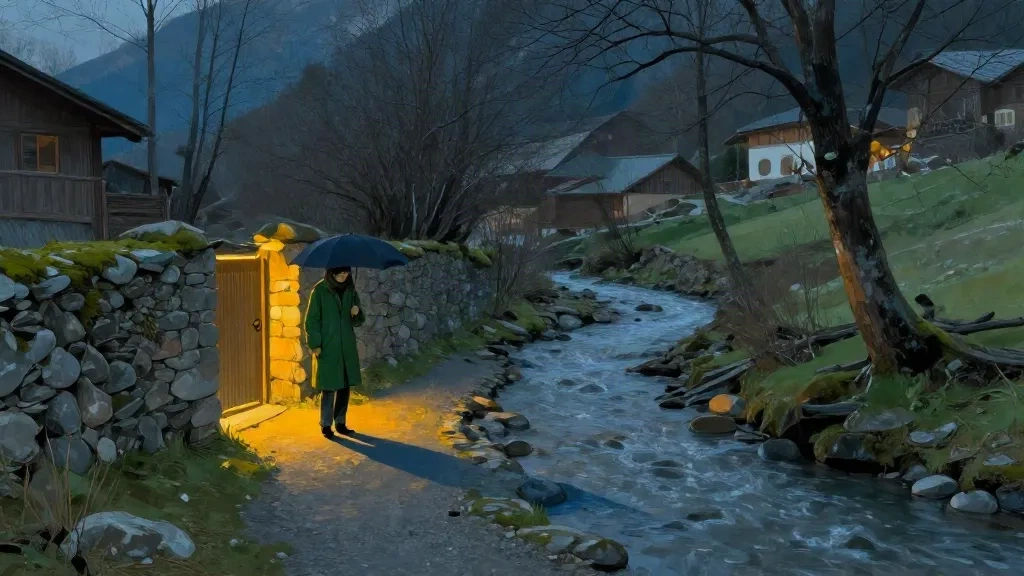
Below the words, a sketch showed a narrow stone gate at the end of the riverbed. Behind it stood a man holding a black umbrella.
The Gate at the River’s End
Mara found Anton there, exactly as the sketch promised. He looked older than the portraits, though not old. Snow rested on his shoulders and melted in his hands.
“You came back,” he said.
“My grandmother said you did.”
“She sent the meals, not me.” His mouth lifted. “I have been waiting for someone to remember the way out.”
The gate opened when Anton touched it. A warm wind poured through the stone, carrying the scent of bread and wet earth. Beyond it lay a green valley, full of tables beneath summer trees.
Then the voice of the kitchen called. Her grandmother appeared in the doorway, young and stern, with flour on her sleeves.
“If you cross,” she said, “the one you love will remain here. The one who loves you will be lost. That is the price.”
Mara understood then. Her grandmother had paid it years ago, opening the gate for Anton’s return. She had forgotten the man who had waited for her outside, the man who had loved her before the resort had been built. Memory was the gate’s toll, and it could not be taken twice from the same heart.
The Meal She Chose
Anton took her hand. “Stay with me.”
Mara looked back at her grandmother. “I did not come to prove the legend,” she said. “I came to prove I remembered you.”
She took the recipe book from the dead woman’s hands and tore out the page with the gate. Then she cooked the meal Anton had loved: barley soup, browned onions, and a spoon of honey.
The shadow guests filled the kitchen. They lifted bowls, laughed, argued, and drank. Anton sat at the empty end of the table. When Mara set his bowl before him, he remembered the winter they met.
She remembered the man she had forgotten.
The gate began to close. Her grandmother vanished into its shadow, and Anton walked through it. But Mara stayed. Not because the resort had claimed her, but because someone had to remember both sides of the story.
At dawn, the guests arrived. Mara served them barley soup in the old hall. When a child asked why one place at the table was empty, she placed a black umbrella beside it.
“Because someone is on his way,” she said.
Outside, the shadows withdrew from the courtyard. The dry riverbed shone with new water, and at its end the stone gate stood open.





