 Netwrck
Romance.
The Table at the Waterline
On the wet-stone edge of Orison, where the river divided the town into morning and midnight, Mara watched the kettle and listened for footsteps.
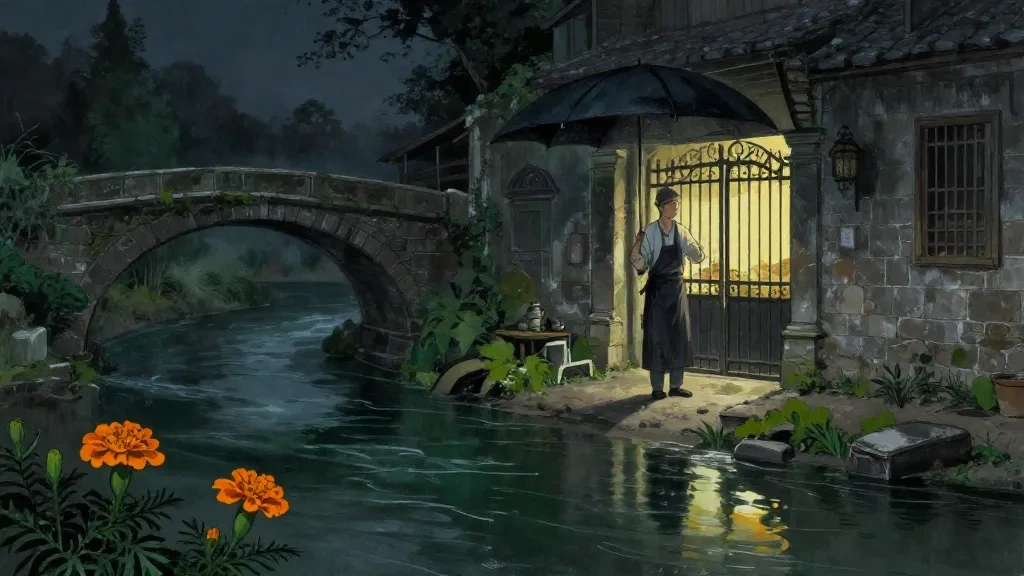
Her cookshop stood where the old bridge used to land. By day, the river ran east, brown and loud, carrying logs from the mountain. At midnight it turned west without warning, dragging the moon's reflection beneath the houses. The crossing gate stood on the old bridge's highest pier, and it opened only for people who knew the price of belonging on both banks.
Mara had inherited the shop, the copper kettle, and a family legend. Her grandmother had claimed that their ancestor, a ferryman's daughter named Ilyra, crossed the reversed river in a black umbrella and returned with a husband from the far bank. The man had vanished before breakfast. Ilyra had waited beside the dry riverbed every night, cooking meals for the travelers who came home hungry.
“One of them will be him,” her grandmother used to say.
Mara wanted to prove the legend true. She wanted the gate to open, the dry riverbed to fill, and the black umbrella to be something more than a story told to keep her alone in the kitchen.
What the River Remembered
At eleven, Mara set six bowls on the worn counter: barley soup, smoked eel, bread baked with river mint. Her recipes had always summoned the absent. A cook who seasoned with the right amount of salt could call back the person who had last eaten from that bowl. It was not magic to Mara, only consequence. Hunger remembered the hands that had relieved it.
At midnight, the river reversed.
The water slid beneath the pilings, carrying ice toward the western houses. The gate's iron chain tightened even though no wind rose. A figure emerged from the dry riverbed, wrapped in the black umbrella Mara's grandmother had polished every winter.
He looked like the man in the old portrait, though rain had erased the details of his face.
“Ilyra sent me back for the soup,” he said.
Mara's hands shook. The soup was still hot. Beneath the counter, the kettle began to whistle, and every bowl filled with green broth.
“My grandmother waited for you,” Mara said.
“Your grandmother was the one who sent me away.” He glanced toward the gate. “The gate took a memory as payment. It did not ask whether the memory belonged to the person who paid.”
The Price Beneath the Stone
The chain gave one hard pull. A voice came from the gate, neither male nor female. “One crossing costs one true name. A second crossing costs the name of the one who waits.”
Mara understood then. The cost could not be paid twice. To bring the stranger through, she would have to surrender her own name. If she called him back again, the river would take the name of the person waiting for her. Her grandmother had waited once. Mara had waited all her life.
The stranger held out the umbrella. Its handle was carved with a river turning in both directions.
“You can keep the name,” he said. “I will be lost, but you will remain you.”
“And you?”
“I will remain a story.”
Mara took the umbrella. Its black cloth was heavy with rain that had not fallen. Across the river, a yellow light blinked in a window.
She remembered her grandmother's hands kneading dough, the flour in her brows, the way she hummed when the soup tasted right. The memory was not painful. It was proof.
Mara lifted the umbrella over the stranger and stepped onto the dry riverbed.
The Meal After Midnight
The gate opened with a sound like a spoon striking a bowl.
When Mara returned, the stranger was beside her, and her grandmother was waiting in the doorway. The old woman had no name that Mara could see, but her face was whole. The stranger bowed to her. She touched his wet cheek, then reached for the ladle.
“You are late,” she said.
Mara laughed. It hurt. It was alive.
At dawn, the river ran east again. The black umbrella dried on the hook by the stove, and the dry riverbed remained a strip of pale stone beside the shop. No one remembered the man who had crossed, but Mara did.
She cooked until noon, feeding travelers whose faces she had never seen. Under the moss-green herbs, she placed one bright marigold in every bowl. The colors held in the steam: wet stone, deep green, and the small golden flash of a door refusing to close.
That night, Mara left the gate chained. Some gifts are larger when they are not spent. She had proved the legend true, and the truth had brought everyone home except the part of herself that had chosen courage over certainty.
Still, when the river changed direction, she set out two bowls.
One for the stranger. One for whoever had learned to wait.





