 Netwrck
Fantasy.
The City Above the City
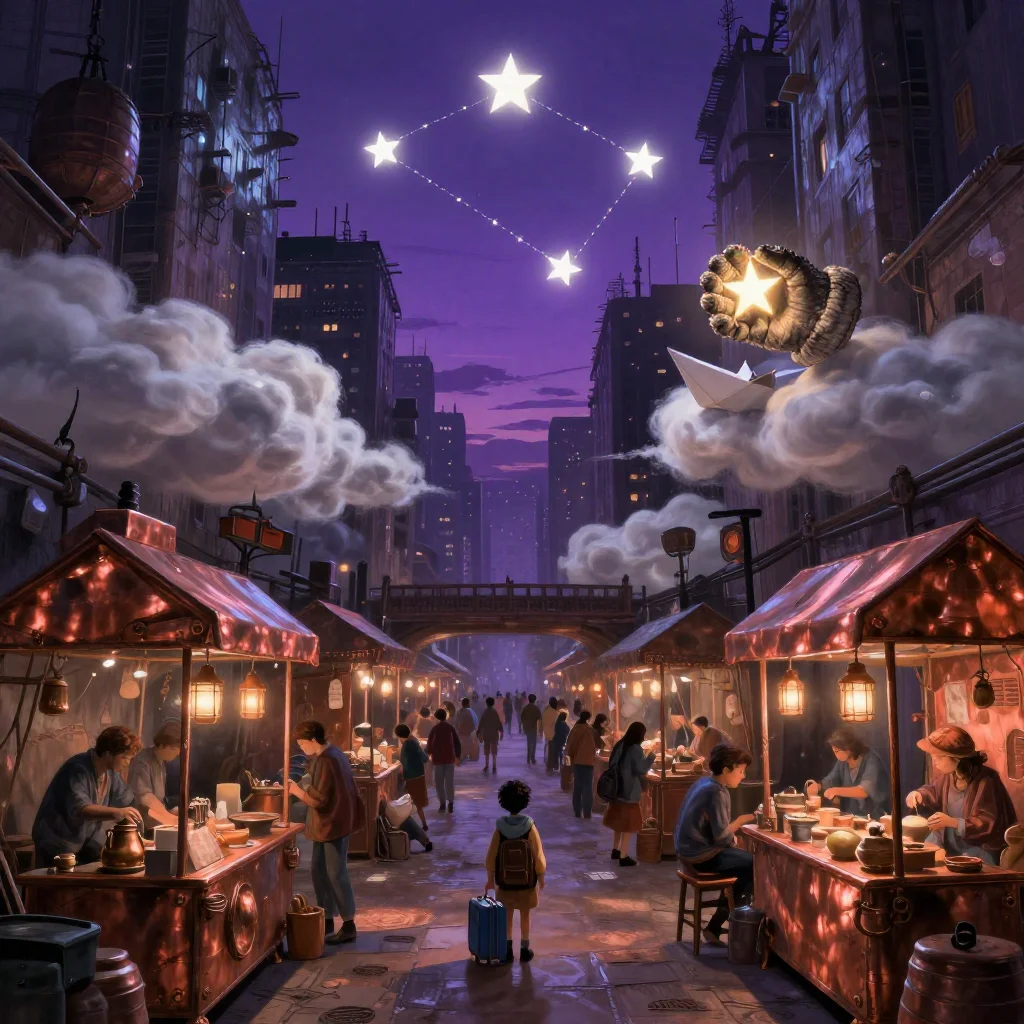
At dusk, when the first-floor windows burned violet against the clouds, Sera carried her library down into the night market.
It weighed eleven pounds in its blue suitcase. The books inside were not large. They were histories of vanished stairways, lullabies for machines, maps of rooms that had never been built, and one unlisted constellation named The Ferryman's Wake. Sera's mother had drawn its seven stars on the inner lid of the suitcase before she went away. She had drawn them in silver ink, then crossed out the last one with a black thread.
The market existed below the city, though the city had no street below its first floor. Stalls leaned against one another over old foundations, their awnings patched with oxidized copper and cloud-white canvas. Vendors sold bottled rain, smoked mirrors, buttons that remembered being worn, and maps to neighborhoods erased by construction. Every lantern gave a small violet shadow.
Sera's grandmother was waiting beside the fountain at the market's center. One hand rested on her walking stick; the other wore a single wool glove.
“You are late,” Grandmother said.
“The stairs moved.”
“They do that when someone is listening.”
Grandmother pointed toward the glove on her hand. It was gray at the fingertips, blue at the cuff, and embroidered with a constellation no one had named.
“The promise was yours before you were born,” she said. “I borrowed the sky for you. Tomorrow, when the market bell strikes twelve, I must return it. If I do not remember why, the stars will remain lost.”
The Debt of the Living
Sera opened the suitcase. The books lifted their pages in the underground wind.
“You are not dying,” she said.
“No.”
“Then why does your promise have a deadline?”
Grandmatter's mouth tightened. She took the paper boat from her coat pocket. It was folded from a child's drawing, its sail marked with seven tiny holes.
“Because I made the promise before I had the right to make it,” she said. “I took those stars to keep your mother safe. She is safe now. The debt has found the person who inherited it.”
The market bell sounded once. Above them, the city's underside opened like a drawer. Pipes crossed the low ceiling, sweating copper drops. Beyond them, far above, the real sky showed only six stars.
Sera found the missing star in a stall called Yesterday's Weather. The seller wore a mask made of wet slate and asked for a memory in payment.
“Take the night I learned to read,” Sera said.
“Not valuable enough.”
She offered the sound of her mother's laugh. Still refused.
At the final stall, a blind woman held the star inside a glass sphere. It glowed like a coal beneath ash.
“Return the constellation,” Sera said.
“Then the sky can collect its debt.”
“Who gave you the star?”
The blind woman tilted her head. “The woman who has not died yet.”
The Long Way Up
Sera ran through the market with the blue suitcase knocking against her knees. Grandmother followed, slower but certain, tapping her stick against the paving stones. The wool glove dangled from her wrist like a small gray flag.
At the stairwell, the door refused them.
“A promise must name its returner,” said the lock.
Sera looked at Grandmother. “You promised me the sky.”
“I promised your mother.”
“Then I return it for you.”
She unfolded the paper boat and placed it on the lock's palm. The boat filled with air from below the city, carrying the market's violet dusk with it.
“By the first star, by the last, by the name I keep, I return what was borrowed.”
The door opened.
They climbed through maintenance passages, past locked rooms and windows full of sleeping machinery. The first star waited at the top of the stairs. The second trembled in a copper pipe. The third, fourth, fifth, and sixth followed, each one answering a different book in Sera's suitcase.
The seventh was nowhere.
Grandmother stopped beneath the first floor. Her glove had turned white.
“It is inside me,” she whispered. “I kept the final star where I could not lose it.”
Sera understood. The debt had not merely stolen a constellation. It had placed one star in Grandmother's memory, so returning the sky would erase the promise that saved her mother.
She took the wool glove from her grandmother's hand. Inside its palm lay a hard, bright seed of light.
A Name Kept Open
Sera put the glove over the paper boat and opened her mother's star chart. The black thread across the last star came loose.
Grandmother gasped. “If I forget the promise, you may lose me.”
“You already forgot part of it.”
“I remembered you.”
Sera placed the paper boat on the sill. The market's violet light rose through its holes, through the copper pipes, through the city's unseen spaces, and into the sky. One by one, the seven stars returned to their places.
The last star went last.
Grandmother closed her eyes. Her face became unfamiliar, then young, then old again. When she opened her eyes, she looked at Sera and said, “You have your mother's stubbornness.”
Sera took the blue suitcase into the daylight. The constellation had changed: its seven stars now formed the shape of a small hand reaching down toward the earth.
At her side, the paper boat finally filled with real rain. The wool glove remained on the step, dry beneath a cloud-white sky, its embroidered stars no longer shining.
Sera did not pick it up. Some promises, she decided, were meant to be returned. Others were meant to be carried home.





