 Netwrck
Weird Fiction.
Room Nine Hundred
At dawn, the citizens of Vespera stepped out of their shadows and went to work. Their shadows remained behind, combing soot from brick walls, carrying bread baskets, arguing over the shade of awnings. At noon the arrangement reversed. The shadows became people, and the people became floors, walls, and small dark stains no one had time to notice.
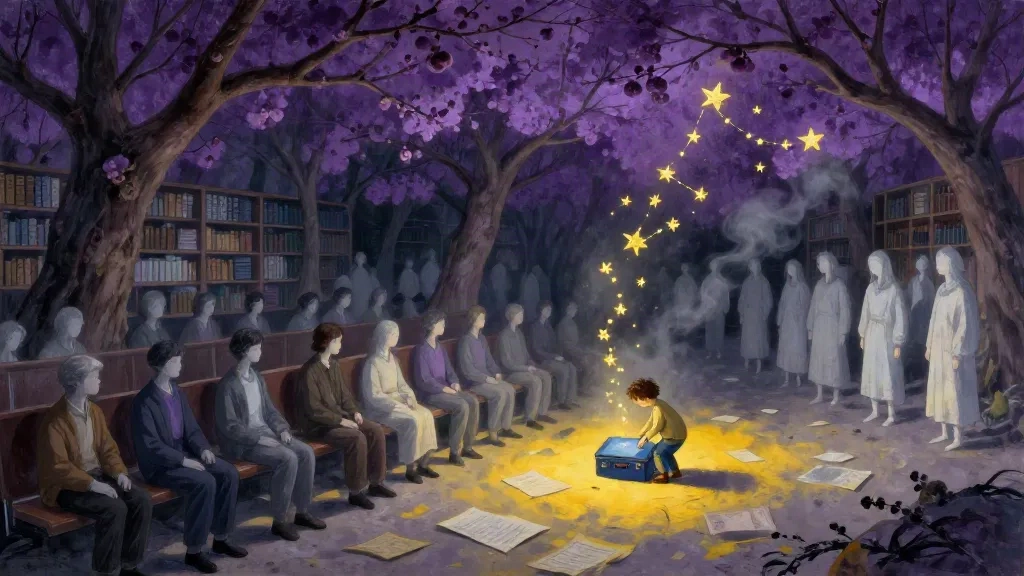
Nera, a child archivist, lived in the glasshouse district, where the plum trees kept their fruit beneath the roots and the air smelled faintly of burnt saffron. She carried a library in a blue suitcase. Spines pressed against one another inside it: atlas, almanac, vanished street register, a book of doors, and a volume bound in wool.
The final book was heavier than the others. When she opened it, nine points of light rose above its pages and arranged themselves into a crooked bowl of stars.
“Ninth Lantern,” Nera whispered.
They belonged to the sky above the Marble Orchard. Nera knew this because the missing stars formed a dark gap among the constellations, and because the library had preserved the sky’s own testimony. Three years ago, city surveyors had cut that piece away and put it in a bottle for safekeeping. The bottle had entered the municipal archive, entered the suitcase, and finally reached Nera.
She wanted to return Ninth Lantern to its proper darkness, not for glory. Her mother had promised that when the constellation was restored, the little bell hidden inside the stars would ring again. Nera needed that sound to guide her mother home.
The Living Deadline
Her mother had not died. That was the trouble. Dead citizens became shadows, and their shadows were easy to search. Living people retained their memories, their debts, and their inconvenient calendars. Nera’s mother had disappeared while cataloguing the old observatory, leaving behind a note written in violet ink:
Bring back the ninth star-house before sunset on the day you are sixteen. If I have not returned by then, keep walking.
On the reverse was a torn corner of a wool glove, saffron yellow, knitted for a child’s hand. Nera had worn its mate every winter. She kept the fragment folded inside the blue suitcase’s handle.
The deadline was inherited rather than absolute. Nera’s mother was still alive somewhere, and the city’s clocks had begun counting down to her daughter’s sixteenth year. Nera had fourteen candles, three rusted paper boats, and no plan beyond the address scratched on the bottle: Apartment Nine Hundred, below the plum trees.
She folded the violet note into a boat. It floated across the smoke-grey air on a current that smelled of rain.
Under the Plum Trees
Nine Hundred was below ground. Its windows were full of darkness, though daylight poured over the rooftops above it. At the door stood a shadow wearing a municipal uniform.
“Identification,” it said.
Nera showed the book of doors. The shadow inspected the page, then the child, then the blue suitcase. “You are bringing back stolen property.”
“It was stolen from the sky.”
“That is how theft is usually described.”
Inside, citizens and shadows sat in separate rows. The shadows voted on a measure concerning the proper ownership of reflections. A woman near the back was speaking rapidly to the wall, listing coordinates she had seen beneath the orchard. Nera recognized her mother’s voice and nearly dropped the suitcase.
Her mother had been found. She had also been made a clerk in the Department of Unfinished Things.
“I found the observatory,” she whispered when Nera reached her. “But the stars are not where they were taken. They are being folded.”
“By whom?”
“By whoever is afraid of losing the only sky they remember.”
Above them, a bell rang. Not a bright sound—a dull iron one, sooty and distant. Nera checked the calendar stitched into her sleeve. Her sixteenth year had begun early.
The city had changed the deadline while they were underground.
The Paper Boat
Nera opened the wool-bound volume. Ninth Lantern spilled into the room, but its stars folded themselves into tiny envelopes. Each envelope bore a date: yesterday, tomorrow, never.
“A constellation can survive in stories,” her mother said. “But it cannot return unless someone carries the right memory.”
Nera understood. The missing piece of sky belonged not to the present, but to everyone who had ever looked up and recognized it.
She took out the saffron glove. She unfolded the paper boat. On its sail, beneath the violet ink, her mother had written one more instruction: For the child who finds me, look up when the water is highest.
Nera placed the boat in her palm. The stars climbed its paper edges, one by one, filling the little folds with gold. The wool glove caught fire without burning. Smoke-grey air turned saffron around Nera’s fingers.
She climbed onto the clerk’s table and opened the suitcase.
“Go home,” she said.
The ninth-star bell rang. Its sound passed through the wall, the floor, the hidden chamber, and the branches of the plum trees. Shadows lifted their faces. Citizens forgot which way they were facing.
High in the Marble Orchard, a torn shape in the night sky filled with stars.
One was brighter than the others. It did not burn above Nera. It burned in the blue suitcase, beside the library, at the exact height of a child’s heart.
Her mother watched the light rise between them.
“Now we know the way,” she said.





