 Netwrck
Science Fiction.
The Market of Unclaimed Things
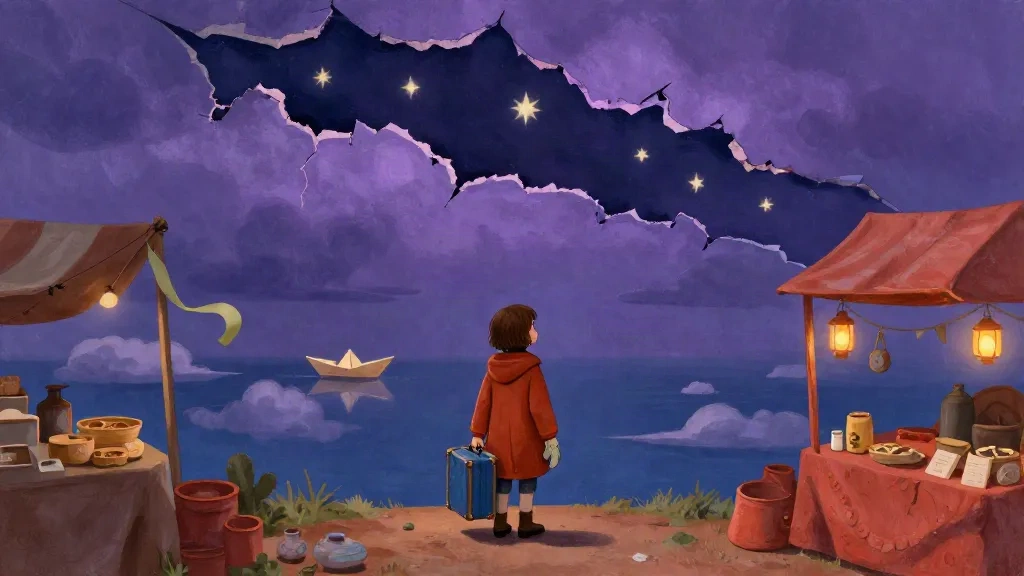
The floating market drifted above the cloud sea, tethered to nothing but old balloons and the warm updrafts of a vanished city. Stalls leaned against one another in crooked rows, their tables crowded with memories that had lost their owners: a silver laugh tied with red string, a childhood staircase folded flat, a rainstorm preserved inside a glass marble.
Nera moved between them with a blue suitcase bumping against her knees. Inside were the library's index cards, three pencils sharpened with a knife, and the small brass catalogue of things that must never be sold. She was eleven, though everyone at the market remembered her as thirty-four, and no one could agree on which version had owned which scar.
Her fingers closed around a wool glove lying beside a bowl of blue salt. One thumb, the right one, had been darned with terracotta thread. Beneath the stall, a paper boat rocked in a jar of rainwater.
“Not for sale,” Nera told the glove.
It opened its wool fingers. “I belong to someone who has forgotten me.”
Nera did not answer. She had learned that lost memories became dangerous when they started asking for their old lives back.
A Deadline Before Death
The errand had arrived three days earlier, folded inside a note written by a woman named Ilyra. Ilyra was alive in the city below, though her hair had gone white and her hands shook whenever she tried to hold a cup. She had not died. That was the trouble.
She had given Nera a brass key, a scrap of sky, and a deadline: return the stolen constellation before sunset on the fourth day.
“Before I forget you,” Ilyra had said. “Before I forget why I asked.”
Now the wool glove whispered through the salt. “She gave me to you as a promise.”
“She gave you to the market.”
“The market gave me back.”
Nera lifted the glove. Inside it, a small star appeared and vanished with each pulse of the cloud market's lanterns.
The constellation had been taken from the sky above the old observatory. Seven stars, one crooked line, a dim blue point that looked like an eye. Ilyra had not stolen it for herself. She had taken it to hide the night when the sky first opened and something answered from beyond it.
For thirty years she had carried that darkness. On the fourth night, she would forget the theft, the hiding, and the daughter she had promised to meet beneath the stars.
The Price of a Sky
At the market's center stood the Returning Office, a round boat of red clay crowded with officials. They agreed to restore the constellation only if Nera could prove its owner. The glove was no proof. The paper boat was no proof. Ilyra's note was no proof, because living people could revise their histories.
“Then what is?” Nera asked.
The clerk pointed beneath the desk. A hole opened in the floor, showing the black gulf below.
“A memory of the sky,” he said. “Trade it.”
Nera opened her suitcase. Every card inside trembled. Her first sunrise. Her mother's hands braiding grass. The sound of rain on the library roof. Without them, she would still know the facts, but the world would lose the shape that made those facts bearable.
She chose the first sunrise.
It left her as a small gold warmth behind her eyes. The clerk counted it into the scale. Still not enough.
Nera chose her mother's hands. The market dimmed. She could no longer remember whether the fingers had been calloused or gentle.
Again the scale tipped, but only halfway. The constellation was vast. Returning it would require the memory of the whole sky.
“You have none,” the clerk said.
Nera looked at the paper boat in its jar. A paper boat did not carry water. It carried the shape of a voyage someone had imagined.
She opened the jar.
The Shape Between the Stars
The boat grew. Its paper sides lifted into a white sail, and inside it lay the sky she had never seen: Ilyra as a young woman beneath the observatory, laughing with Nera's mother, both of them pointing upward while the stars rearranged themselves into a map.
Nera stepped into the boat.
“That memory belongs to someone else,” she said.
“It belongs to everyone who loved her,” the boat replied.
She pushed off. The cloud market became a handful of lanterns below. The glove clung to her wrist, and the paper sail carried her through the bruise-colored darkness.
She found the missing place in the sky where seven stars had been torn away. The edges of the wound glowed. Beyond them, the answer waited with a patience older than the market.
Nera raised the glove. Its wool palm opened like a small sky.
“Return what was borrowed,” she whispered.
She released the star, then the crooked line, then the blue eye. Each one crossed the paper sail and settled into its proper darkness. The sky closed around them, and the remembered voyage disappeared from beneath her feet.
The paper boat collapsed into a wet sheet. The glove went still.
By dawn, Nera was back at the market. The Returning Office had vanished. In its place stood a patch of clear sky reflected in a puddle, showing seven bright points and one that blinked.
She never learned whether Ilyra remembered their promise. But every fourth winter, the old woman climbed to the observatory roof and pointed at the constellation, while a wool glove lay beside the telescope and a paper boat dried in the sun.
Some things return not because someone remembers them, Nera thought, but because someone refuses to let them go.





