 Netwrck
Fantasy.
The Library in Blue
At the Monastery of patient mechanisms, Ora carried every book that could not afford to remain still. Her library lived inside a blue suitcase: atlases bound in calfskin, almanacs for abandoned provinces, and a weather ledger whose final page was always damp.
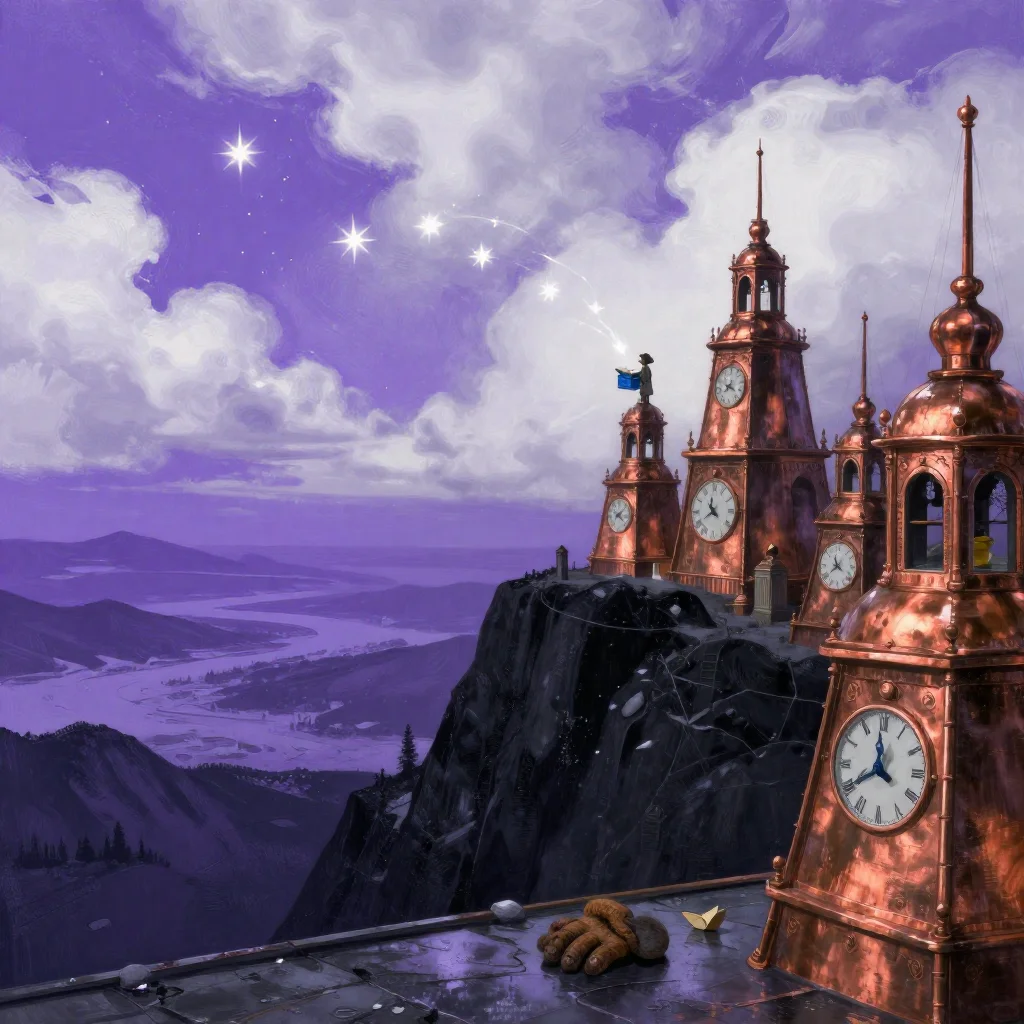
She was eleven, though the monks measured children by their errands. On the lowest stair of the western tower, she found Father Vale holding a copper case lined with cloud-white felt. Seven pieces of night lay inside it, each shaped like a bright splinter.
“The Heron’s Wing,” he said. “Taken from the eastern sky three hundred years ago. It must return before first snow.”
Ora touched the case. “Then why is the deadline written in your hand?”
Vale turned the paper over. Beneath his name, smaller letters said: If I fail, Sister Meren inherits the hour.
Meren was alive. She repaired the monastery’s only seaward clock, though no sailor trusted it. Ora had seen her silver braid crossing the violet dusk toward the coast, carrying a paper boat filled with salt.
Vale said nothing about leaving. He only pressed the case into the blue suitcase and placed a single wool glove on top.
“For the mountain,” he said. “You will understand when it is cold.”
The Country Without Morning
Beyond the monastery walls, the country had forgotten how to keep time. Clocks leaned from shop windows at contradictory angles. Bread rose when the baker felt tired. Dawn could hover above one valley for an hour while night gathered in the next.
Ora followed milestones recorded not by distance but by shadows. The Hare’s Stone cast its shadow east in 1604 and west in 1911. A toll bridge rang whenever someone lied about where they had been.
At noon—or what the tower called noon—the wool glove became damp. Ore had been written inside its cuff in pale violet ink.
Only Ore.
Ora hurried toward the mountain observatory. The glove had been Meren’s.
At the bridge, the toll rope struck the rail three times. A courier blocked the narrow path.
“No passage for borrowed stars,” he said.
Ora showed him Vale’s written deadline. He read it twice.
“The Sister inherited an hour?”
“She inherited a promise,” Ora said.
“That is heavier.” He untied the red cord from the bridge rail. “Cross before the first toll. I cannot lend you the road.”
Ora ran. The bridge rang behind her with every step, recording lies she had not told.
Meren’s Missing Noon
Meren was waiting at the mountain gate, unconscious in a chair beneath the observatory wall. An empty paper boat rested in her lap. Her copper pocket clock ticked backward.
Ora found three notes in blue ink.
The first said: The sky was not stolen for money.
The second: Vale owes the sky three centuries of morning.
The third ended: Bring the paper boat. Do not open the case.
Above them, the clouds had thickened until they looked like uncut wool. The violet dusk pressed against the western peaks.
Vale was the keeper of clocks, not merely their repairer. Three hundred years earlier, facing an endless drought, he had pulled the Heron’s Wing from the sky and folded it into time. The monastery ran on stolen brightness. Every accurate mechanism had consumed a little of it.
Ora understood then why the deadline could not be inherited by the dead. Only Meren remained inside the missing hour: the noon when Vale struck a bargain with a stranger and threw that stranger’s name into the sea.
To restore the sky, the borrowed hour had to be returned to Meren.
Ora unfolded the paper boat. Salt grains shone along its creases. She placed it on the observatory’s flooded floor, aimed its bow downhill, and released it into the shallow water.
The water carried the boat through an open doorway in the mountain. Beyond it stood the bare eastern sky.
First Snow
At dusk, snow began above the monastery and fell upward.
Meren coughed. Her clock stopped.
Ora opened the copper case. Cloud-white light swelled between her hands, cold enough to numb her fingers. She carried the fragments outside and cast them toward the waiting sky.
The Heron’s Wing reassembled itself in a single bright motion. Its seven stars swept past violet clouds, leaving a long, delicate wake.
Vale came into view below, older by three hundred mornings. He looked up with wet eyes.
Meren held out her hand. Ora returned the damp wool glove.
When the first flake reached them, the monastery’s clocks began together, no more accurate than before. Some ran backward. Some stopped. The seaward clock rang once with a woman’s voice.
Ora closed the blue suitcase, leaving room among the books for a streak of new white.
That night, the borrowed stars held above the mountain, and for the first time in three centuries, dawn arrived where it was expected.





