 Netwrck
Folk Horror.
Four Minutes to the Past
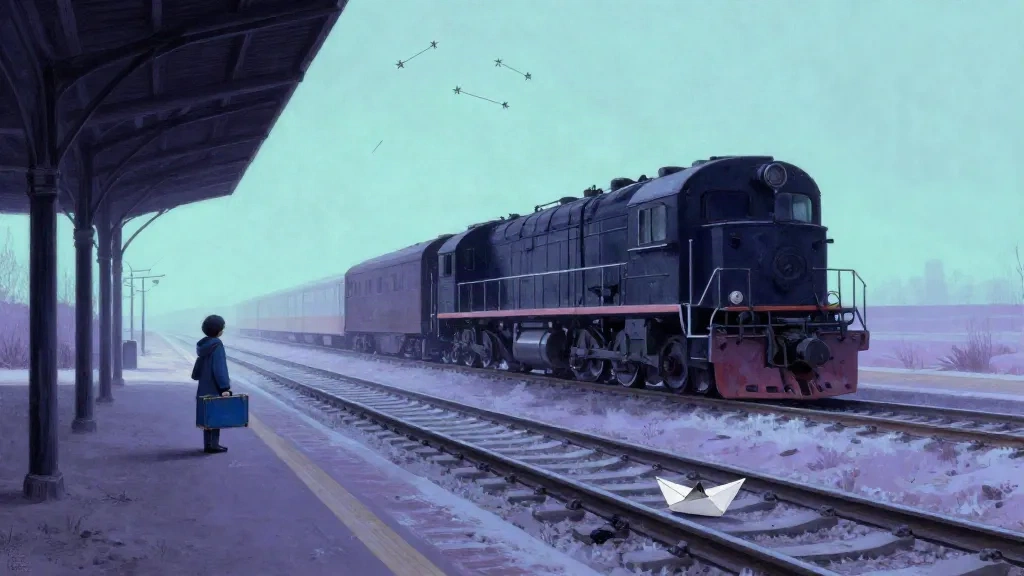
Mina kept the station library in a blue suitcase: catalogue cards salted against rain, a brass date stamp, nine ledgers bound in red cloth, and the railway’s one telescope. Each night at Calder Silt, she rolled the telescope toward the eastern track. The desert lay beneath a hard frost. Iron rails shone beyond the dunes, though no train had laid them.
At 4:17, something arrived from 1897.
The locomotive had no smoke. Its windows carried frost, and its wheels turned silently over ground still bright with impossible dawn, a soft cyan bloom beneath a violet sky. One passenger stepped down carrying a child’s wool glove, though the air was too warm for wool.
“You are the new archivist,” he said.
Mina closed the suitcase. “There is no new archivist.”
He placed the glove in her hand. A paper boat was stitched inside its palm.
The Debt Still Breathing
The passenger gave her a train order dated tomorrow.
BRING HOME THE SEVEN.
Below, in a different hand: Before Orren Vale’s heart stops, or he will forget where the sky was taken.
Mina knew the name. Orren Vale maintained the station’s forbidden register. Every morning, he watered an iron kettle and spoke to the shadows under the platform canopy. Every morning, he was still alive. That morning he sat beyond the waiting room with one hand pressed to his chest, refusing to see the doctor.
“The deadline is his?” Mina asked.
“It became yours when he gave you the glove.”
She searched the library indexes. Seven stars had been removed from the sky in 1897 and entered into railway custody. Official maps called them the Silt Dipper. Miners used their positions to find water beneath the desert. If the stars returned, the wells would lose their stars.
But without them, the sky had begun sliding westward.
Orren opened his eyes. Across the room, his shadow continued speaking.
Blue Suitcase, Paper Boat
The seven stars were not on the platform. They were traveling through it.
Each train window showed one piece of the missing sky, passing through the station as midnight passed through a desert noon. Mina’s telescope showed the fragments only in reflections: in the polished dome of Orren’s watch, in pooled rainwater, in the wet eyes of the pale passenger.
The wool glove was the key. Its fingers pointed toward the stations still reflected on the departing train. The paper boat inside it was a timetable written in miniature.
Mina put the glove on. The blue suitcase became heavier than its library deserved.
“You cannot carry the sky,” the passenger said. “It is not yours.”
She tightened the handle. “It belongs where it was made visible.”
He vanished into the cyan dawn. The paper boat began to melt, its folds loosening one by one.
Mina opened the ledger marked Lost Property: Sky, Local. On every blank page, the stars appeared as seven small burns, moving south.
The Living Man’s Hour
Orren’s watch stopped at 5:02. The doctor said he was asleep. His shadow stood behind him, black against the frost-white wall, pointing down.
Under the station, Mina found the missing sky folded inside a tunnel of iron sleepers. The stars hung in little glass cages above the tracks. When the century train rushed through, the stars flickered with the blue light of its impossible dawn.
To release them, she had to send them forward before Orren’s heart stopped. He was alive, therefore the future still had room for him. Once he died, the lost stars would arrive with him and the sky would close over its own vacancy forever.
Mina placed the paper boat on the rails. It caught the last drop of rainwater and became larger than the tunnel. She opened the blue suitcase, releasing the catalogue cards into the wind. Each card found one star.
The glove’s fingers closed around hers. Warm, for the first time.
At 5:03, Orren breathed. At 5:04, the seven lights tore free and rose through the iron ceiling. The desert blazed frost-white, then softened to cyan.
On the platform lay one child’s glove, empty.
Mina took her library and boarded the train. Its conductor bowed as if returning a borrowed book.
Never trust a deadline, she wrote in the new ledger.
Trust the sky to know its own address.
Ahead of her, the stations grew dark one by one. Somewhere behind her, Orren remembered the taste of rain.





