 Netwrck
Fantasy.
The Last Empty Frame
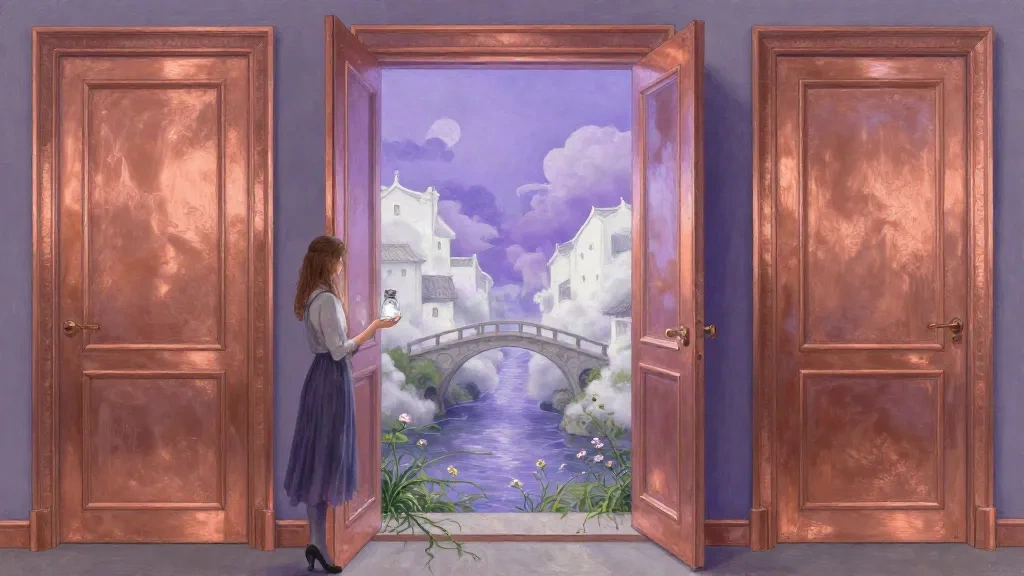
At dusk, when violet light settled across the Museum of Doors, Mara Venn found an empty frame in the eastern gallery.
Its hinges were oxidized copper, green at the edges. Beside it rested a placard: DOOR NOT YET MADE. She touched the salt jar at her belt and heard the glass seed inside it click against the ceramic.
Mara was a seamstress of distances. She could mend what had come apart between two people: the silence after a quarrel, the years between siblings, the long wound left by a village and its exiled son. Her work began with a spoken truth and ended with a needle drawn through invisible cloth.
She had come to make a door that opened only when both sides consented. Not because love demanded it, though she had loved once and lost the thread. Not because the museum lacked doors, though every wall was crowded with them. She wanted a passage that refused to become a command.
Across the gallery, a door opened onto courage measured by fire. A young courier walked through a blue flame without looking back. Another opened onto courage measured by water. An old woman stepped into a silver flood and vanished beyond sight.
Every threshold, Mara saw, asked for a person to be brave. The one she wanted would ask for something harder: surrender.
The Agreement Beneath the Floor
Near midnight, the curator found her beside the empty frame.
“It cannot accept a drawn design,” he said. “It is waiting for a promise.”
Mara laid her palm against the frame. The wood was warm. Somewhere behind it, many people spoke at once, their voices layered like cloth folded too many times.
A young man from the village of Bellweather entered carrying a sealed case. He brought news that the village and the dead had renewed their old agreement: the living would inherit the river’s water, the dead would inherit the living’s memories. The pact was written in a language only the dead could read.
Now the river was dying, and the agreement demanded a new boundary. Whoever crossed it would belong to both worlds.
“The village wants you to mend the gap,” the young man said. “They say your needle can join the living and the departed.”
Mara felt the salt jar grow cold. The glass seed inside began to glow cloud-white.
She had repaired other people’s agreements, but never their inheritance. Consent required more than two voices. What did a village owe the dead? What could the dead give without giving up the right to refuse?
Two Hands on the Latch
The dead came at dawn.
They did not appear as bodies. Their voices rose through the floorboards, through the salt jar, through the narrow window where violet clouds gathered. One spoke of a field buried beneath the schoolhouse. Another remembered a child born behind the river bend.
Mara opened the empty frame.
On the other side stood Bellweather at night, every window glowing. The villagers waited on one bank. On the other, the dead waited with faces like moonlit water.
“Sew it shut,” the village elder called. “Then the river will remain ours.”
“Open it,” said the youngest dead voice. “Then none of us will be owned.”
The seed cracked inside the salt jar. A thin green sprout rose between Mara’s fingers, roots threaded with light. She understood then: the door would not judge who was right. It would reveal willingness.
She set the glass seed beneath the frame and drew her needle across the air.
“I consent to carry what is given freely,” she said.
The villagers spoke. Some consented. Some refused. The dead answered in the same way.
The thread tightened. Mara’s hands shook. The distance between worlds pulled at her ribs, demanding that she choose one side and make the other vanish.
She cut the thread.
Then she mended.
What Both Hands Chose
At sunset, the Museum of Doors had one new door.
It opened onto a small stone bridge above the Bellweather river. On one side, the living stood with empty hands. On the other, the dead stood among white flowers. Neither bank owned the bridge. The river moved beneath it, carrying seeds and leaves in clear, unequal currents.
Those who wished to cross could cross. Those who did not could turn away without shame. Every journey changed both shores, and every return required a fresh answer.
Mara hung the salt jar beside the new frame. The glass seed had become a tree, thin as a needle, its leaves flashing violet under cloud-white light.
She never claimed to have built a door for love. She had built one for consent: the courage to admit that even a passage between enemies could belong to no single hand.
Whenever the door opened, Mara heard the soft pull of thread.
It was the sound of two sides learning to meet without becoming one.





